

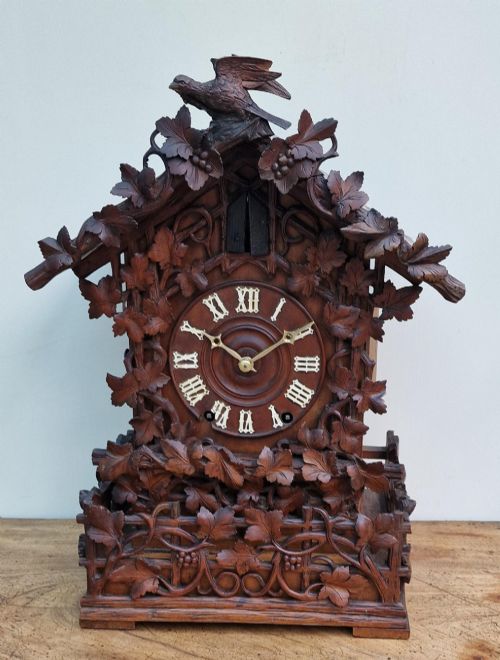

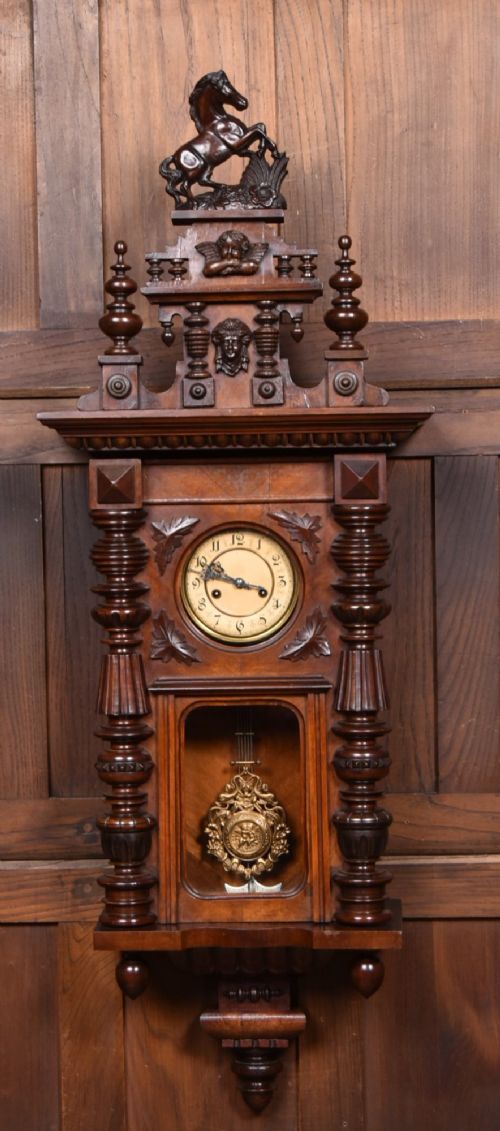


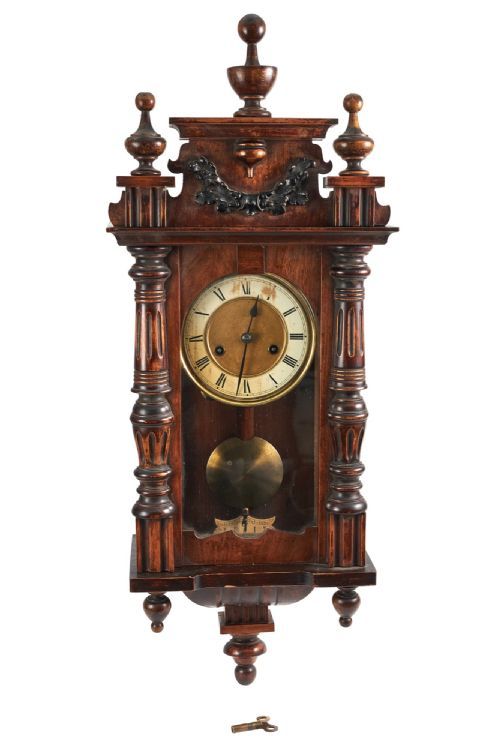
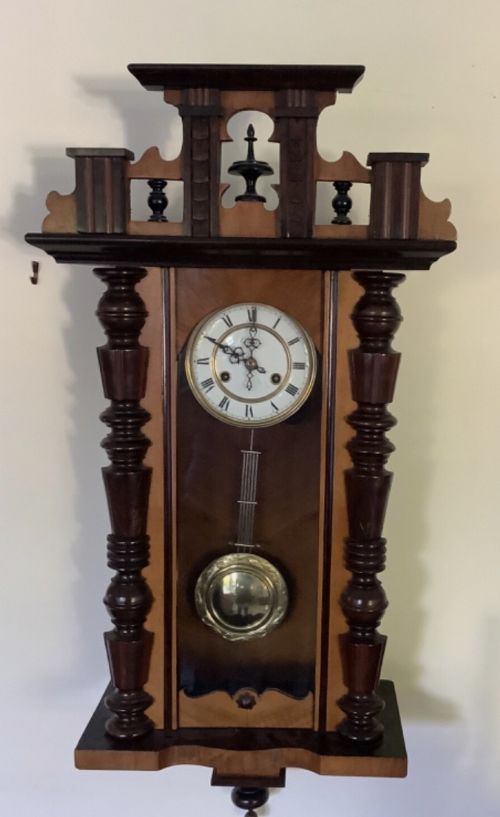


Victorian Spring Driven Clock
A victorian spring driven clock brings mechanical precision and rich timber cases into a room, offering both reliable timekeeping and period presence.

Victorian Spring Driven Clock
A victorian spring driven clock encompasses timepieces powered by coiled mainsprings rather than hanging weights, allowing them to sit on mantelpieces, brackets, and walls without needing a heavy drop. These domestic clocks emerge from the nineteenth century in various regional and continental forms, spanning small library timepieces to large boardroom examples.
The most common formats on this page include mahogany, walnut, and oak bracket clocks alongside wall-mounted Vienna regulators and brass-cased carriage clocks. Makers range from provincial English watchmakers to notable London firms and German workshops.
Buyers look for these pieces to anchor a room with traditional horology, selecting mantel clocks for surface placement or wall clocks to draw the eye upward. Each piece reflects the industrial capabilities and domestic tastes of the nineteenth century.
Materials and construction
Cases utilise dense hardwoods like mahogany, walnut, oak, and occasionally coromandel, selected for stability and polished to show rich grain patterns. Brass and gilt bronze feature in movement plates, bezels, and carriage clock frames, whilst glass protects delicate dials and pendulums.
Spring-driven movements rely on steel springs stored within brass barrels or fusee cones to equalise power delivery as the spring unwinds. Enamel, silvered metal, and brass dials display the hours, often paired with finely blued steel hands.
Victorian Spring Driven Clock Retail Price Guide 2026
Typical asking prices for victorian spring driven clock among the pieces listed under this phrase on Sellingantiques today, from the lower quarter to the upper quarter. They describe what is for sale here now, not the wider market.
The listings show clocks spanning from eighteen-fifty to nineteen-hundred, combining mahogany and walnut timber cases with brass movements.
Assessing quality and finish
Quality reveals itself in the crispness of the movement engraving, the weight and thickness of the brass plates, and the complexity of the train, such as triple fusee or quarter-striking configurations. Finer makers invested heavily in hand-finished components and robust anchor escapements.
Cabinetwork distinguishes standard production from superior workshops through well-selected timber veneers, carved architectural details, and well-fitted glazed doors. The integration of signed dials and movement backs adds provenance and confirms the original maker's hand.
George Wadham Bath·Mappin and Webb·Bryson Edinburgh·Piggin Norwich·Phillips Brothers·Geo Carter Hackney·Wilkinson Leicester·J Kingerley Manchester·Johann Baptist Beha·Dwerrihouse and Bell·Winterhalder and Hofmeier·Funnell of Brighton·Osborn of Bognor Regis·Christie of Perth·Payne and Co London·Purvis of London·Gustof Becker
The Victorian Spring Driven Clock Glossary
- Fusee
- A conical pulley used in spring-driven clocks to equalise the torque of the mainspring as it winds down. This mechanism ensures more consistent timekeeping throughout the duration of the wind.
- Bracket clock
- A portable table or mantel clock traditionally designed to sit on a wooden wall bracket. Many feature elaborate architectural wooden cases and carrying handles.
- Carriage clock
- A small, spring-driven timekeeper housed in a brass case with glass panels, originally designed for travel by officers and gentry. They usually feature a folding handle on top.
- Vienna regulator
- A precision wall clock developed in Austria, driven by weights or springs and characterised by a long glass-fronted door and a delicate pendulum. They became popular in British homes during the later nineteenth century.
- Escapement
- The mechanical linkage that controls the release of the clock's gear train, giving the characteristic tick. Common types include the anchor and lever escapements.
Victorian Spring Driven Clock: Frequently Asked Questions
How do I wind a spring driven clock?
Use the appropriate winding key on the arbors located on the dial face, turning gently until you feel resistance. Avoid over-winding to protect the internal mainsprings.
Ensure you wind both the time and strike trains if the movement has multiple keyholes, maintaining a regular schedule for best timekeeping results.
Where should I place a bracket clock?
Place your clock on a stable, level surface such as a heavy mantelpiece, sideboard, or dedicated wall bracket away from direct sunlight and drafts. A level foundation is vital for the pendulum to beat evenly.
Avoid exterior walls that experience significant temperature fluctuations, as wood and metal components respond to environmental changes.
How do I tell a fusee clock from a standard spring clock?
Look inside the back door or through the side panels to see if the mainspring barrel is connected to a conical pulley via a chain or cord. This fusee cone is characteristic of higher-grade English timepieces.
Standard spring clocks house the mainspring directly within a cylindrical brass barrel without the conical fusee assembly.
How do I identify a Victorian carriage clock?
Examine the exterior for a heavy gilt brass frame inset with beveled glass panels and a swing handle mounted on top. These travel clocks often feature white enamel dials with Roman numerals.
Lifting the top or back panel reveals a small platform escapement regulating the movement, typical of nineteenth-century French and English manufacture.