

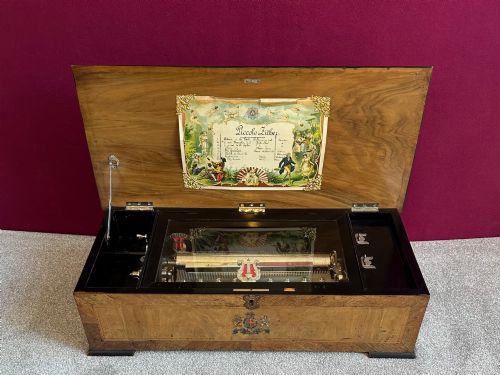


Victorian Cylinder Musical Box
These robust victorian cylinder musical box examples bring mechanical melody and handsome rosewood or walnut cases straight into the modern drawing room.
Victorian Cylinder Musical Box
A victorian cylinder musical box is a complex mechanical instrument designed to play pre-set tunes using a revolving pinned brass cylinder acting against a tuned steel comb. The pieces on this page span the Victorian era, with particular density around the eighteen seventies and eighties, alongside work attributed to Swiss makers.
The dominant forms are table cases constructed from rosewood, walnut, and ebonised wood, frequently decorated with marquetry inlay. Many incorporate additional mechanical accompaniment such as bells, drums, or zither attachments to enrich the sonic output.
Construction and Materials
The casework relies on dense timber foundations of rosewood and walnut, selected for both structural stability and acoustic resonance, often finished with intricate boxwood and marquetry inlay. Interiors combine heavy cast brass beds with finely tempered steel combs and pinned brass cylinders.
Makers pinned the brass cylinders by hand to dictate the exact timing and sequence of notes struck upon the steel teeth of the comb. Complex arrangements integrated auxiliary elements like visible bells, drums, or harp attachments directly into the chassis.
Victorian Cylinder Musical Box Retail Price Guide 2026
Typical asking prices for victorian cylinder musical box among the pieces listed under this phrase on Sellingantiques today, from the lower quarter to the upper quarter. They describe what is for sale here now, not the wider market.
Some cylinders were pinned to play popular opera tunes so Victorian guests could hum along without leaving the sofa.
Quality Variations
Quality rests heavily upon the precision of the pin placement on the brass cylinder and the uniformity of the steel comb teeth. Boxes featuring multiple airs, bells in view, or additional percussion mechanisms demand significantly greater mechanical skill and command attention.
The refinement of the cabinetwork sets the upper tier apart from standard production, particularly where marquetry inlay and choice rosewood veneers remain crisp and well-preserved. Sound quality serves as the ultimate arbiter, distinguishing clean, resonant mechanical performance from tired or uneven tones.
Langdorff And Fils·B A Bremond·Nicole Freres·LeCoultre
The Victorian Cylinder Musical Box Glossary
- Cylinder
- The rotating pinned metal barrel that triggers the notes on the comb. It contains the encoded instructions for each specific tune.
- Comb
- The tuned flat plate of steel with individual teeth that vibrate when plucked by the cylinder pins. Each tooth corresponds to a specific musical note.
- Air
- A distinct musical tune or melody played during one complete rotation or shift of the cylinder. Boxes are frequently categorized by the total number of airs they can perform.
- Zither
- An auxiliary attachment pressed against the comb to impart a buzzing, mandolin-like timbre to the music. It creates a distinctly lighter, plucked string effect.
Victorian Cylinder Musical Box: Frequently Asked Questions
How do I wind a cylinder musical box?
Winding requires steady engagement with the winding lever or key located on the side or top of the case. Care must be taken not to overwind the internal spring mechanism.
Allow the current tune to finish completely before altering levers or adjusting the governor settings to protect the delicate pins and comb.
Can I change the tunes on the cylinder?
The pinned cylinder is fixed with a specific set of programmed airs during its original manufacture. Changing tunes is not intended as a user operation.
Instead, the mechanism shifts the cylinder laterally across the comb automatically to play subsequent tracks stored along its length.
Where should I place a musical box in the room?
Position the box on a stable, level wooden surface away from direct sunlight and fluctuating heat sources like radiators. Solid furniture enhances the natural acoustic projection of the case.
Keep the instrument out of damp environments to protect the steel components and iron springs from rust.
What maintenance do these mechanical boxes need?
Routine care involves keeping the case clean with a dry cloth and ensuring the movement remains free from dust accumulation. Professional servicing is recommended if the timing slips or notes fail to sound.
Avoid applying domestic oils or lubricants to the precision pins and comb teeth, as this attracts grit and dampens vibration.