


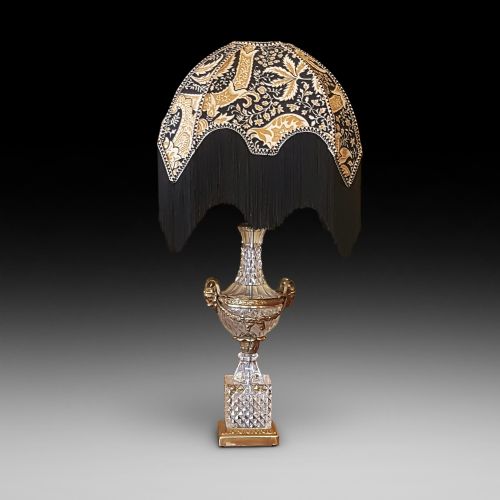

Victorian Cut Glass Urns
Victorian cut glass urns bring deep refraction and heavy substance to a room, offering the refined presence collectors seek.
Victorian Cut Glass Urns
Victorian cut glass urns encompass lidded jars, covered sweetmeat vessels, and decorative ovoid vases from the nineteenth century. These pieces emerge across the Victorian and Edwardian periods, frequently demonstrating Classical Revival or Bohemian influences.
The objects listed on this page run from substantial lidded jars dated around eighteen sixty to cobalt blue and ruby glass vases from the eighteen eighties. Buyers frequently encounter storage jars, spirit dispensers, and covered candy bowls alongside traditional urn forms.
Originating in Britain and Bohemia, these vessels combine heavy crystalline bodies with architectural forms. They serve equally as centrepieces and functional lidded containers on sideboards and tables.
Materials and construction methods
Makers utilised lead crystal, cobalt glass, and ruby glass, frequently employing cased or overlay techniques where a coloured glass layer is cut away to reveal clear crystal beneath. This process demands precise wheel cutting to expose the contrasting strata.
Many vessels incorporate gilt decorative enamel, brass mounts, Dutch silver, or Hukin and Heath silver elements to secure rims and bases. Etched motifs often complement the deep geometric wheel cuts across the body.
The documented objects span the nineteenth century, including specific dates from eighteen sixty and eighteen eighty alongside Edwardian examples.
Judging the quality of cut glass
Quality rests in the crispness of the wheel cutting and the depth of the facets, which determine how sharply the glass refracts light. Superior examples display clean, uniform edges along every diamond and flute without softening or distortion.
The weight of the lead crystal and the integration of metal mounts dictate the overall substance of the piece. Fine pairing, balanced proportions, and intact overlay layers separate standard decorative items from superior specimens.
Hukin and Heath
The Victorian Cut Glass Urns Glossary
- Lead crystal
- Heavy, high-clarity glass containing lead oxide that increases brilliance and makes deep wheel cutting possible. This material defines the substantial weight characteristic of nineteenth-century pieces.
- Cut to clear
- A technique where a layer of coloured glass is overlaid on clear crystal and partially ground away to create contrasting patterns. The method produces striking visual depth.
- Sweetmeat jar
- A covered vessel originally designed to hold confectionery, sweetmeats, or dry preserves. These lidded jars often share the monumental proportions of formal urns.
- Ovoid
- An egg-shaped vessel form commonly utilised in nineteenth-century Bohemian vases and covered jars. This contour provides an ideal canvas for large-scale facet cutting.
Victorian Cut Glass Urns: Frequently Asked Questions
What were Victorian cut glass urns used for?
These vessels served primarily as decorative ornaments on mantelpieces and sideboards, while lidded versions often functioned as sweetmeat jars or storage containers for preserves.
Larger examples acted as focal points in formal reception rooms, reflecting candlelight through their heavily faceted surfaces.
How do I distinguish Bohemian pieces from British ones?
Bohemian pieces frequently employ vibrant colours such as cobalt blue and ruby glass, often featuring overlaid surfaces and elaborate etching.
British production during the period typically focuses on heavy, colourless lead crystal with deep geometric facet cutting.
How should I clean and care for cut glass?
Wash the glass by hand in warm water using mild soap, avoiding sudden temperature changes that can crack heavy lead crystal.
Dry the vessel immediately with a lint-free cloth to maintain the brilliance of the faceted cuts and metal mounts.
How do I identify a Victorian piece?
Examine the weight, the sharpness of the facet edges, and the presence of nineteenth-century design characteristics such as Classical Revival proportions.
Many examples also incorporate period silver mounts or hallmarks corresponding to the Victorian era.