


Victorian Crystal Mantle Lustres
These Victorian crystal mantle lustres catch every flicker of firelight with suspended prismatic glass drops.
Victorian Crystal Mantle Lustres
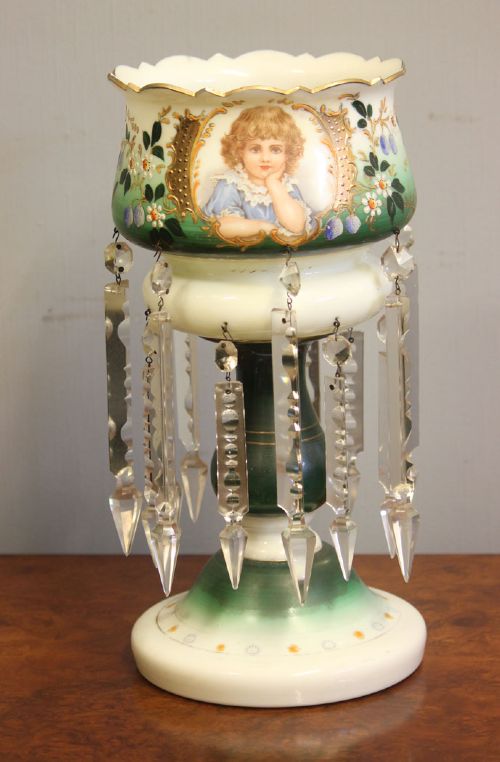
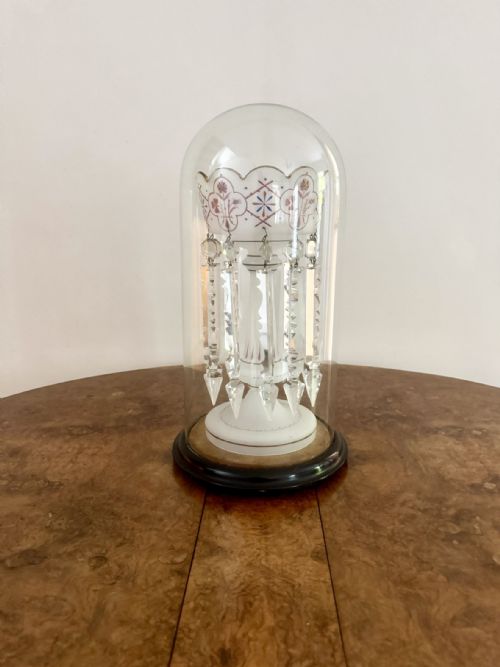
Victorian crystal mantle lustres are decorative candelabras designed to sit upon a fireplace mantelpiece, combining a central candle holder with hanging glass prisms. When you search for victorian crystal mantle lustres, you encounter tall, upright glass or crystal stems hung with faceted droplets that refract light around the room.
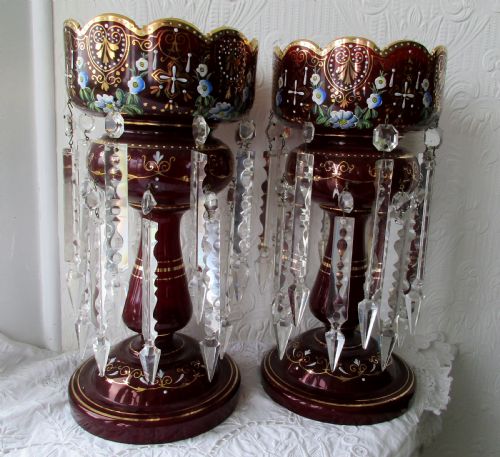
The versions most commonly met on this page include pairs of ruby glass, cranberry glass, and clear cut-glass vessels dating from the nineteenth century. These items function simultaneously as lighting and as ornamental centrepieces for a formal interior.
How they were made
Makers shaped the bodies using free-blowing, mould-blowing, or flash glass techniques, frequently applying layered coloured glass over a clear core. Cut-glass variants received deep geometric facets ground by hand on a stone wheel to maximise light refraction.
Hanging drops, often called lustres or prisms, were individually formed, drilled, and faceted before being attached to the rim with wire loops or metal pins. Gilt decoration and enamel painting were applied to the glass surface and fired in a kiln for permanence.
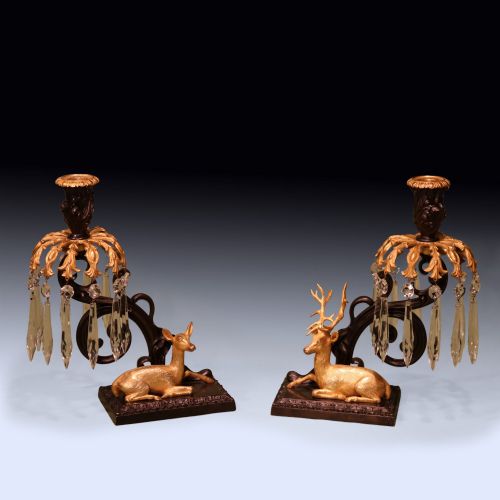
Listings feature items from the Victorian period alongside nineteenth-century pieces and earlier Regency examples in glass, crystal, and brass.
What varies in quality
Quality depends heavily on the depth of the glass cutting and the clarity of the crystal material. Superior pieces display sharp, crisp facets and heavy lead crystal composition that rings clearly when struck.
The completeness and match of the hanging glass drops strongly influence the standard of a pair. Finer specimens retain their original prisms, while painted enamel and gold leaf details show careful brushwork rather than stencilled uniformity.
The Victorian Crystal Mantle Lustres Glossary
- Lustre
- A type of candle holder decorated with pendant glass prisms designed to refract light. They sat upon mantels and sideboards in nineteenth-century drawing rooms.
- Ruby glass
- A deep red glass coloured with gold chloride during production. It creates a rich, translucent tone popular in Victorian decorative objects.
- Flash glass
- Glass made by casing a thin layer of coloured glass over a thick body of clear glass. Craftsmen then cut through the coloured layer to reveal the clear glass underneath.
- Ormolu
- Gilt bronze ornamentation applied to furniture and decorative objects. It provides a metallic contrast to the glass and crystal bodies.
Victorian Crystal Mantle Lustres: Frequently Asked Questions
How do I clean a lustre?
Wash the glass body and individual drops in warm, soapy water using a soft cloth. Remove the hanging prisms first to prevent chipping.
Dry each piece thoroughly with a lint-free towel before reattaching the drops with care.
Are all lustres made in pairs?
Many survive as matching pairs intended to flank a clock or mirror on a mantelpiece. Single examples do appear from time to time.
Collectors generally prefer pairs for symmetry, though individual pieces remain decorative.
What is flash glass?
Flash glass consists of a clear glass base coated with a very thin outer layer of coloured glass. This technique allowed makers to achieve intense colour while keeping the material workable.
Cut-away patterns expose the clear glass beneath the coloured skin.
Did they burn candles in them?
They were designed to hold candles, though the flickering flame also activated the prism drops. This created a glittering display when the room was lit at dusk.
Many survive with wax residue inside the socket from nineteenth-century use.