
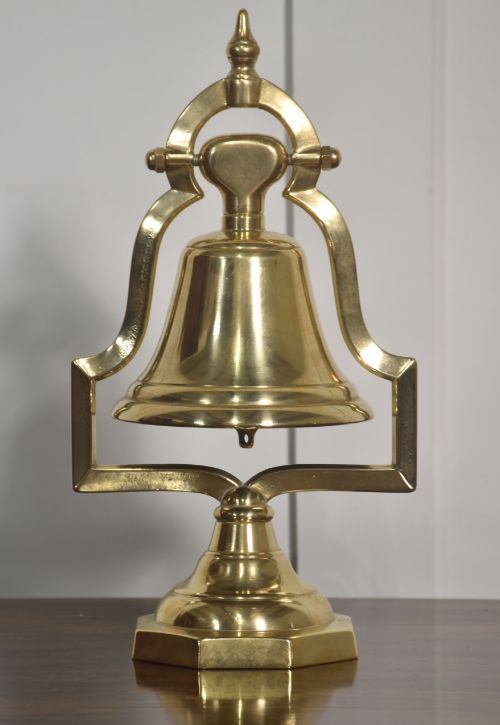


Victorian Counter Bell
These Victorian counter bell examples are robust service tools designed for desks and shops, offering crisp tone and period presence.
Victorian Counter Bell
A Victorian counter bell is a functional mechanism intended for shops, hotels, and country houses to summon attention. You will frequently encounter heavy brass desk and counter bells dating from the nineteenth century, alongside related table bells and hand bells.
The selections span from late Victorian brass models to silver-plated and bronze variations. These pieces often take simple domed forms or ornate figural shapes meant for display on a reception desk.
Materials and construction
Makers utilised cast brass, bronze, and iron to form the resonant domes and sturdy bases of these desk accessories. Polished finishes highlight the metalwork, while wooden elements such as oak or ebonised wood provide stable mounting platforms.
Silver plating was applied to select reception bells for a brighter appearance, matching the standards of formal country houses and high-end establishments.
Assessing quality and build
Quality rests in the weight of the metal casting and the clarity of the resulting ring. A heavier brass or bronze dome yields a cleaner, more resonant tone than lighter alternatives.
Fine examples demonstrate precise mechanical action within the plunger or strike mechanism, paired with well-finished wooden bases or detailed figural mounts.
William Comyns
The Victorian Counter Bell Glossary
- Counter bell
- A bell designed to sit on a shop or hotel counter, struck to summon assistance. These items were essential fixtures in Victorian commerce.
- Bronze
- An alloy of copper and tin utilised for durability and deep tonal resonance. It appears alongside brass in nineteenth-century examples.
- Silver plate
- A thin layer of silver applied over a base metal such as brass or copper. This finish offered the look of solid silver at a lower cost.
- Ebonised wood
- Timber treated to resemble ebony, providing a dark, polished contrast to bright metal domes.
- Figural bell
- A bell incorporating a sculpted human, animal, or cherub figure into the design. Such pieces served decorative functions on domestic desks.
Victorian Counter Bell: Frequently Asked Questions
What is a Victorian counter bell?
A Victorian counter bell is a mechanical signaling device placed on reception desks or shop counters during the nineteenth century. Customers or staff struck the top to alert attendants.
These pieces combine functional metal domes with weighted bases of brass, bronze, or wood to remain stable during daily use.
How do I date a counter bell?
Dating relies on material choices, casting methods, and style indicators found in nineteenth-century domestic and commercial hardware. Pieces marked from the 1880s and 1890s often show specific brass finishes and Victorian proportion.
Archival examples and accompanying hallmarks or registration marks help narrow the production era further.
Where were these bells used?
They served primarily in British shops, hotels, railway stations, and large country houses where staff needed summoning. A receptionist or shopkeeper relied on the clear ring to bridge rooms.
Their presence ranged from utilitarian commercial counters to ornate domestic desk spaces.
How do I maintain brass bells?
Brass components benefit from gentle dusting and occasional cleaning with appropriate metal care products to preserve the polished finish. Avoid harsh abrasives that remove historical patina.
Wooden bases require standard furniture wax to keep the timber conditioned over time.