



Victorian Coromandel Desk
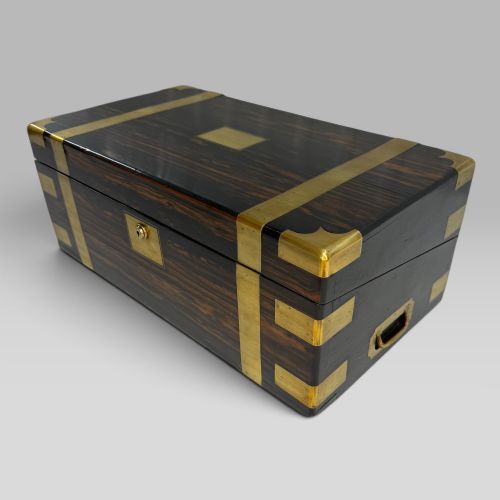
A victorian coromandel desk or writing box brings dense, exotic grain and gleaming brass mountings straight to the study.
Victorian Coromandel Desk
A victorian coromandel desk encompasses writing slopes, stationery boxes, and inkstands fashioned from rich timber during the nineteenth century. These items served domestic and campaign purposes, organising correspondence with secret drawers and fitted compartments.
The most common formats on this page are writing boxes and stationery caskets, often enhanced by gothic revival influences or brass banding. Pieces range from modest mid-century inkstands to elaborate cabinets dated to the eighteen-eighties.
How they were made
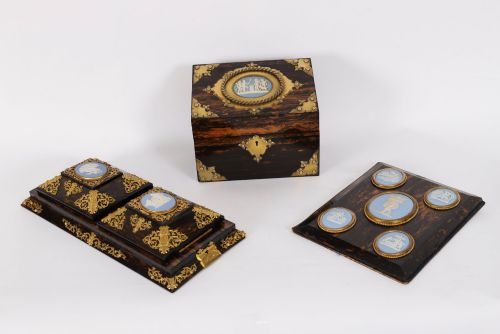
Craftsmen utilised heavy coromandel wood as a dense foundation, frequently pairing the dark timber with contrasting brass mounts and hinges. Inlaid mother-of-pearl and ormolu details add decorative punctuation to the hard wooden surfaces.
Interiors often feature fitted satinwood compartments, secret drawers, and glass inkwells securely housed within the sloping or box-like structures. Precision joinery allows folding writing slopes to open smoothly into baize-lined writing surfaces.
Victorian Coromandel Desk Retail Price Guide 2026
Typical asking prices for victorian coromandel desk among the pieces listed under this phrase on Sellingantiques today, from the lower quarter to the upper quarter. They describe what is for sale here now, not the wider market.
Listings feature items spanning the nineteenth century, utilising coromandel wood, brass, and mother-of-pearl across writing slopes and stationery boxes.
What varies in quality
Quality rests in the density of the grain and the complexity of the interior fittings, distinguishing standard campaign boxes from elaborate cabinets. Maker attribution elevates a piece significantly, particularly when bearing signatures from prominent London firms.
The precision of the brass inlay and the survival of original components like glass inkwells and working locks determine the standing of an individual item. Finer examples display meticulous pietra dura or intricate mother-of-pearl work set flush into the timber.
Briggs 27 Piccadilly London·Rupert Favell·Houghton and Gunn·Mechi and Bazin·Lund of London·C.G. Hope Hastings·Wright and Mansfield
The Victorian Coromandel Desk Glossary
- Coromandel wood
- A dense, heavily figured southeast asian timber characterised by dark brown stripes over a lighter background. It provides the primary structural and decorative material for nineteenth-century luxury boxes.
- Writing slope
- A portable box with a hinged, slanted lid designed to hold paper and provide an angled surface for writing. Interiors typically conceal secret drawers and pen trays.
- Stationery box
- A desk accessory built to store envelopes, writing paper, and letters in upright compartments. Many feature dome tops or drop fronts.
- Ormolu
- Gilded bronze mountings applied to furniture and desk accessories for decorative effect. It adds metallic contrast to the dark timber.
- Pietra dura
- An artistic technique using cut and fitted polished coloured stones to create mosaic designs. On these desks, it appears as inlaid panels.
Victorian Coromandel Desk: Frequently Asked Questions
What is a coromandel writing slope?
A portable desk built from dense, striped coromandel timber that folds open to reveal a baize-lined writing surface.
Inside, the compartments organise inkwells, pens, and paper, often concealing secret drawers beneath removable panels.
How do I date a coromandel desk?
Dating relies on stylistic clues such as gothic revival brass mounts, maker signatures, and construction techniques typical of the nineteenth century.
Cabinet makers often stamped their premises or names inside the box, helping narrow the decade of production.
Were these desks used for travel?
Many writing boxes and slopes were designed for campaign use by travellers who needed a portable desk.
Brass binding and reinforced corners protected the dense timber during journeys across the empire.