


Victorian Coastal Watercolour Picture
A victorian coastal watercolour picture brings the nineteenth-century shore onto paper through pigment and wash, offering direct access to maritime history.
Victorian Coastal Watercolour Picture
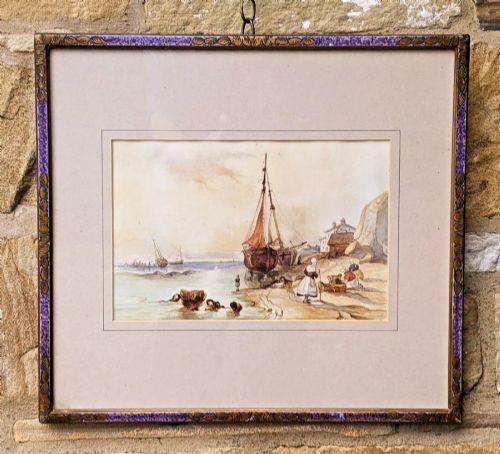
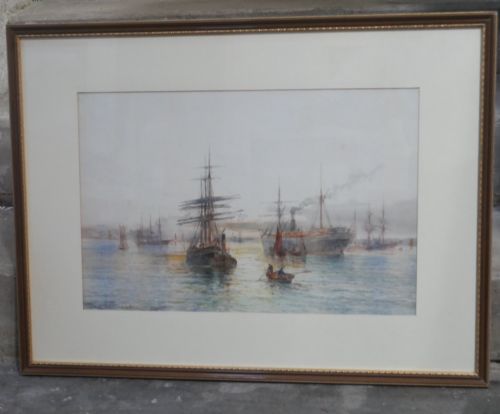
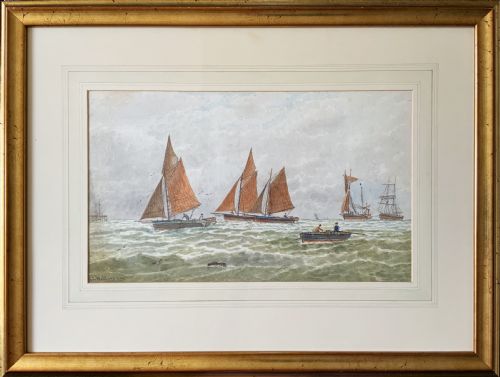
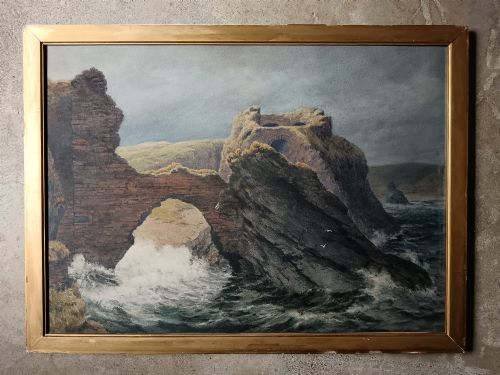
A victorian coastal watercolour picture captures harbours, fishing fleets, cliffs, and shipping lanes across British and European waters. These works typically date from the nineteenth century, ranging from intimate local sketches to detailed architectural and marine scenes.
Buyers encounter works signed by named artists as well as unsigned studies, depicting locations from Whitby and Scarborough to Dublin Bay and the Isle of Man. The subjects focus closely on maritime life, coastal architecture, and changing weather conditions along the shore.
Most pieces survive framed behind glass, preserving the delicate paper support and water-soluble pigments from atmospheric moisture. Common formats include single framed sheets and occasional pairs depicting complementary coastal views.
Materials and Technique
Painters applied watercolour pigment suspended in water onto heavy paper sheets, building up transparent washes to render sea, sky, and stone. Artists frequently used pencil or ink underdrawing to establish perspective before applying colour.
Many surviving examples sit within period wooden frames, often finished with gilt or carved details that complement the maritime subject matter. Glazing protects the paper surface, though older frames occasionally retain original wood mouldings and hand enamelled elements.
Listings feature works created across the nineteenth century and the early twentieth century, utilising paper, watercolour pigment, and gilded wood.
Quality Variations
Quality rests upon the artist's handling of light, atmosphere, and spatial depth, distinguishing accomplished marine painting from standard topographical record. Stronger works demonstrate confident brushwork in rendering choppy water, rigging, and coastal architecture.
The condition of the paper and the integrity of the pigment heavily influence a piece. Masterly control over transparent washes without excessive body colour marks the distinction between fine artistic execution and routine illustration.
George Stanfield Walters·John Moxon·William Frederick Settle·Alfred George Morgan·John Bedloe Goddard·Sir Thomas Newenham Dean·Arthur Tucker·John McDougal·Robert Buchan Nisbet·Frederick William Hattersley·James Thomas Watts·John Mitchell·Frederick William Booty·Kate E Booth·R.P.Noble·Frederick Williamson·Thomas Bush Hardy·Ralph Todd·Frank Wasley·Madeline Hughes·Peter Ghent·Frank Rousse·Edward Aubrey Hunt
The Victorian Coastal Watercolour Picture Glossary
- Watercolour
- A painting method where fine pigment is mixed with water-soluble binders and applied to paper. This medium allows for transparent washes that capture light and atmospheric effects.
- Gilt Wood
- Wood that has been coated with a thin layer of gold leaf or metallic gilt finish. Such frames are frequently found enclosing nineteenth-century works.
- Marine Art
- Artistic representation of ships, maritime scenes, and coastal environments. This genre encompasses both commercial shipping and dramatic coastal weather.
- Provenance
- The documented history of ownership or origin for an artwork. Records help confirm the attribution and date of nineteenth-century watercolours.
- Wash
- A thin, semi-transparent layer of diluted watercolour pigment spread across paper. Artists use this technique to create smooth expanses of sky and sea.
Victorian Coastal Watercolour Picture: Frequently Asked Questions
How should I hang a antique watercolour?
Keep watercolours away from direct sunlight to prevent the pigments and paper from fading over time. Direct heat sources can also dry out the paper and damage the surrounding frame.
Ensure the room maintains stable humidity levels to protect both the paper support and the historical wooden frame behind the glass.
Are these paintings always signed?
Many nineteenth-century watercolours bear artist signatures, monograms, or studio initials, while others remain entirely unsigned. Unsigned works were often created as field studies or commercial topographical views.
Attribution for unsigned pieces usually relies on style, subject matter, old framing inscriptions, or recorded provenance details.
How do I identify a Victorian frame?
Nineteenth-century frames typically utilise timber construction with gesso ornamentation, often finished in gold leaf or dark wood tones. Moulding profiles and corner joints reflect the manufacturing methods of the period.
Original frames frequently show signs of age, including minor gilt loss and patination, which collectors value as part of the piece's history.