



Victorian Chess Set
A Victorian chess set brings tactile history to the table, offering finely turned woods and carved bone pieces designed for serious play.
Victorian Chess Set
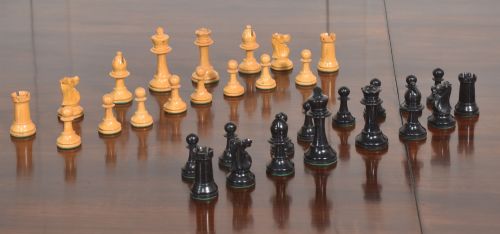
When searching for a victorian chess set, buyers encounter complete playing pieces alongside comprehensive games boards and compendiums housing multiple pastimes. The Staunton pattern dominates the selection, appearing alongside regional variations such as the St George, Whittington, and Calvert patterns.
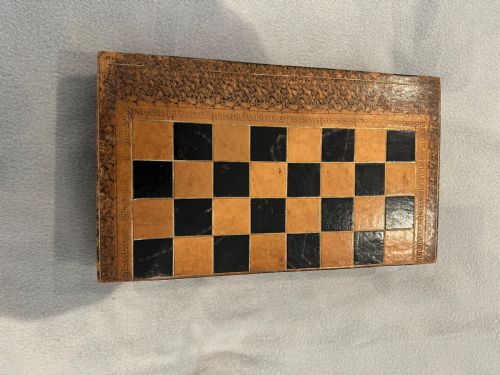
Alongside the playing pieces, the material evidence includes games boxes in burr walnut and mahogany, leather boards, and mother of pearl chessboards. These objects reflect a period when parlour games formed a central pillar of domestic entertainment.
Materials and Craftsmanship
Turned woods form the foundation of these sets, with boxwood paired against dark ebony or ebonised wood to create the contrasting sides. Selected pieces also incorporate rosewood and mahogany, often housed within fitted wooden slide-top boxes or leather bindings.
Beyond timber, makers utilised bone and ivory for intricately carved pieces, while lead weighting inside the base provided stability during play. Felt linings protected the undersides of pieces and the interiors of folding travelling boards.
Victorian Chess Set Retail Price Guide 2026
Typical asking prices for victorian chess set among the pieces listed under this phrase on Sellingantiques today, from the lower quarter to the upper quarter. They describe what is for sale here now, not the wider market.
Listings demonstrate a strong prevalence of boxwood and ebony woods alongside bone materials across nineteenth-century chess sets.
Distinctions in Quality
The standing of a set often rests upon the reputation of the maker, with established firms achieving higher regard for precision in turning and carving. Maker attribution, through stamps or original boxed presentation, elevates a set above anonymous workshop production.
Completeness dictates utility and desirability, particularly for travelling sets and compendiums retaining all original pieces and internal boards. The crispness of detail in turned knights and carved finials separates standard production from superior craftsmanship.
Jaques·F H Ayres·British Chess Company
The Victorian Chess Set Glossary
- Staunton pattern
- The standard design of chess pieces introduced in the mid-nineteenth century, featuring architectural kings and queens with distinct coronets. This style became the universal tournament standard.
- Ebonised wood
- Fruitwood or boxwood treated with a dark stain to imitate ebony. It provided a cost-effective alternative for the darker pieces.
- Compendium
- A fitted box containing equipment for multiple games, such as chess, backgammon, and draughts. These boxes frequently feature folding boards and internal storage trays.
- Statu quo
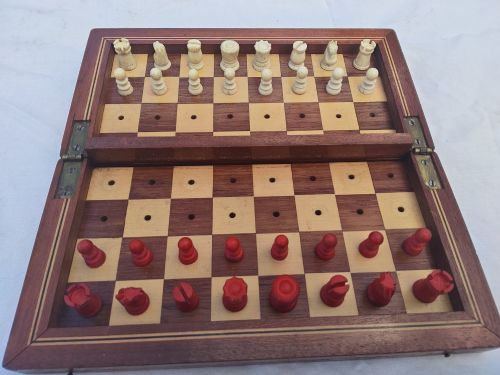
- A patented travelling chess design utilising pegged pieces that insert into slotted boards to maintain position during transit. This allowed players to pause games while travelling.
- Calvert pattern
- An early nineteenth-century chess style characterised by distinctive turned and carved details before the standardisation of the Staunton pattern.
Victorian Chess Set: Frequently Asked Questions
What materials were used for these sets?
Makers relied heavily on boxwood paired with ebony or ebonised wood for standard wooden sets. Bone and ivory also appear frequently, particularly in earlier nineteenth-century examples.
Cases and boards utilise mahogany, rosewood, burr walnut, and leather bindings to protect the pieces during storage.
How do travelling sets work?
Travelling sets often feature pegged wooden pieces that fit securely into drilled holes on the board surface. Other versions utilise sliding mechanisms or folding leather boards designed for portability.
These compact sets allowed Victorians to play matches while on coaches, trains, or steamships without losing the positions of the pieces.
Are games compendiums common?
Games compendiums appear regularly, housing chess alongside backgammon, draughts, and sometimes cribbage within a single fitted box. These multi-game boxes utilise folding lids that double as playing boards.
Burr walnut and mahogany form the primary carcasses for these elaborate parlour items.