






Victorian Cherub Timepiece
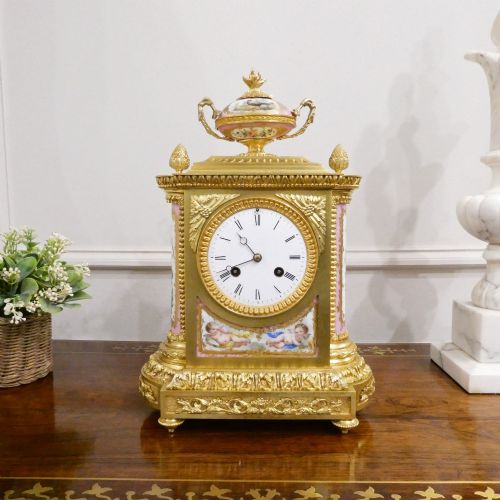
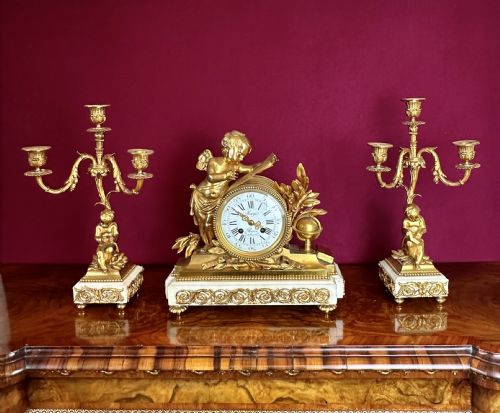
These Victorian cherub timepiece examples bring together gilt bronze, ormolu, and marble, offering ornamental utility for the mantelpiece.
Victorian Cherub Timepiece
A victorian cherub timepiece takes the form of mantel clocks, table clocks, and clock garnitures originating from the nineteenth century. These objects combine figural cherub motifs with timekeeping mechanics, predominantly styled in French Rococo Revival, Louis XVI Revival, and French Empire aesthetics.
The pieces on this page are most likely to be French or British mantel clocks fashioned from gilt bronze, ormolu, porcelain, and marble. Makers such as Jean-Baptiste Delettrez, Le Roy and Fils, John Bennett Cheapside London, Dumont, and Farcot appear among the listings.
Forms range from small timepieces on bronze plinths to substantial variegated marble stands featuring cherub and dragonfly motifs. Enamel dials and hand-painted details frequently accompany these works.
How they were made
Constructed primarily using gilt bronze, ormolu, and brass, these timepieces rely on cast metalwork combined with marble and porcelain elements. Makers utilised champleve enamel for dials and decorative panels, alongside hand-painted ceramic surfaces.
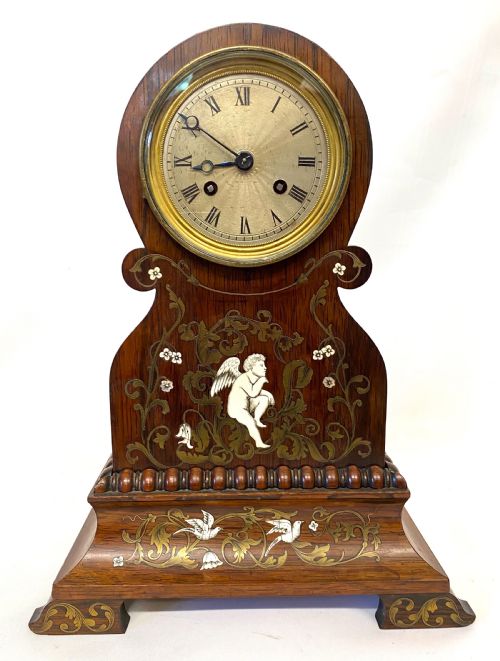
Woodwork also appears in specific examples, such as rosewood bodies housing brass and bovine inlay work. Artisans mounted these clock movements upon bronze or variegated marble stands to complete the architectural composition.
Materials across the inventory span gilt bronze, ormolu, porcelain, marble, glass, brass, and rosewood.
What varies in quality
The standard of a victorian cherub timepiece depends on the crispness of the bronze or ormolu casting and the refinement of the figural cherub sculpture. Hand-painted enamel dials and the integration of substantial marble or porcelain bases separate simpler designs from more ambitious works.
Attribution to documented makers such as Le Roy and Fils, John Bennett, or Jean-Baptiste Delettrez introduces notable distinction. The complexity of the garniture sets and supplementary materials like champleve enamel or bovine inlay further influence the character of each piece.
Jean Baptiste Delettrez·Le Roy and Fils·John Bennett Cheapside London·Dumont·Farcot
The Victorian Cherub Timepiece Glossary
- Ormolu
- Gilded bronze produced through a mercury gilding process, widely used in nineteenth-century French and British clockmaking.
- Garniture
- A set of matching ornamental objects for a mantelpiece, typically comprising a clock flanked by candelabra or vases.
- Champleve
- An enamelling technique where troughs or cells are carved into the metal surface and filled with vitreous enamel before firing.
- Plinth
- A heavy base or pedestal upon which the clock movement and figural cherub sculpture rest.
Victorian Cherub Timepiece: Frequently Asked Questions
What is a Victorian cherub timepiece?
A victorian cherub timepiece is a nineteenth-century clock featuring figural cherub ornamentation, commonly produced in mantel or table formats.
These pieces draw upon French Rococo Revival and Louis XVI Revival styles, utilising materials such as gilt bronze, ormolu, marble, and porcelain.
Where were these clocks made?
The evidence shows a strong French influence in style and manufacture, alongside London retailing presence.
Makers operating in France and Britain produced these mantel clocks and garniture sets during the nineteenth century.
What materials are used in these timepieces?
Common materials include gilt bronze, ormolu, brass, porcelain, glass, and white or variegated marble.
Some examples also incorporate enamel dials, rosewood bodies, and bovine inlay work.
How do garniture sets work?
Garniture sets comprise a central clock accompanied by matching decorative pieces designed to sit together on a mantelpiece.
These sets coordinate in material and style, such as ormolu and bronze groupings from the nineteenth century.