



Victorian Carved Triple Armoire
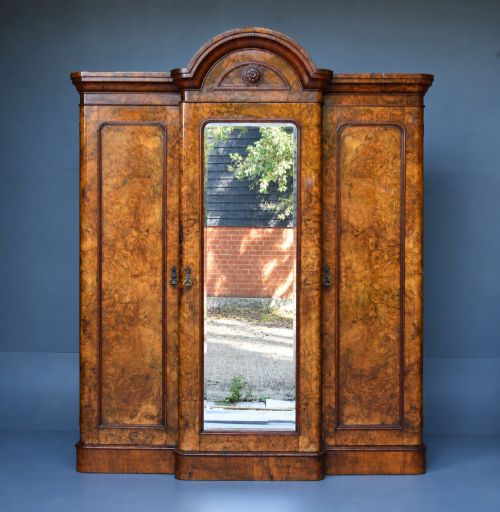
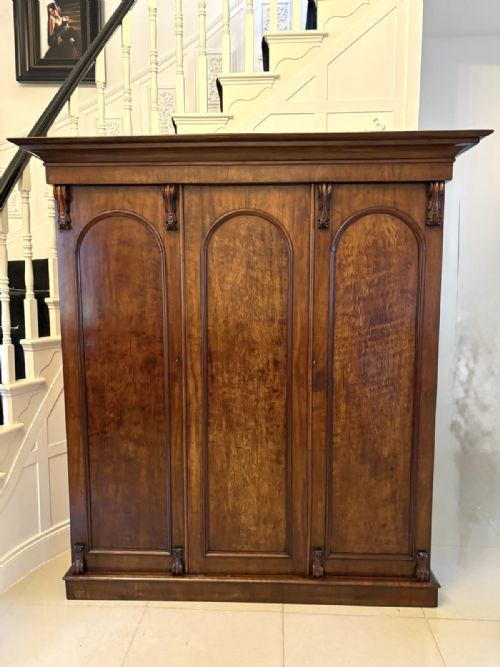
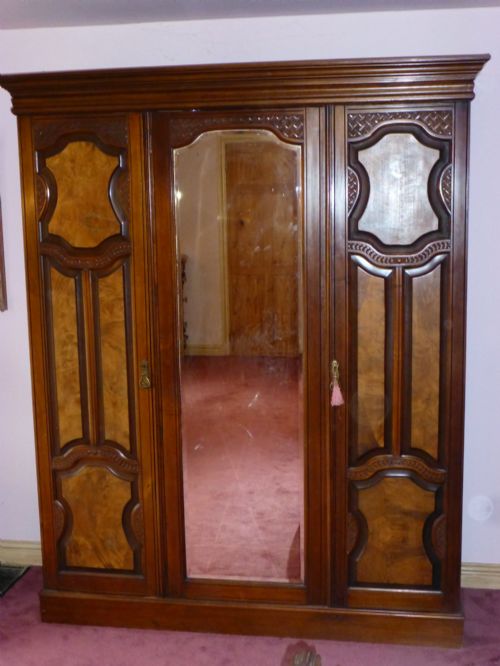
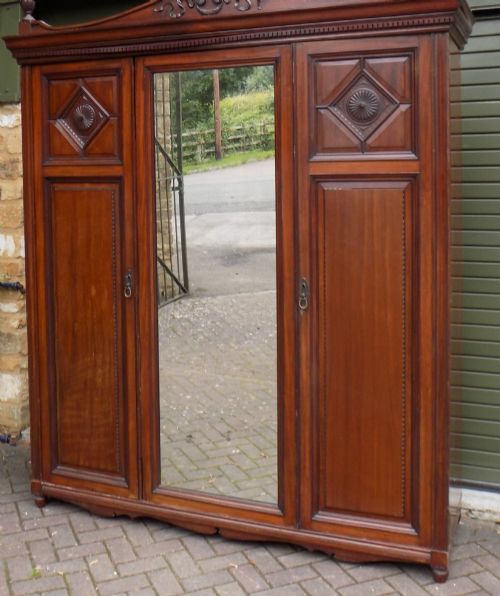
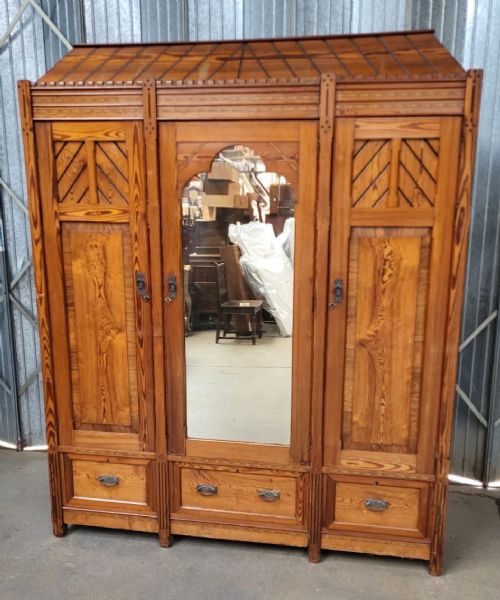
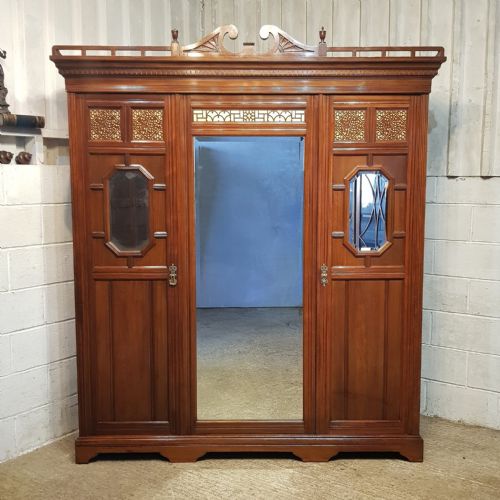
These substantial pieces of furniture are a victorian carved triple armoire, offering generous hanging space and architectural presence for the bedroom.
Victorian Carved Triple Armoire
A victorian carved triple armoire typically manifests as a three-door wardrobe or compactum, often featuring a central mirrored or panelled door flanked by two matching hanging sections. These large bedroom pieces originate primarily from the nineteenth century, spanning from early Victorian examples through to late Victorian, Arts and Crafts, Gothic Revival, and Aesthetic Movement designs.
The format is built to dominate a room, standing as a primary storage solution in country houses and large Victorian homes. Buyers encounter versions ranging from breakfront configurations to combination compactums fitted with internal drawers and trays.
Materials and construction
Cabinetmakers utilised dense timbers including mahogany, walnut, burr walnut, pitch pine, and figured birch, often selecting figured veneers to create dramatic grain patterns across the wide doors. Carved ornamentation was applied by hand to cornices, panels, and pilasters, while structural stability was maintained using secondary woods and substantial iron or brass fixings.
Glass mirrors were frequently set into the central door, requiring sturdy internal framing to support the heavy weight. Component parts were built to dismantle into sections to allow transport into domestic spaces.
Listings feature mahogany, burr walnut, and pitch pine across Victorian, Gothic Revival, and Arts and Crafts styles.
Distinctions in craftsmanship
The calibre of a triple wardrobe rests on the choice of timber and the execution of the carving. Superior examples display carefully matched burr veneers and crisp, deeply undercut mouldings rather than simple applied decoration.
Internal joinery differentiates standard production from exceptional cabinet work, seen in the lining of drawers, the smoothness of sliding trays, and the original functioning of brass locks and hinges.
Holland and Sons
The Victorian Carved Triple Armoire Glossary
- Compactum
- A multi-functional wardrobe featuring a combination of hanging space, drawers, and linen slides within a single carcass. This layout maximises internal organisation.
- Breakfront
- A piece of furniture where the central section projects forward from the flanking wings. This architectural arrangement creates depth and shadow on large facades.
- Burr walnut
- Timber taken from the gnarled growth of a walnut tree, yielding highly figured and swirly grain patterns. Cabinetmakers prized this material for veneering prominent door panels.
- Pitch pine
- A resinous and durable softwood utilised during the Victorian period, particularly favoured in Arts and Crafts furniture. It offers a strong grain structure.
- Sentry box
- A narrow form of wardrobe designed to fit compact spaces while maintaining vertical hanging height. These pieces often feature arched upper sections.
Victorian Carved Triple Armoire: Frequently Asked Questions
How do I dismantle a triple wardrobe?
Most nineteenth-century triple wardrobes separate into distinct components consisting of a heavy cornice, a base plinth, two or three flanking sides, and the doors. The main carcass sections typically lock together using internal bolts or draw-pins rather than modern fixings.
Marking each piece with chalk during disassembly ensures proper alignment when rebuilding the wardrobe in its final room. Two people are required to lift the heavy mirrored doors safely off their hinges.
What is a compactum wardrobe?
A compactum is a specialised multi-compartment wardrobe that combines vertical hanging space with banks of internal drawers, linen slides, and shoe compartments. These internal fittings allowed Victorian users to store an entire wardrobe of garments within one piece of furniture.
The central section usually houses the smaller drawers or sliding trays, flanked by full-length hanging compartments behind solid or mirrored doors.
Will a triple wardrobe fit in my bedroom?
These large wardrobes demand substantial wall space and high ceilings, as they frequently exceed six feet in width and height. Measuring both the intended room and all access stairwells or doorways is essential before purchasing.
Because original pieces dismantle into modular sections, they can navigate tight turns if the ceiling height permits the vertical erection of the side panels.
How do I care for antique walnut wood?
Maintaining walnut and burr walnut surfaces involves regular dusting with a dry, soft cloth to prevent particulate accumulation. Avoiding direct sunlight and sustained heat sources protects the fragile veneers from drying out and splitting over time.
Applying microcrystalline wax once or twice a year feeds the timber and preserves the sheen without building up sticky residues that attract dirt.
How do I distinguish early from late Victorian?
Early Victorian pieces from around 1850 often utilise solid mahogany with restrained classical mouldings and deep, rich patination. Structural lines tend to follow formal architectural rules established in earlier decades.
Late Victorian examples from the 1880s and 1890s frequently incorporate lighter woods like pitch pine or figured birch, reflecting Arts and Crafts or Aesthetic Movement preferences for carved panels and exposed grain.