



Victorian Carved Oak Crest
These Victorian carved oak crest pieces bring heraldic weight and rich grain into a room, offering striking focal points for panelled walls or overdoors.
Victorian Carved Oak Crest
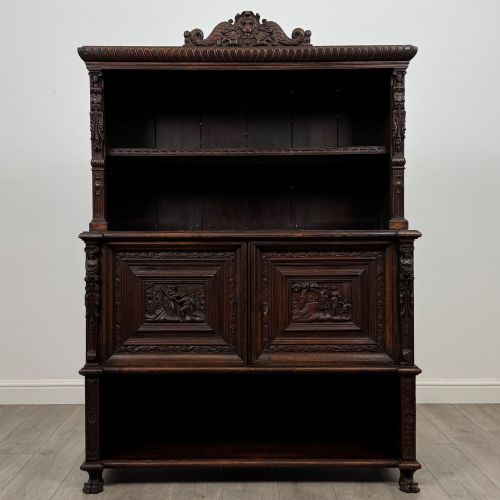
A victorian carved oak crest appears across various decorative and architectural forms, most commonly as heraldic shields, wall plaques, overdoors, and furniture pediments. These items reflect a nineteenth-century fascination with lineage, Gothic Revival themes, and Dutch Renaissance motifs.
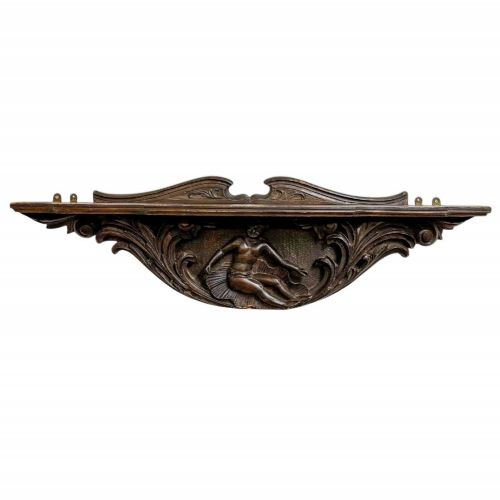
The version most frequently met on this page is the carved wooden heraldic panel or crest inset into architectural joinery or mounted independently as a wall feature. They range from compact nineteenth-century cartouches to larger overdoor elements incorporating carved lions and family coats of arms.
Making and materials
Solid timber forms the foundation of these items, utilising heavy oak alongside occasional beech or tiger oak for contrasting grain and durability. Carvers employed hand chisels and gouges to build deep relief work, establishing sharp undercut details in foliage, figures, and heraldic charges.
Assembly relies on traditional joinery methods such as mortise and tenon frames, while secondary elements incorporate chased brass, embossed metal, glass, and leather. Surfaces were often finished with dark wax polishes to highlight the natural medullary rays in quarter-sawn oak.
Some crests preserve the specific lineage of continental nobility, tucked neatly inside repurposed brass frames.
Judging quality
The selection of the timber itself dictates longevity and visual impact, with quarter-sawn oak displaying prominent figuring that enhances the carved depth. Integrated elements such as embossed brass frames or original heraldic polychromy elevate the piece beyond standard decorative joinery.
John Moyr Smith·Pugin
The Victorian Carved Oak Crest Glossary
- Heraldic shield
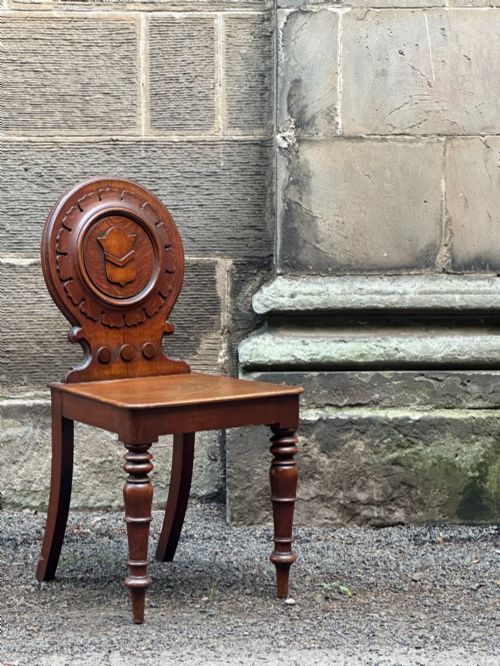
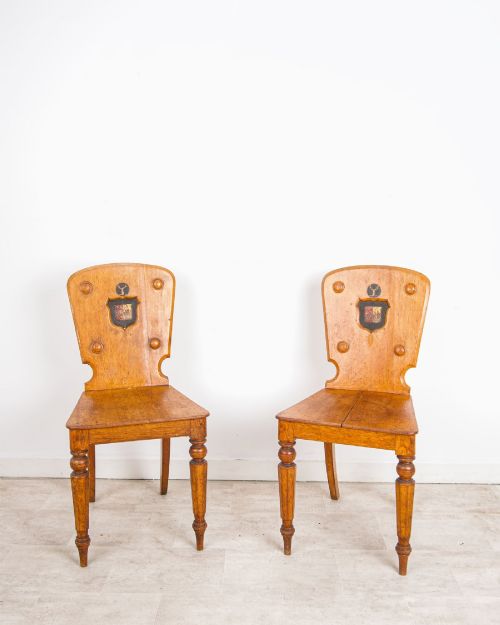
- A flat or slightly curved support displaying a coat of arms. These form the focal point of many carved wooden crests and hall chairs.
- Overdoor
- A decorative panel, pediment, or carved crest positioned immediately above a doorway. They often feature prominent wooden carvings or inset brass plaques.
- Gothic Revival
- An architectural and decorative style popular during the nineteenth century, characterised by pointed arches, tracery, and heavy carved woodwork.
- Cartouche
- An oval or oblong frame design resembling a scroll or rolled-up piece of paper, frequently utilised to enclose heraldic crests or inscriptions.
- Barley twist
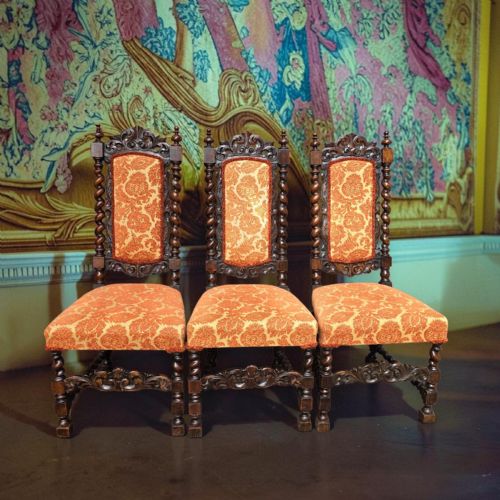
- A turning technique resembling a spiral rope, commonly found on the legs and structural uprights of nineteenth-century chairs and tables.
Victorian Carved Oak Crest: Frequently Asked Questions
How were carved oak crests originally displayed?
These pieces were typically mounted above doorways, integrated into library panelling, or hung directly on walls as expressions of family lineage and status.
In grand nineteenth-century interiors, they anchored the decorative scheme of hallways, reception rooms, and municipal spaces.
What is the difference between an overdoor and a wall plaque?
An overdoor is specifically shaped to sit horizontally above a doorframe as an architectural pediment, often featuring a flat base and projecting shelf.
Wall plaques are designed for independent hanging at eye level, functioning purely as decorative or heraldic artwork rather than architectural joinery.
How do I care for antique carved oak?
Maintain the timber by applying a microcrystalline wax sparingly and buffing gently with a soft brush to remove dust from deep carved recesses.
Keep the wood away from direct heat sources and strong sunlight to prevent the oak from drying out and splitting over time.
Can I hang a heavy oak crest safely?
Secure mounting requires screwing directly into wall studs or using heavy-duty masonry fixings matched to the weight of the solid timber.
Many pieces feature integrated hanging loops or brackets designed to distribute the substantial weight of dense nineteenth-century oak.