
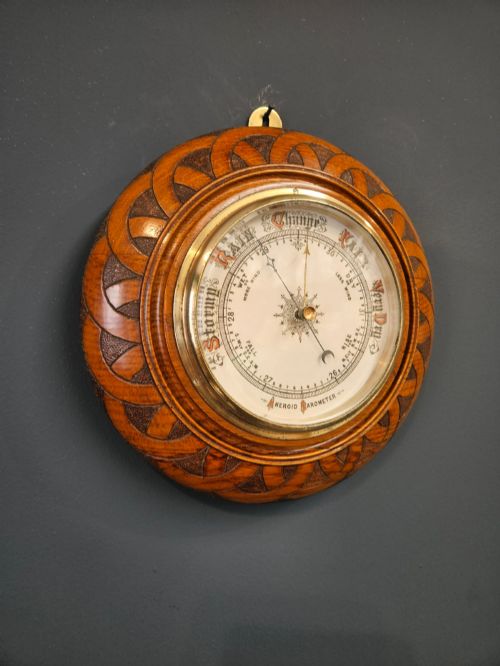
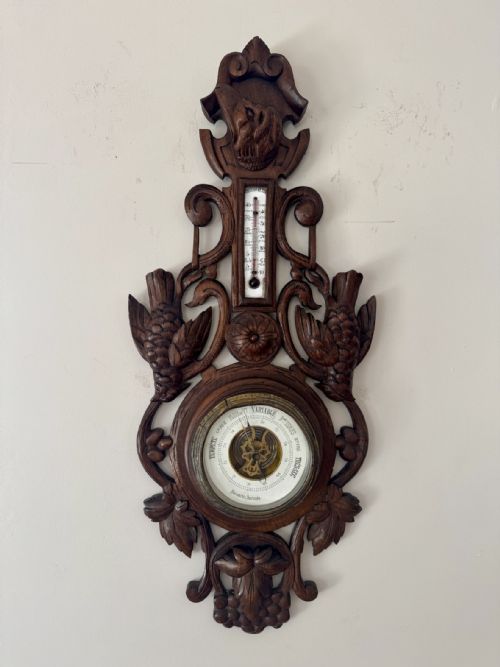
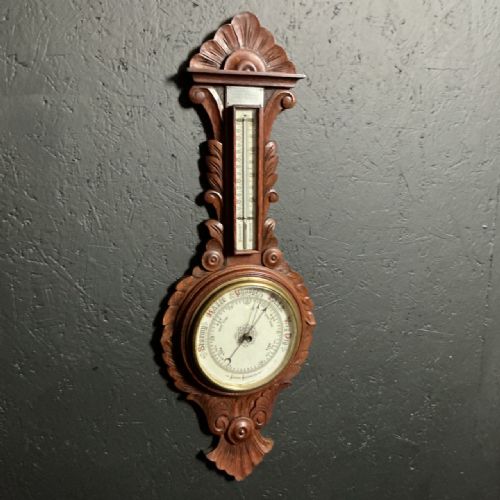
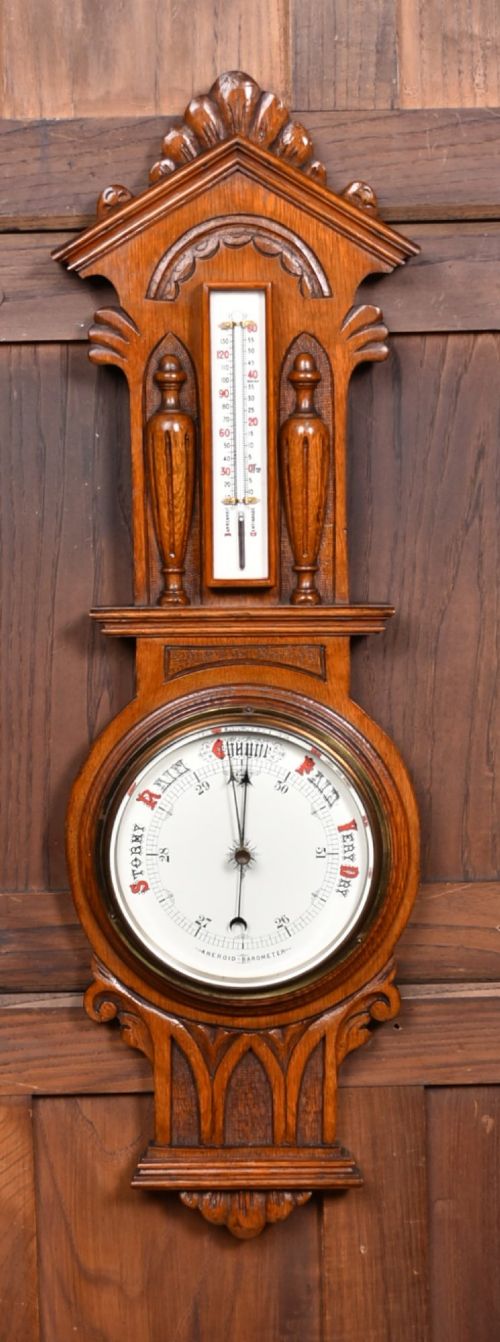




Victorian Carved Oak Barometer
A victorian carved oak barometer brings domestic utility and robust nineteenth-century craftsmanship into a room.
Victorian Carved Oak Barometer
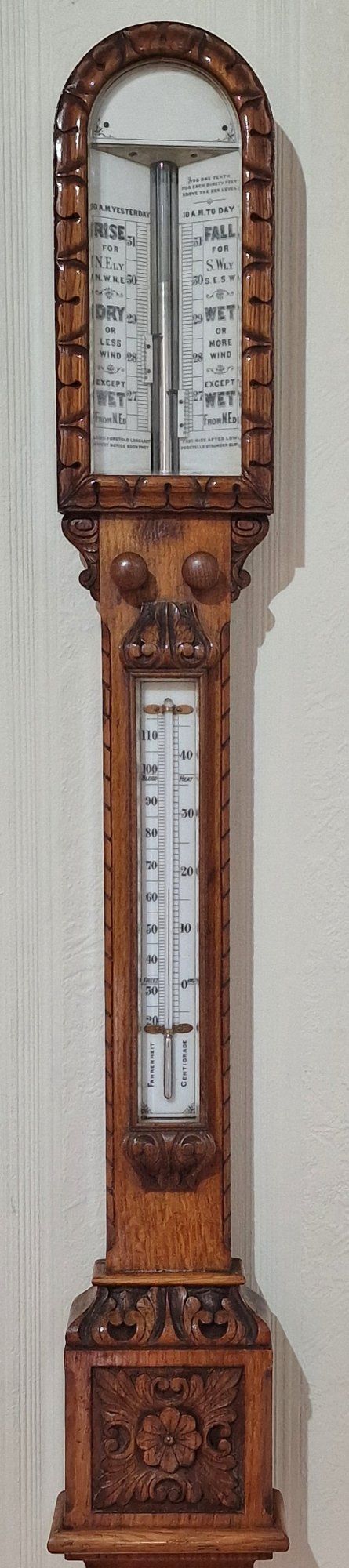
A victorian carved oak barometer is a domestic meteorological instrument housed in timber frames shaped by nineteenth-century makers.
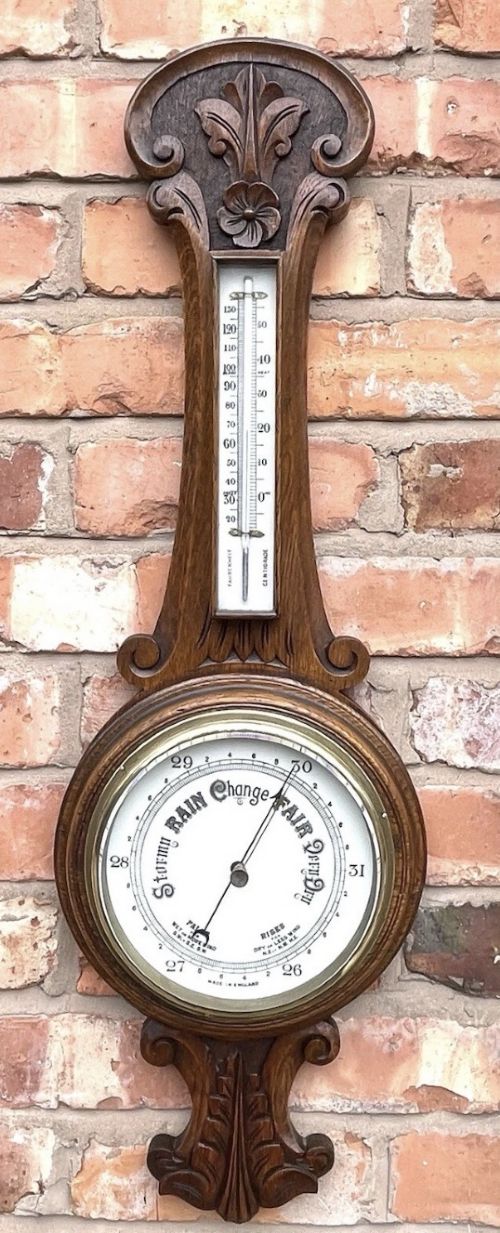
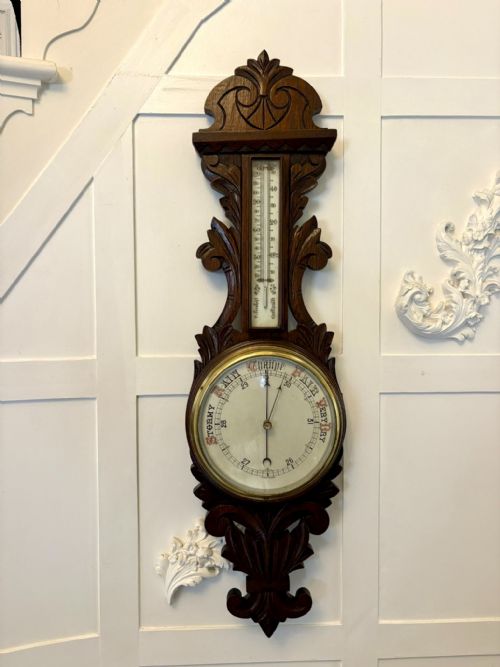
The version most commonly met on this page is the banjo barometer, which combines the weather-reading dial with an integrated thermometer.
These pieces draw upon Victorian, Black Forest, and Gothic Revival styles, utilising dense oak timbers carved with foliage, birds, and geometric designs.
Materials and construction
Makers built the structural cases from solid oak, frequently turning, shaping, and carving the timber with deep relief foliage or animal motifs.
Internal mechanisms rely upon brass fittings, paper scales, and glass tubes containing mercury or aneroid movements to measure atmospheric pressure.
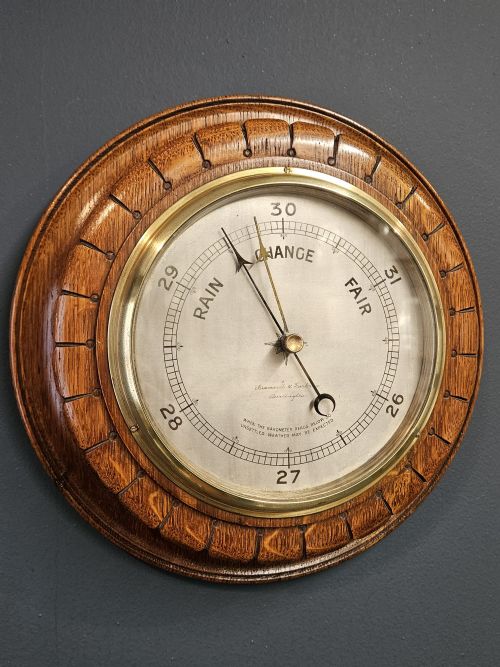
Dials are executed in silvered metal, porcelain, or ceramic, often paired with engraved thermometer plates and protective bevelled glass bezels.
Victorian Carved Oak Barometer Retail Price Guide 2026
Typical asking prices for victorian carved oak barometer among the pieces listed under this phrase on Sellingantiques today, from the lower quarter to the upper quarter. They describe what is for sale here now, not the wider market.
Listings feature pieces spanning the Victorian era, the Edwardian period, and the nineteenth century, constructed primarily in oak with glass and brass components.
Judging execution and origin
The distinction between ordinary production and superior work rests upon the depth, sharpness, and ambition of the wood carving.
Signed examples by established opticians and instrument makers demonstrate higher precision in movement assembly and dial graduation.
The integration of secondary complications, such as skeletonised movements, calendars, or carved figural elements, marks the upper tier of surviving pieces.
Bramwell & Harbron·W Watson & Sons·J Hughes London·Negretti & Zambra·Maple & Co·James Pitkin London·J Hicks of London·Frederick Cox
The Victorian Carved Oak Barometer Glossary
- Aneroid barometer
- An instrument that measures atmospheric pressure using a flexible metal box rather than liquid mercury, contracting or expanding with weather changes.
- Banjo barometer
- A wall-mounted barometer shaped with a circular dial head above a long tapered trunk, which frequently houses a thermometer.
- Stick barometer
- A tall, narrow instrument featuring a long vertical glass tube filled with mercury alongside an exposed scale.
- Admiral Fitzroy barometer
- A large storm barometer designed with multiple indicator tubes and comprehensive instructions for predicting maritime weather.
- Silvered dial
- A metal barometer face treated to produce a matte silver finish upon which graduations and maker names are engraved.
Victorian Carved Oak Barometer: Frequently Asked Questions
How do aneroid and stick barometers differ?
Aneroid barometers utilise a sealed internal metal chamber to indicate pressure changes through a needle on a circular dial face. Stick barometers display the direct rise and fall of mercury within a long vertical glass tube.
Both types record atmospheric shifts, though stick instruments require careful handling due to the exposed liquid column inside the wooden trunk.
Where were these barometers originally placed?
Victorian households positioned wall-hung barometers in entrance halls, libraries, and principal living rooms where residents checked the weather before travelling.
Their substantial carved oak cases served decorative roles as interior furnishings alongside practical forecasting duties.
How should an antique barometer be maintained?
These instruments benefit from stable indoor environments away from direct sunlight and sudden temperature swings that affect the timber casing. Regular dusting with a dry cloth preserves the carved oak surfaces and protects the glass bezels.
Internal movements should be left undisturbed unless professional horological conservation is required.
Are thermometer tubes original to the cases?
Many banjo and stick barometers include auxiliary thermometers mounted onto the wooden trunk alongside the main dial. Surviving instruments often retain their matched porcelain or paper thermometer scales, though replacement tubes do occur.
Examining the fit within the carved oak recess helps determine the authenticity of the components.