

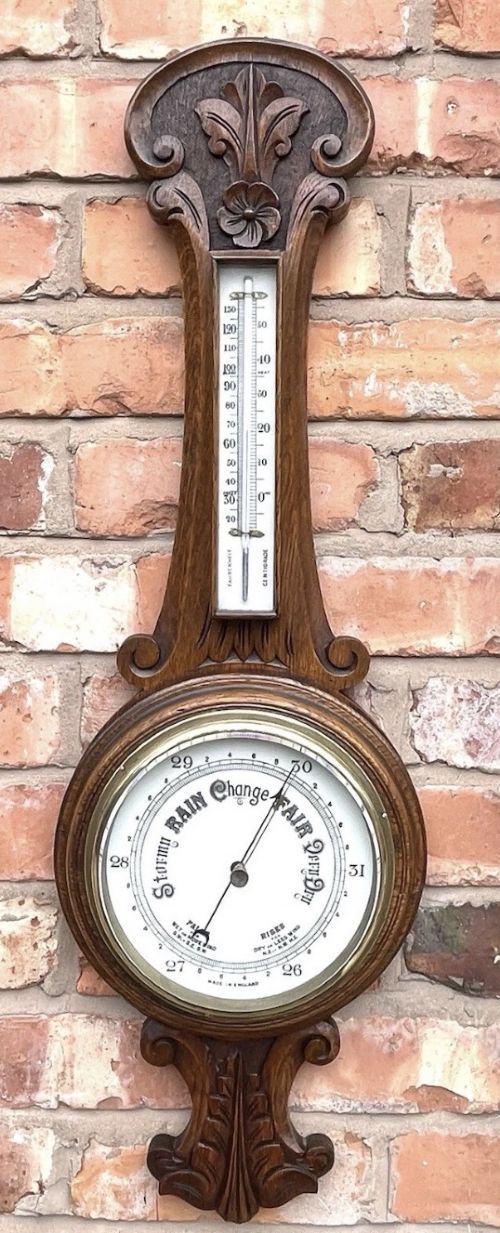


Victorian Carved Oak Banjo Barometer
These victorian carved oak banjo barometer pieces combine utility with craftsmanship, offering both functional weather indication and traditional wall decoration for the home.
Victorian Carved Oak Banjo Barometer
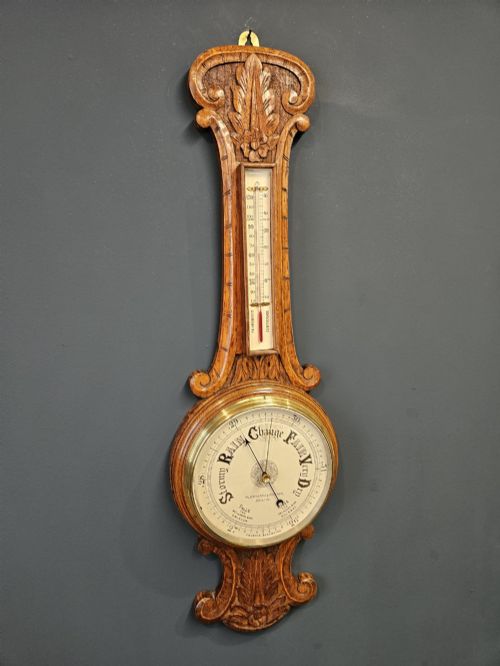
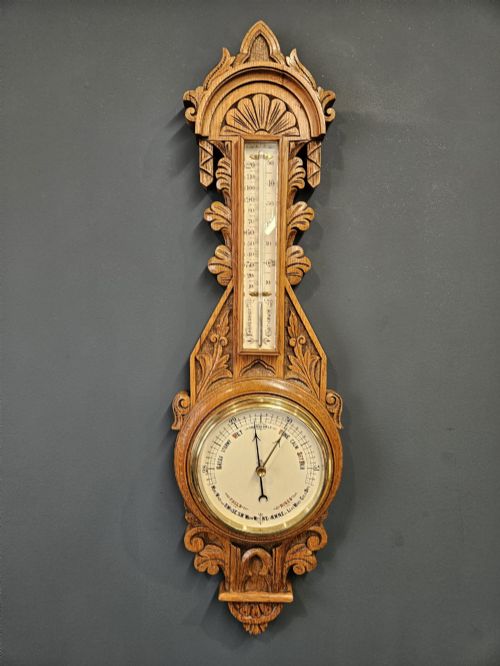
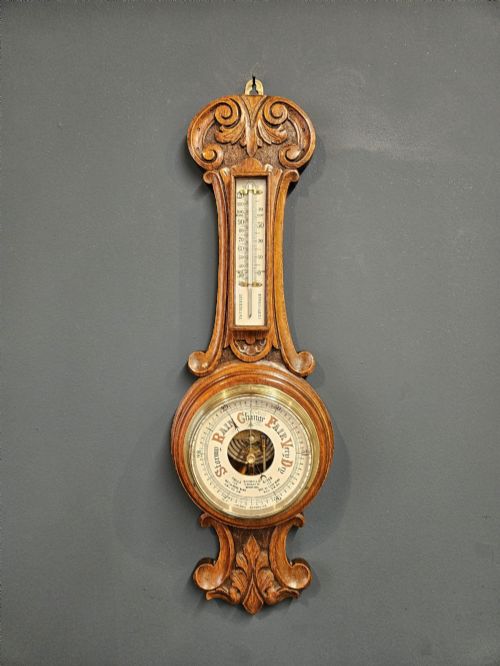
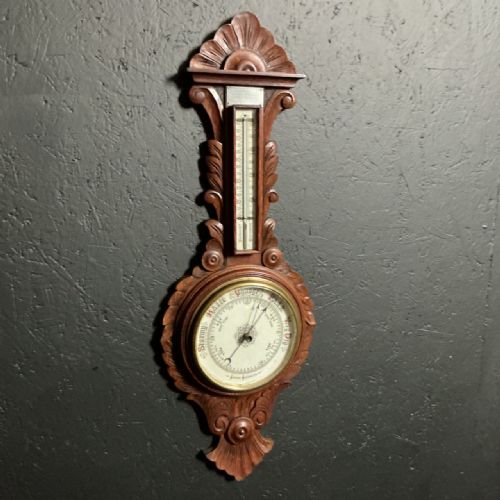
A victorian carved oak banjo barometer typically presents a distinctive curved wooden wall hanging frame shaped similarly to the stringed instrument it mimics in profile. The selection on this page centres primarily on Victorian and Edwardian examples rendered in solid oak, golden oak, and related timber tones.
Many specimens integrate additional instruments into the main body, such as thermometer scales, porcelain dials, or exposed skeletonised movements alongside the central glass-faced gauge. Buyers encounter both aneroid mechanisms and mercurial configurations within these wall-mounted formats.
Originating predominantly from the nineteenth and early twentieth centuries, these instruments range from compact domestic models to larger architectural hall barometers. The predominant style remains Victorian and late Victorian, reflecting the heavy decorative tastes of the era.
Materials and construction
Makers utilised solid oak and golden oak as the primary timber for the frames, applying deep hand-carving techniques to create foliage, scrollwork, and geometric borders. This sturdy wood supported the heavy internal metallic machinery and protected the delicate glass faces.
Internal mechanisms combined brass components and glass tubing to register atmospheric pressure, occasionally featuring porcelain or ceramic dial faces with hand-painted numerals. Metal fittings such as brass bezels and mercury reservoirs required precise calibration by instrument makers.
Victorian Carved Oak Banjo Barometer Retail Price Guide 2026
Typical asking prices for victorian carved oak banjo barometer among the pieces listed under this phrase on Sellingantiques today, from the lower quarter to the upper quarter. They describe what is for sale here now, not the wider market.
Some models squeeze a thermometer and a clock alongside the barometer, ensuring you have three ways to be disappointed by the British weather.
Distinctions in quality
Quality rests heavily on the depth and crispness of the timber carving, where master carvers achieved sharp relief work compared to softer, machine-milled mouldings. The presence of named makers or specialised movements elevates the standing of an individual piece.
The integrity of the dial face, whether porcelain, ceramic, or metal, influences the overall finish, alongside the original condition of the brass bezels and glass covers. Retaining the original mercury tube or functioning aneroid mechanism marks the difference between a display item and a preserved instrument.
W Watson & Sons·Maple & Co·Negretti & Zambra
The Victorian Carved Oak Banjo Barometer Glossary
- Aneroid barometer
- A barometer that measures atmospheric pressure through the expansion and contraction of a sealed metal capsule, without using liquid mercury.
- Banjo barometer
- A wall-mounted weather instrument housed within a symmetrical wooden case whose widened middle and elongated neck resemble a banjo.
- Mercurial barometer
- An instrument that determines air pressure by balancing the weight of a column of mercury against the atmospheric pressure.
- Skeletonised movement
- A clock or instrument mechanism designed with cutaway plates that expose the inner gears and operational workings to view.
- Bezel
- The metal ring that holds the protective glass cover securely in place over the dial face of the barometer.
Victorian Carved Oak Banjo Barometer: Frequently Asked Questions
How do I hang a banjo barometer safely?
These instruments require a secure wall fixing due to the weight of the dense oak timber and internal glass components. Hang the piece from a sturdy screw or bracket anchored directly into wall studs or solid masonry.
Ensure the barometer hangs completely plumb against the wall so the internal mechanics operate without friction or binding.
What is the difference between aneroid and mercurial barometers?
Aneroid barometers utilise a sealed metal box that flexes with pressure changes, making them safe and stable for domestic movement. Mercurial versions rely on liquid metal in a glass tube to indicate atmospheric shifts.
Mercurial models represent earlier traditional technology, while aneroid variants became widespread for household use during the Victorian period.
How should I clean the oak case?
Dust the carved wooden frame regularly with a dry, soft cloth to prevent particulate buildup in the recesses of the carving. Avoid chemical polishes or water, which can damage the aged timber finish and antique patination.
Applying a light coat of traditional beeswax occasionally helps nourish the oak and maintain its natural lustre.