


Oak Banjo Barometer
An oak banjo barometer brings practical science and rich timber grain to a hallway wall.
Oak Banjo Barometer
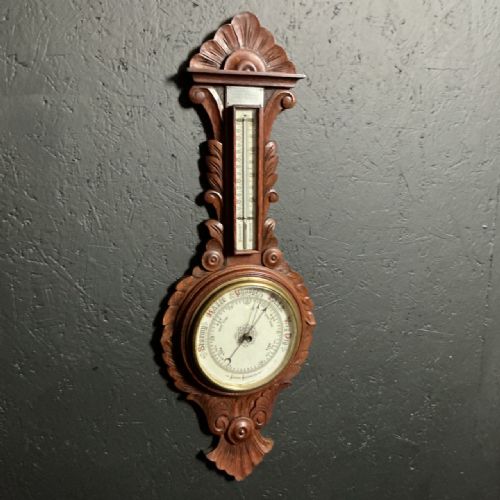
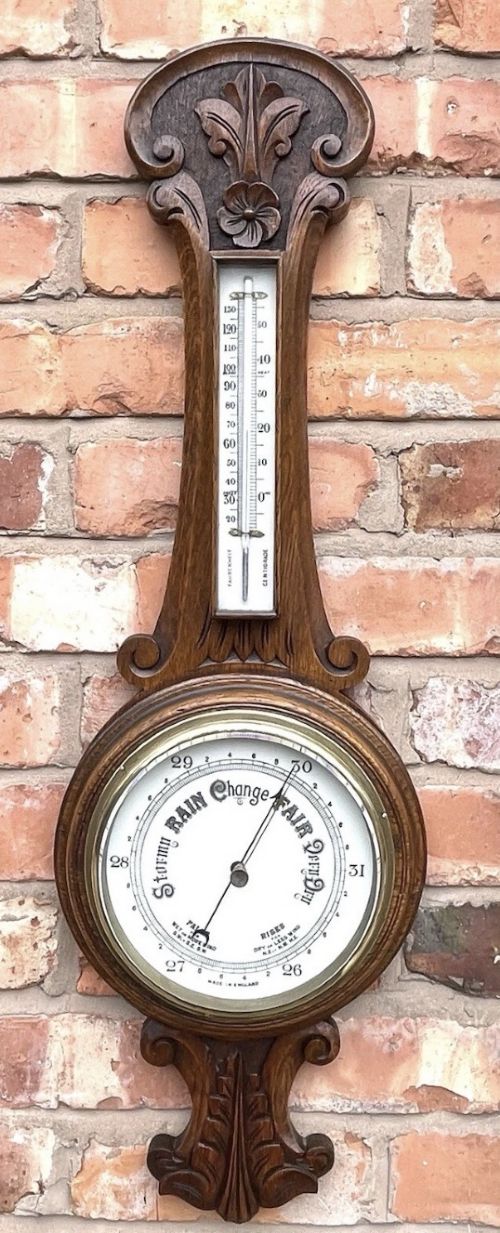
An oak banjo barometer takes its name from the distinctive stringed instrument shape, featuring a circular dial at the top that tapers down to a longer trunk. When you search for an oak banjo barometer, you are looking at wall instruments predominantly from the Victorian and Edwardian periods.
Most examples you meet on this page are carved from oak, housing aneroid mechanisms inside wall-hanging cases. The form frequently accommodates an integrated thermometer on the trunk and occasionally combines a clock alongside the barometer dial.
The archive shows that smaller formats appear regularly alongside grander scaled versions, offering choices for both narrow hallways and large principal rooms. Makers from Liverpool to London produced these instruments, supplying homes that valued domestic weather tracking.
Judging Quality and Craftsmanship
The crispness of the wood carving marks the distinction between standard production and superior workshop output. Deeply undercut foliage and well-defined mouldings show the hand of a skilled carver rather than mechanical replication.
Materials beyond the timber elevate the piece, such as heavy bevelled glass, finely engraved silvered dials, or porcelain dial faces that retain sharp black lettering. The inclusion of visible works or a skeletonised movement adds mechanical complexity that rewards close inspection.
Listings feature oak alongside walnut and ceramic elements, spanning Victorian, Edwardian, and Art Nouveau periods.
W Watson And Sons·Maple And Co·Chadburns Castle St Liverpool·Negretti And Zambra
The Oak Banjo Barometer Glossary
- Aneroid barometer
- An instrument measuring atmospheric pressure through the expansion and contraction of a sealed metal capsule, avoiding liquid mercury. This design allowed wall cases to take the vertical banjo shape.
- Silvered dial
- A brass circular plate treated with silver powder to create a matte metallic finish for engraved numbers and weather notes. These dials catch hall light differently depending on their state of preservation.
- Thermometer
- A secondary temperature scale mounted on the trunk of the banjo case, usually matching the timber surround. It provides domestic room readings alongside the barometric pressure.
- Bezel
- The brass or metal ring that holds the glass cover over the dial face. A hinged bezel allows access to the setting hand.
- Skeletonised movement
- An exposed interior mechanism where plates and bridges are cut away to reveal the inner springs and levers. This showcases the mechanical engineering behind the weather reading.
Oak Banjo Barometer: Frequently Asked Questions
How do I hang a banjo barometer?
Use a secure wall fixing that matches the weight of the solid oak case and the bracket on the reverse. Ensure the hanging point takes the full vertical load firmly.
Position the instrument away from direct heat sources and exterior doors to prevent timber warping and sudden temperature shocks to the mechanism.
Do these barometers still work accurately?
Many aneroid movements remain responsive to local air pressure changes after adjustment against a known local reading. The brass screw on the back allows manual calibration.
Older mechanisms can become sluggish over decades, so treat the pressure readings as decorative history with functional potential rather than laboratory-grade data.
How do I tell Victorian from Edwardian pieces?
Victorian examples often feature heavier, deeper relief carvings in dark oak, sometimes displaying starburst motifs or golden timber tones. The styling leans towards robust proportions.
Edwardian pieces tend to show lighter oak colouring with cleaner lines and restrained ornamentation, reflecting changing domestic interiors around the turn of the century.
How should I clean the oak case?
Dust the carved woodwork gently with a dry, soft-bristled brush to lift particles from the recesses of the foliage and mouldings. Avoid modern liquid sprays.
Apply a microcrystalline wax sparingly if the timber appears dry, buffing it lightly with a clean cloth to preserve the natural grain of the oak.