



Traditional Wall Mounted Barometer
A traditional wall mounted barometer brings mechanical weather-reading and period timber into a room.
Traditional Wall Mounted Barometer
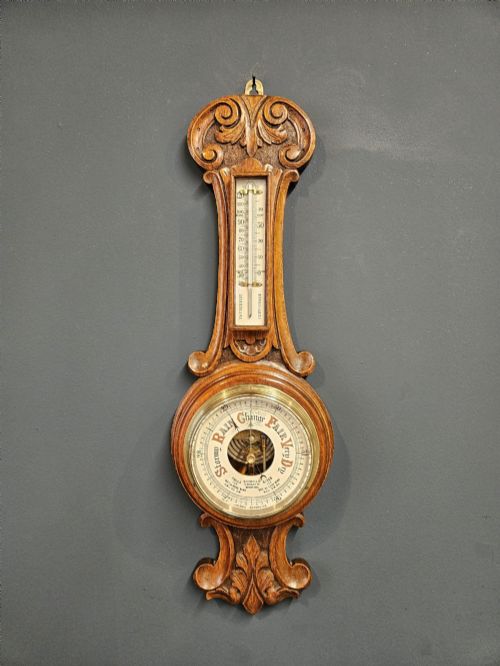
When you search for a traditional wall mounted barometer, you are looking at practical meteorological instruments housed in timber cases designed to hang on a wall. The pieces available span the Georgian, Victorian, and nineteenth-century periods, showing how domestic weather-glass design evolved from simple sticks to elaborate combination instruments.
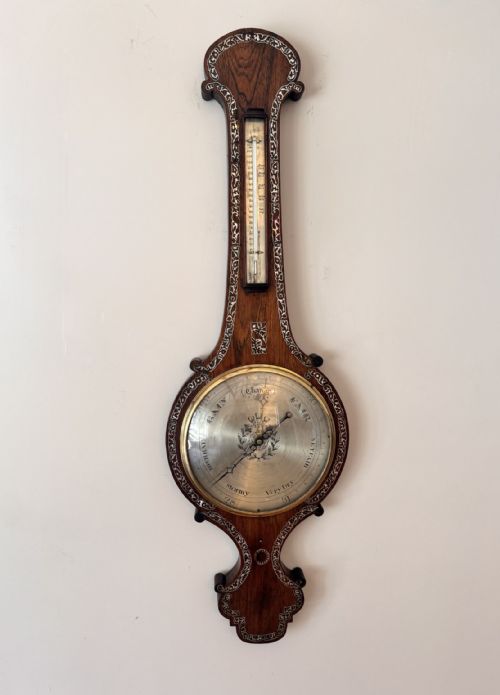
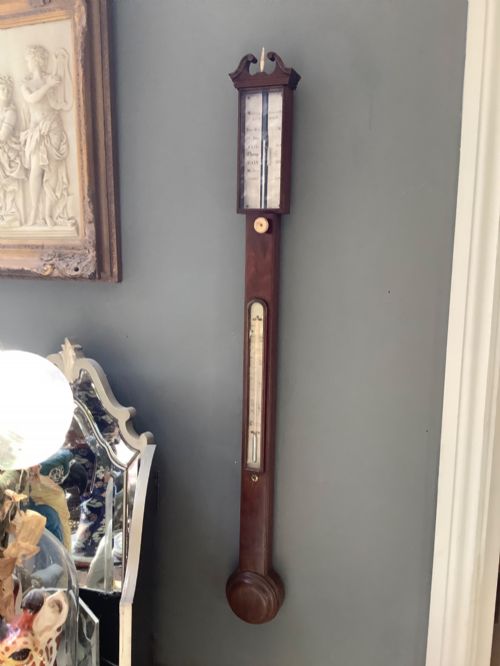
The most common forms you will meet on this page are stick barometers and banjo or wheel barometers, alongside pieces that combine a clock, thermometer, and barometer. These instruments originate from British workshops as well as nineteenth-century continental makers.
Materials range from rich timbers like mahogany, walnut, and oak to ebonised wood, complemented by brass dials, glass tubes, bone scales, and mother of pearl inlay. Each piece reflects the interior taste of its era, whether plain and functional or heavily carved.
How they were made
Casings are constructed from solid and veneered timbers including mahogany, walnut, and oak, often shaped into slender stick frames or wider banjo bodies. Carpenters utilised ebonised wood and applied intricate hand-carved details or mother of pearl inlay to elevate the visual appeal of the housing.
Precision dials and scales utilise brass, bone, and glass components, engraved or printed to display barometric pressure, temperature, and time. Skilled makers integrated mercury or aneroid movements within the timber frames to ensure accurate atmospheric readings.
Traditional Wall Mounted Barometer Retail Price Guide 2026
Typical asking prices for traditional wall mounted barometer among the pieces listed under this phrase on Sellingantiques today, from the lower quarter to the upper quarter. They describe what is for sale here now, not the wider market.
Listings feature Victorian and Georgian periods alongside nineteenth-century continental examples, utilising mahogany, walnut, oak, and ebonised wood.
What varies in quality
The grade of timber and the precision of the case carpentry set the baseline for quality, distinguishing simple utility instruments from grander parlour pieces. Superior examples feature crisp hand-carving, well-fitted mother of pearl inlay, and carefully selected mahogany or walnut grain.
The refinement of the dial engraving and the complexity of the movement also separate the tiers. Instruments that combine multiple functions, such as clocks and thermometers alongside the barometer, demonstrate higher ambition from the maker.
Ciresa of Milan·George Dollond of London
The Traditional Wall Mounted Barometer Glossary
- Stick barometer
- A tall, narrow instrument where the mercury column rises and falls in a vertical glass tube against a fixed scale. This form is often associated with Georgian and nineteenth-century domestic interiors.
- Banjo barometer
- A wall instrument housed in a symmetrical, curved wooden case resembling a banjo, also known as a wheel barometer. The design allows for a large circular dial to display weather indications clearly.
- Aneroid barometer
- A weather-reading instrument that uses a small, flexible metal box instead of liquid mercury to measure atmospheric changes. This mechanism became popular during the Victorian period.
- Ebonised wood
- Timber treated with a dark finish to imitate the appearance of ebony. Makers utilised this technique on nineteenth-century stick barometers for a stark, formal look.
- Mother of pearl
- An iridescent inner shell layer utilised for decorative inlay on instrument cases. It catches the light against dark mahogany or walnut surrounds.
Traditional Wall Mounted Barometer: Frequently Asked Questions
What is a stick barometer?
A stick barometer is a tall, narrow wall instrument that houses a vertical glass tube filled with mercury. It relies on atmospheric pressure to move the liquid up and down against a calibrated scale.
These pieces date back to the Georgian and nineteenth-century periods, valued for their straightforward, elegant timber cases designed to hang vertically in a hallway or study.
How do banjo barometers work?
A banjo barometer uses a mechanical linkage connected to the barometer tube to turn a pointer around a large circular dial. This wheel mechanism translates small vertical pressure changes into a sweeping rotational motion.
The shape became widespread during the Victorian era, offering a clearer and more decorative display than traditional linear stick instruments.
Are these barometers still accurate?
Many traditional barometers retain functioning movements, though older mercury instruments require careful handling and professional calibration. Aneroid versions respond readily to changing weather conditions without liquid.
Even when the internal mechanics require attention, these pieces function effectively as decorative wall furniture that reflects historical meteorological technology.
How do I date a barometer?
Dating relies on the style of the timber case, the materials used for the dial, and the complexity of the mechanism. Georgian pieces often favour plain or inlaid stick frames, while Victorian examples lean towards carved oak banjo shapes.
Signatures on the dial or maker plaques provide definitive attribution, linking the instrument to specific workshops and production decades.