

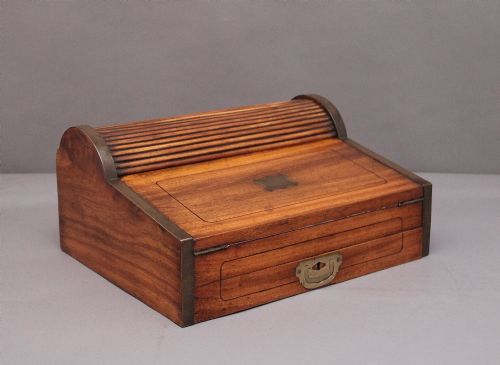
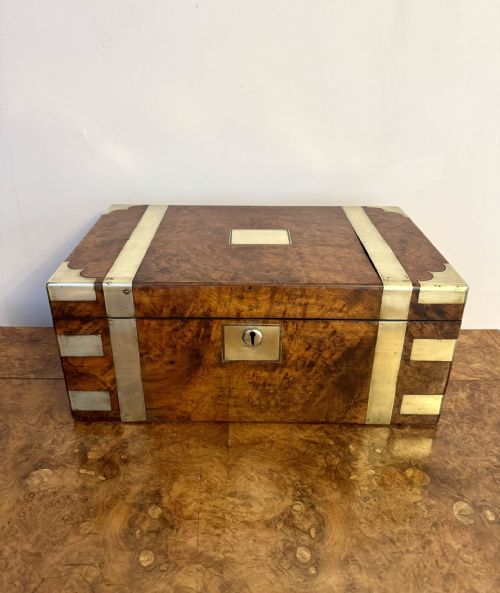
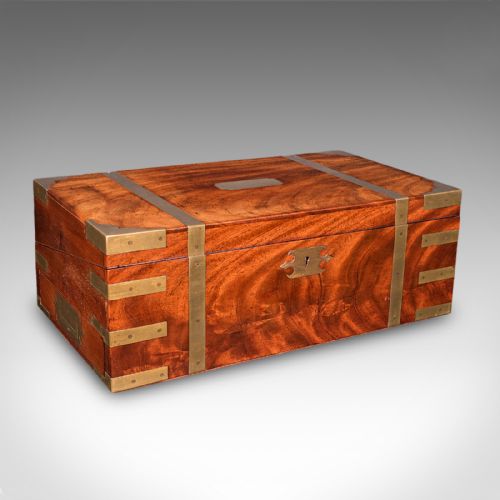
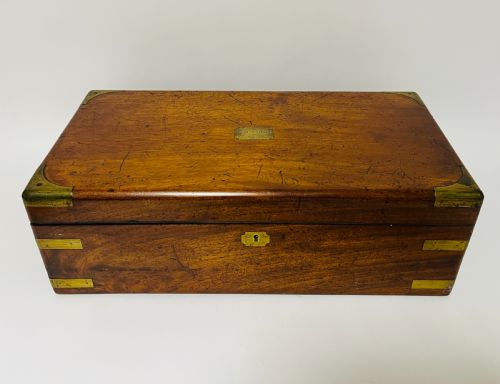
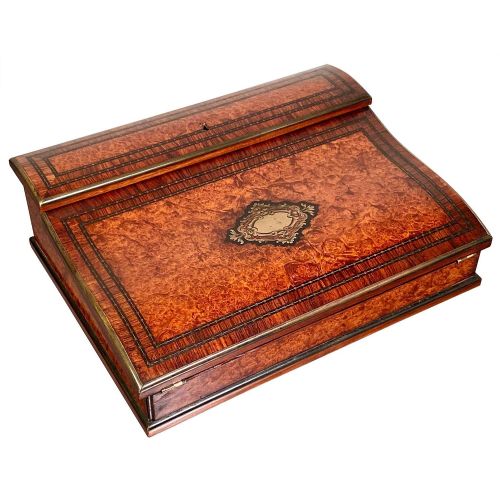


Victorian Campaign Writing Slope
A victorian campaign writing slope is a portable timber desk bound in brass, designed for travel and built to last.
Victorian Campaign Writing Slope
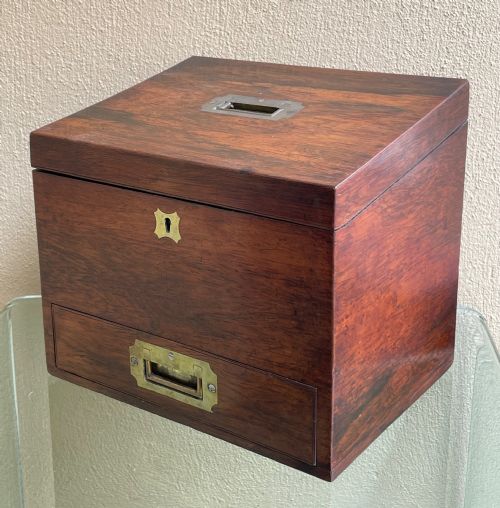
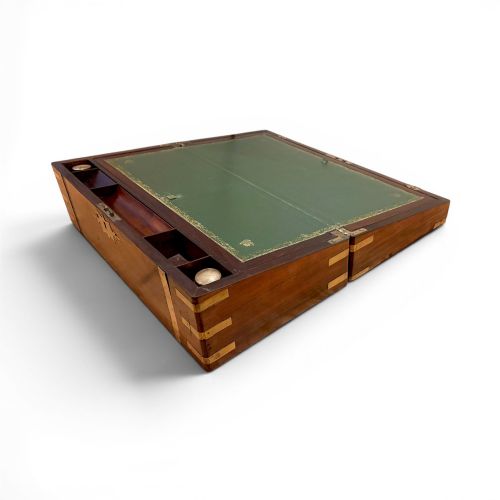
A victorian campaign writing slope is a portable desk constructed to fold open into a writing surface, designed originally for officers and travellers on the move. These boxes open to reveal sloped writing surfaces lined with leather, alongside compartments for inkwells, pens and stationery.
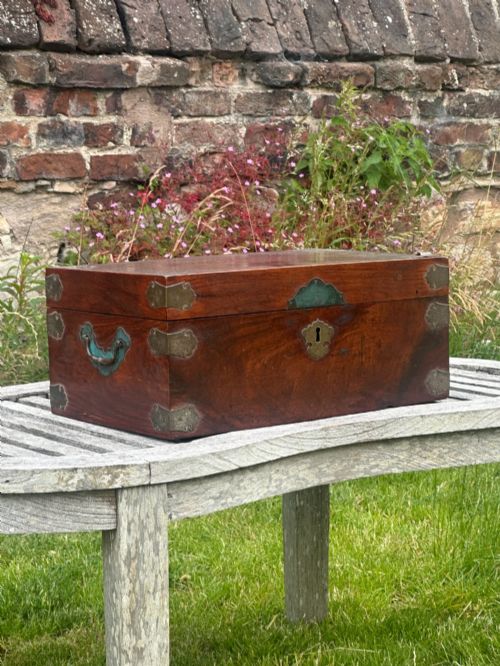
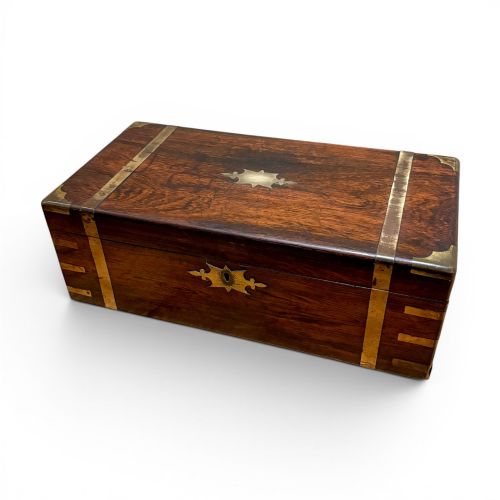
Mahogany and rosewood versions dominate the selection, heavily reinforced with brass corners, straps and flush carrying handles to withstand rough transit. Many examples include secret drawers concealed beneath internal stationery compartments, accessed by small wooden triggers or false partitions.
Beyond standard writing slopes, the selection includes correspondence boxes, reading stands, and metamorphic designs incorporating candle sconces or sovereign sections. These pieces range from plain, utilitarian military models in camphor wood or oak to highly decorative burr walnut and coromandel boxes.
How they were made
Cabinet makers built these portable desks around sturdy timber carcases of mahogany, walnut, camphor wood, or padouk, often using dense tropical hardwoods capable of enduring extreme climates. The external surfaces received brass corner braces, edge bindings and flush drop handles, secured tightly with countersunk brass screws to protect the joints from impact.
Internal fittings required precise joinery to integrate folding writing surfaces, small accessory drawers, and specialised compartments for ink and pens. Fine leather panels formed the writing surfaces, typically gold-tooled around the edges, while brass locks by makers such as Bramah secured the contents during transport.
Listings feature brass-bound writing slopes in mahogany, rosewood, burr walnut, camphor wood, and coromandel dating from the Georgian and Victorian eras.
What varies in quality
Quality rests on the selection of timber veneers, the precision of the brass inlay, and the integration of internal mechanisms like secret drawers and Bramah locks. Finer boxes utilise solid mahogany, figured burr walnut, coromandel, or exotic calamander, contrasted with simpler deal or secondary timbers on utilitarian pieces.
Construction details differentiate standard production from superior workshops, visible in flush-fitting brasswork, hand-cut dovetails on internal drawers, and complete, matching interior fittings. The inclusion of specialised elements, such as silver-capped inkwells, working keys, and candle sconces, elevates a piece.
Mappin and Webb
The Victorian Campaign Writing Slope Glossary
- Campaign slope
- A portable folding desk fitted with brass mounts and hinges, designed for military officers or colonial travellers. These boxes open to create a slanted writing surface and often feature internal compartments for ink and letters.
- Secret drawers
- Concealed storage compartments hidden behind false panels or beneath stationery wells within a writing box. Access usually requires removing specific divider partitions or operating small wooden spring catches.
- Bramah lock
- A high-security cylindrical lock invented by Joseph Bramah, commonly found on better-quality nineteenth-century campaign boxes. These locks operate with a specialised tubular key.
- Brass bound
- A method of reinforcing wooden campaign furniture by fixing brass strips and corner pieces along the edges and corners. This protected the timber from splitting during rough transport.
- Correspondence box
- A specialised stationary chest or box designed to hold writing paper, envelopes, and dispatch documents rather than serving primarily as a desk.
Victorian Campaign Writing Slope: Frequently Asked Questions
How do you open secret drawers?
Secret drawers are typically concealed behind false floor panels or removable partitions inside the stationery compartment. Lifting a specific interior divider or pressing a hidden wooden spring catch releases the secret compartment.
Many nineteenth-century boxes require removing the inkwells or lifting the pen tray to access these release mechanisms. Care must be taken not to force panels that resist movement.
What timber was used most often?
Mahogany is the primary timber found across these portable desks, prized for its stability and resistance to warping during travel. Rosewood, walnut, and camphor wood also appear frequently in regional and colonial variants.
More decorative examples utilise burr walnut, coromandel, and pollard oak veneers, often highlighted with brass inlay. Secondary timbers such as pine or cedar frequently form internal drawer linings.
Did military officers use these desks?
British military officers, diplomats, and colonial administrators utilised portable writing slopes during campaigns and extended postings abroad. The robust brass binding and compact folding design protected official documents and personal correspondence in transit.
Simpler utilitarian models served active military campaigns, while more luxurious rosewood and walnut versions suited permanent colonial residences.
How do you date a campaign slope?
Dating relies on timber choices, brass mounting styles, and lock types characteristic of the nineteenth century. Early nineteenth-century examples often feature plain mahogany with simple brass corners, while mid-Victorian pieces frequently incorporate elaborate brass inlay and burr veneers.
Makers' marks on locks, such as Bramah, provide a reliable benchmark for establishing the period of manufacture.