




Victorian Brass Canterbury
These Victorian brass canterbury pieces are sturdy, compartmentalised stands for sheet music and periodicals that bring period warmth and practical organisation to any room.
Victorian Brass Canterbury
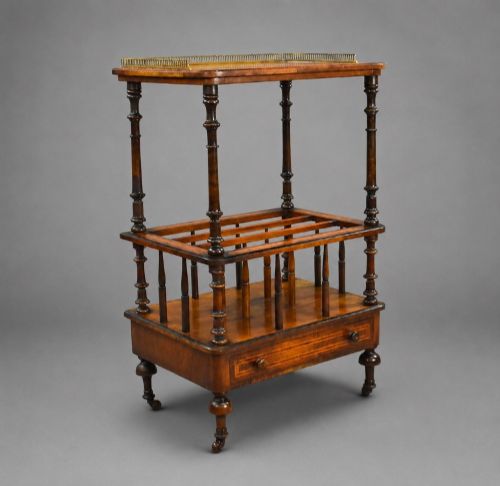
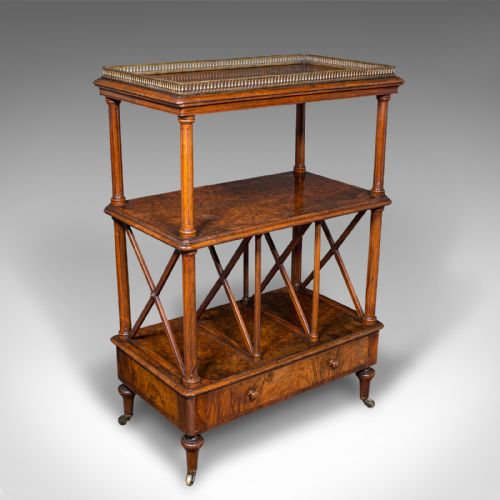
A victorian brass canterbury is a dedicated storage piece designed to keep folios, journals, and newspapers close at hand beside a piano or seating area. The form typically combines slatted partitions for upright papers with low drawers and occasional shelves.
Most examples encountered on this page date from the nineteenth century, spanning various decades of the Victorian era alongside related forms like revolving stands, music cabinets, and whatnots. Woods such as mahogany, walnut, rosewood, and ebonised timber frequently form the main structure, accented with brass rods, galleries, and castors.
Beyond standard floor-standing divisions, variations include revolving book stands and table-top music racks that reflect evolving domestic pastimes of the period. These pieces bridge the gap between heavy library furniture and light, movable parlour accessories.
How they were made
Cabinet makers utilised dense hardwoods like mahogany, walnut, and rosewood for the primary frames, often applying burr veneers or decorative inlay to visible surfaces. Ebonised finishes and contrasting timber combinations appear frequently across the selection.
Metalwork played a structural and decorative role, with cast brass rods forming the dividers, while brass castors allowed the heavy wooden frames to move smoothly across carpets. Linings, galleries, and knobs incorporated both brass and copper elements to withstand daily handling.
Listings feature woods including mahogany, walnut, burr walnut, rosewood, and ebonised timber paired with brass and copper.
What varies in quality
The degree of hand-finishing in the timber veneers and the intricacy of the wood inlay distinguish simpler utilitarian pieces from finer cabinet work. Strong figure in burr walnut or carefully matched rosewood grain elevates the visual weight of the furniture.
Hardware quality remains a key indicator, with heavy cast brass galleries and original rotating mechanisms showing superior weight and precise engineering compared to lighter replacements. The integration of structural brass rods with sturdy wood joinery ensures long-term stability under the load of heavy folios.
Henry Ogden and Son·J.C. Loudon
The Victorian Brass Canterbury Glossary
- Canterbury
- A low stand featuring upright partitions, originally designed to hold music folios or periodicals near an instrument. The name originates from an eighteenth-century Archbishop of Canterbury who commissioned a similar stand.
- Etagere
- A set of open shelves for displaying small objects, often incorporated into the upper tiers of music cabinets and whatnots. It allows items to be viewed from multiple angles.
- Gallery
- A low decorative railing, usually made of brass, fitted around the top edge of a stand or table to keep items from sliding off. This metal detail adds both structural security and a visual accent.
- Whatnot
- A multi-tiered piece of freestanding furniture used for storage and display in nineteenth-century drawing rooms. These stands combine open shelving with enclosed lower sections.
- Castor
- A small wheel mounted in a swivel housing attached to the base of furniture to permit easy rolling. Brass versions are typical on nineteenth-century stands.
Victorian Brass Canterbury: Frequently Asked Questions
What is a victorian brass canterbury used for?
These stands were originally built to hold sheet music, folios, and daily newspapers beside pianos or sitting room chairs. They keep paper goods organised upright and accessible.
Today, they serve the same function for modern magazines, vinyl records, or books while adding period character to a room.
Where should I place a music cabinet?
Music cabinets and stands work well beside armchairs, sofas, or musical instruments where reading materials gather. Their compact footprints suit corners and smaller wall spaces.
Revolving stands function effectively near the centre of a room or beside a desk where items need to be reached from multiple angles.
How do I care for wood and brass?
Maintenance involves dusting the wooden surfaces regularly and applying appropriate furniture wax occasionally to nourish the grain. Harsh chemical cleaners should be avoided.
Brass elements can be left with their natural aged patina or gently polished with a non-abrasive cloth if a brighter finish is preferred.
How can I tell the period?
Dating relies on observing construction methods, timber choices, and hardware styles across the piece. Heavier rosewood and mahogany frames with turned legs often point to the mid-nineteenth century.
Later Victorian and Arts and Crafts examples introduce stylistic shifts like exposed copper accents, ebonised surfaces, or lighter revolving mechanisms.