



Victorian Bowfront Table
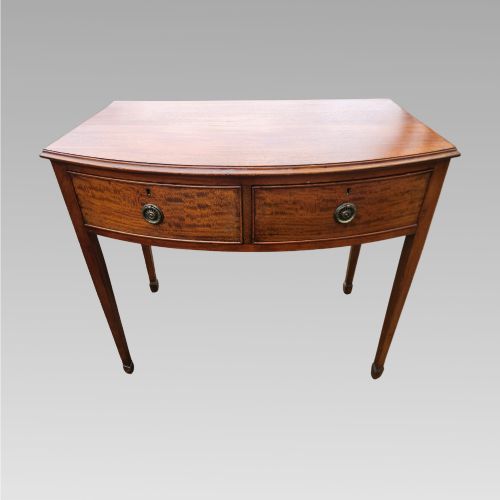
These Victorian bowfront table pieces offer curved silhouettes and rich timber grains, bringing practical surface space and period character to any room.
Victorian Bowfront Table
A Victorian bowfront table combines the curved convex front characteristic of the nineteenth century with functional forms ranging from bedside cabinets and side tables to larger sideboards and desks. These pieces originate across the nineteenth century, including specific dates such as 1870 and 1880, alongside broader Victorian and revival periods.
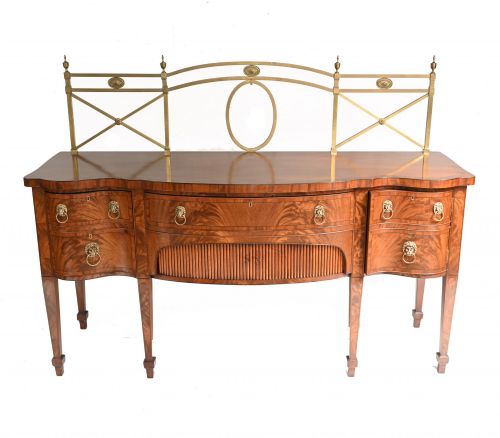
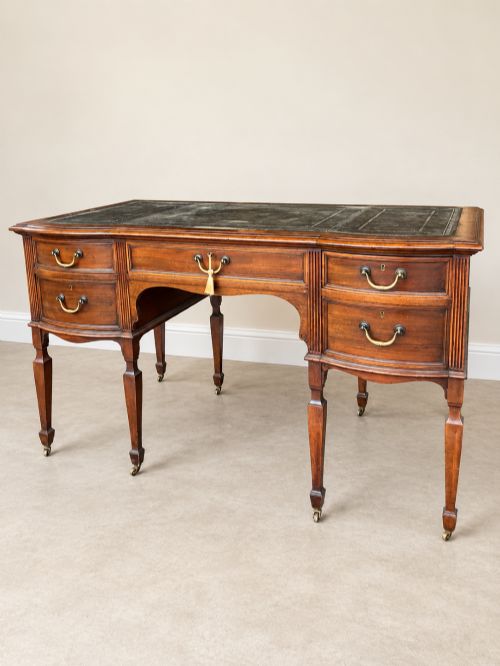
The variety spans compact bedside lockers and hall tables with lift-up lids up to grand twin pedestal desks and sideboards featuring brass galleries and drawers. Mahogany is the predominant timber found across these forms, frequently enhanced by contrasting veneers and inlays.
Buyers seeking a victorian bowfront table will encounter diverse stylistic influences, including Georgian Revival, Grand Regency, Queen Anne Revival, and William IV interpretations. Each object demonstrates the distinctive curved front edge that defines the category.
How They Were Made
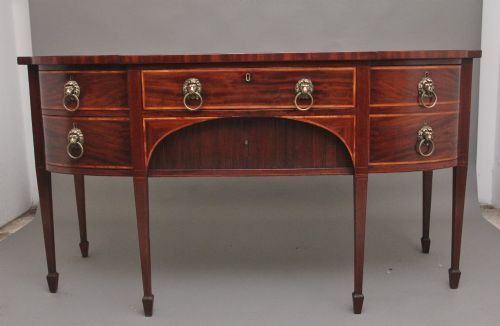
Cabinet makers constructed these pieces primarily using solid mahogany and supportive secondary timbers, often applying flame mahogany veneer to create rich, figured surfaces on the curved fronts. Inlays of boxwood, satinwood, and ebony provide linear contrast and geometric detailing.
Additional material touches include polished marble tops on specific tables and cast brass fittings such as galleries and drawer pulls. Construction techniques balance structural integrity with the intricate carpentry required to shape a continuous curved front.
Victorian Bowfront Table Retail Price Guide 2026
Typical asking prices for victorian bowfront table among the pieces listed under this phrase on Sellingantiques today, from the lower quarter to the upper quarter. They describe what is for sale here now, not the wider market.
Some hall tables hide a lift-up lid within their curved silhouette, offering secret storage for nineteenth-century visiting cards.
What Varies in Quality
The standard of a Victorian bowfront table rests upon the selection and matching of timber veneers across the curved facade, where continuous grain alignment indicates superior cabinet work. Finely executed stringing, boxwood and ebony inlay, and well-cast brass hardware further elevate a piece.
Proportion and the handling of secondary details, such as dovetailed drawer construction and the integration of marble tops or brass galleries, distinguish simpler utility items from more ambitious workshops.
Maples
The Victorian Bowfront Table Glossary
- Bowfront
- A convex curved front contour that swells outward toward the centre, softening the linear geometry of case furniture and tables.
- Flame mahogany
- A veneer cut from the fork of a mahogany tree where the branch joins the trunk, producing a distinctive flickering, flame-like grain pattern.
- Satinwood
- A pale, hard yellowish timber from tropical trees, frequently used for contrasting stringing, banding, and marquetry details in nineteenth-century furniture.
- Stringing
- Thin inlaid lines of contrasting wood used to outline drawers, table edges, and panels.
- Brass gallery
- A decorative open railing of metal fitted to the top surface of a sideboard or table to secure objects from sliding off.
Victorian Bowfront Table: Frequently Asked Questions
What rooms suit a bowfront table?
These pieces fit comfortably into hallways, bedrooms, and reception spaces where the curved front softens tight traffic routes.
Smaller bedside cabinets and side tables provide functional surface and storage space without dominating a room.
How do I identify a Victorian piece?
Look for characteristic nineteenth-century timber choices such as mahogany and pitch pine, often paired with hand-cut dovetails in the drawer construction.
Stylistic markers like revival influences and brass hardware help place the object firmly within the period.
Are marble top tables practical?
Marble tops offer a durable, wipe-clean surface that originally suited washstands and specific serving tables.
They add distinct weight and visual contrast to the surrounding timber frame.
What is the difference between a sideboard and a hall table?
Sideboards are generally larger dining room pieces designed for storage and serving, often incorporating drawers and cupboards.
Hall tables offer leaner proportions suited for entryways, sometimes featuring lift-up lids or compact drawer arrangements.