



Victorian Bow Front Credenza
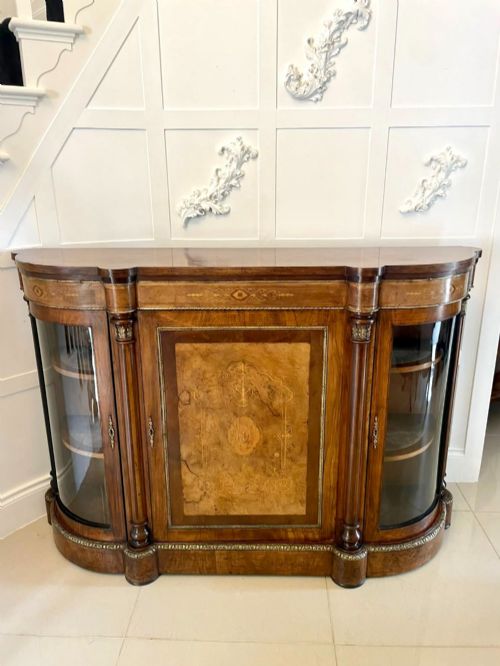
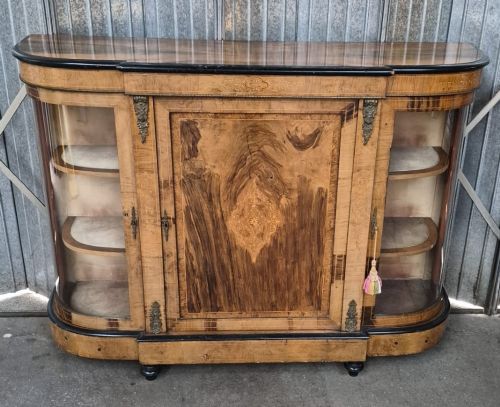
These Victorian bow front credenza pieces are substantial reception room cabinets combining curved glass and rich timbers to anchor a formal interior.
Victorian Bow Front Credenza
A Victorian bow front credenza stands as a prominent display and storage cabinet for the principal rooms of nineteenth century houses, defined by its curved central or end sections. These low credenzas and side cabinets appear primarily from the Victorian era, alongside revival pieces produced towards the end of the nineteenth century.
The form typically incorporates glazed central doors flanked by curved side compartments or bow ends, offering display space for porcelain and silver. Makers utilised burr walnut, mahogany, and satinwood, often enhanced with contrasting ebonised wood and classical stringing.
Examples on this page span from the William IV period through mid Victorian walnut iterations to Sheraton revival and Georgian revival interpretations dating up to eighteen ninety. Each version reflects the nineteenth century taste for figured veneers and polished mounts.
Materials and Construction
Cabinet makers constructed these pieces using solid carcasses of mahogany or pine, overlaid with highly figured burr walnut or satinwood veneers to create rich grain patterns across the curved fronts. Ebonised wood detailing and marquetry inlay provide sharp contrast against the golden tones of the primary timbers.
Mounts of cast or chased ormolu and brass frame the glazed doors and accent the corners, while curved glass panels are set carefully into the bowed timber doors. Pietra dura panels and painted decoration occasionally supplement the traditional wood veneers on specific exhibition quality cabinets.
Victorian Bow Front Credenza Retail Price Guide 2026
Typical asking prices for victorian bow front credenza among the pieces listed under this phrase on Sellingantiques today, from the lower quarter to the upper quarter. They describe what is for sale here now, not the wider market.
Makers of these credenzas bent thick walnut timber using steam and patience long before power tools arrived in the workshop.
Distinctions in Quality
Quality reveals itself in the selection of the burr walnut veneer, where symmetrical grain matching across a curved bow front requires considerable skill from the cabinet maker. Finer credenzas display crisper ormolu mounts, more intricate marquetry inlay, and heavier gauge brass hardware that remains tight and true to the timber.
The execution of the curved woodwork sets the standard for these credenzas, distinguishing standard cabinet work from the precision found in pieces bearing maker marks such as Edwards and Roberts. Structural integrity in the bowed glass doors and the depth of the hand polished finish separate ordinary side cabinets from superior examples.
Edwards and Roberts
The Victorian Bow Front Credenza Glossary
- Credenza
- A low cabinet or sideboard designed for dining rooms and reception rooms, typically featuring central doors flanked by side cupboards. The form gained immense popularity throughout the Victorian period.
- Bow Front
- A convex curved front section that projects outward in a smooth arc. This shape softens the profile of a heavy wooden cabinet.
- Burr Walnut
- Timber taken from the gnarled growth of a walnut tree, yielding a swirling, highly decorative grain pattern. Cabinet makers prized this veneer for high status Victorian furniture.
- Ormolu
- Gilded bronze or brass applied as decorative mounts and feet on nineteenth century furniture. It provides a bright metallic contrast against dark timber.
- Marquetry
- Decorative patterns formed by fitting contrasting pieces of veneer into a wood foundation. Craftsmen used floral and geometric motifs on these surfaces.
Victorian Bow Front Credenza: Frequently Asked Questions
What room were these cabinets made for?
Victorian credenzas were designed principally for the drawing room or formal dining room to store and display precious household items.
Their low profile ensured they did not block wall art or mirrors while providing a substantial surface for ornaments.
What timber is most common?
Burr walnut is the predominant timber found across these nineteenth century credenzas and side cabinets.
Mahogany and satinwood also appear frequently, particularly on revival pieces and earlier William IV examples.
Are these credenzas glazed?
Many examples incorporate glazed doors on the central or side sections for the display of ceramics and glassware.
Solid wood panel doors also occur, sometimes complemented by pietra dura plaques or painted satinwood decoration.