


Victorian Blue Glass Lighting
Victorian blue glass lighting brings rich colour and steady nineteenth-century craftsmanship into a room.
Victorian Blue Glass Lighting
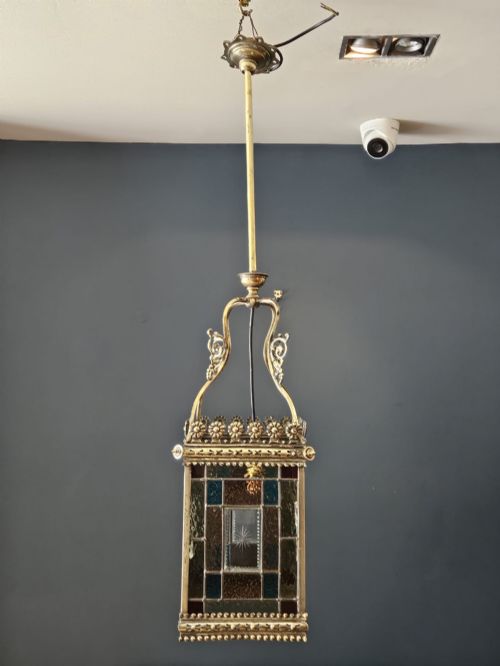
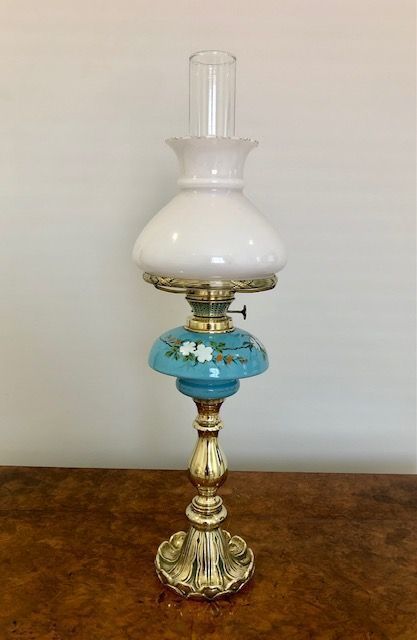
Victorian blue glass lighting encompasses oil lamps, table lamps, ceiling lights, and lanterns produced primarily during the nineteenth century. These items combine deep blue glass fonts or shades with mounts in brass, gilt bronze, or ceramic.
The pieces appearing here span from mid-nineteenth-century examples through to late Victorian and Edwardian periods. Oil lamps with blue fonts and tinted or matching shades form a central part of this selection.
Related decorative items such as mantel lustres and vases also emerge within these listings, sharing the same characteristic glass colouring and period manufacture.
Materials and construction
Makers utilised rich blue glass, often formed as cut glass, opaline glass, or overlay glass, paired with sturdy metal components. Brass and gilt bronze provide the structural frames, wall brackets, and burner assemblies that support the glass elements.
Techniques range from hand-painted decoration and decalcomania to complex layered glass cutting, as seen in Bohemian overlay pieces. Lead and ceramic elements additionally appear in the bases and structural mounts of lamps and lanterns.
Terrestrial globes peer out from nineteenth-century glass shades, bringing a touch of early cartography directly to the tabletop.
Assessing quality in period lighting
Quality rests upon the clarity and depth of the blue glass itself, alongside the precision of any cut or overlay work. Superior pieces display crisp detailing in the brass embossing and solid construction in the mounting hardware.
The integration between the glass font and its metal base indicates the standard of original assembly. Pieces retaining matching shades or original burner mechanisms demonstrate higher integrity than those with later replacements.
The Victorian Blue Glass Lighting Glossary
- Font
- The reservoir that holds the lamp oil beneath the burner assembly. It is frequently formed from coloured or cut glass.
- Overlay glass
- A technique where a layer of blue glass is fused over a clear or contrasting glass body and partially cut away to reveal the base colour. This method creates rich surface pattern and depth.
- Mantel lustre
- A decorative ornamental vase hung with crystal prisms, designed to sit upon a fireplace mantel. These often share the blue glass aesthetic of period lighting.
- Decalcomania
- A decorative technique involving the transfer of printed designs onto glass surfaces. It appears on specific nineteenth-century table lamps in this selection.
- Opaline glass
- An opaque or translucent glass popular in the nineteenth century, often tinted in shades of blue. It diffuses light softly when used for lamp shades and globes.
Victorian Blue Glass Lighting: Frequently Asked Questions
How do I clean antique blue glass?
Wash the glass gently in lukewarm water with mild soap, avoiding harsh abrasives that might damage the surface. Dry with a soft cloth to preserve the finish.
Keep metal mounts dry and dust them carefully with a soft brush to protect brass or gilt bronze elements.
Are these oil lamps still usable?
Many period oil lamps retain their original burners and reservoirs, though most are adapted for modern electrical use today. Consulting a professional electrician ensures safe operation if you choose to wire them.
Retaining the original components maintains the historical value of the piece regardless of whether it functions with oil or electricity.
What is Bohemian overlay glass?
Bohemian overlay glass consists of multiple fused glass layers where the outer blue layer is cut away to reveal a different colour underneath. This creates high-contrast decorative patterns characteristic of nineteenth-century craftsmanship.
Such pieces demand considerable skill from the glassmaker and are typically prized for their intricate ornamental effect.
How do I date a Victorian lamp?
Examine the materials, burner types, and mounting styles to establish an approximate period within the nineteenth century. Brass framing, ceramic bases, and specific glass cuts often point to particular decades between eighteen-fifty and nineteen-hundred.
Maker marks on the burner mechanisms, such as Hinks, also provide helpful chronological markers for dating the assembly.