
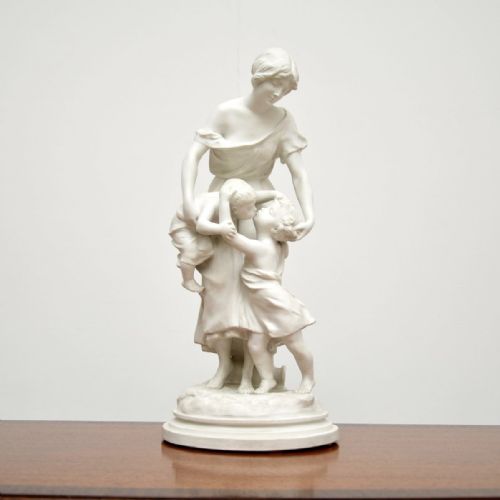


Victorian Bisque Figures
These Victorian bisque figures bring unglazed ceramic charm and classical detail to a mantelpiece, offering a tactile glimpse into nineteenth-century decorative sculpture.
Victorian Bisque Figures
When searching for Victorian bisque figures, you are looking at unglazed ceramic works that capture human forms, mythological subjects, and domestic scenes from the nineteenth century. These pieces appear as single statuettes, sculptural pairs, and intricate figure groups originating from English, French, and German makers.
The most common examples on this page are porcelain and parian figures, often depicting classical women, children, fisher folk, and romantic couples. They range from small cabinet pieces to large scale studies, carrying influences from neoclassical, rococo revival, and art nouveau styles.
Materials and manufacture
These figures are made primarily from bisque porcelain and parian porcelain, an unglazed ceramic body developed to imitate carved marble. The ceramic mass is cast in moulds, allowing for fine detail in drapery, hair, and facial expressions before being fired without a glossy glaze.
Listings feature works spanning the nineteenth century and into the early 1900s, encompassing English, French, and German origins.
Distinctions in quality
The distinction also lies in the ambition of the subject and the reputation of the porcelain works. Larger scale studies and named models produced by established factories exhibit a sculptural presence that simpler mass-produced figurines lack.
Letu & Mauger Paris·Minton·Vion et Baury·Copeland·Royal Dux·Triebner Ens & Co·Gebruder Heubach
The Victorian Bisque Figures Glossary
- Bisque porcelain
- Unglazed white ceramic ware that has been fired once, presenting a matte, marble-like texture. It was widely utilised in the nineteenth century for portrait busts and decorative statuary.
- Parian porcelain
- A fine-grained white porcelain developed in England to resemble carved marble. This material allowed nineteenth-century manufacturers to produce highly detailed sculptural figures.
- Piano baby
- A decorative bisque or ceramic figurine produced around 1900, traditionally placed on the decorative ledge of a piano. These figures typically depict infants or children in reclining or crawling poses.
- Figurine
- A small, three-dimensional sculpted figure representing a human or animal. In nineteenth-century ceramics, these objects served primarily as interior ornamentation.
Victorian Bisque Figures: Frequently Asked Questions
What are Victorian bisque figures made of?
These pieces are made from unglazed ceramic bodies, primarily standard bisque porcelain and parian porcelain. Some examples incorporate touches of enamel paint or gold leaf.
The unglazed surface gives them a distinctive matte finish that mimics carved marble, setting them apart from glossy glazed porcelain.
How do I display them at home?
Place these figures on stable surfaces such as mantelpieces, wooden cabinets, or side tables where their detailed modelling can be appreciated up close. Avoid areas of heavy traffic where delicate elements like fingers or basket handles might be brushed.
Keep them away from direct sources of grease or heavy dust accumulation, as the porous unglazed surface absorbs grime over time.
Are these figures marked by makers?
Many pieces carry impressed numbers, factory stamps, or moulded seals on the underside or base. These marks often indicate the producing pottery or the specific model number.
Unmarked examples still frequently reveal their origin through the quality of the ceramic paste and the sculptural style characteristic of French or English studios.