

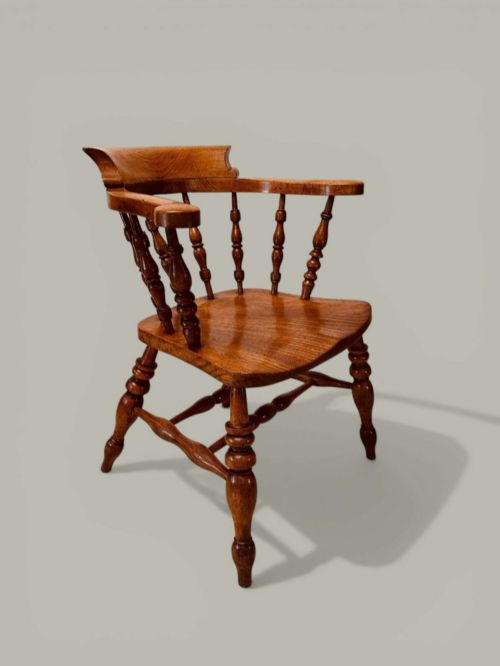
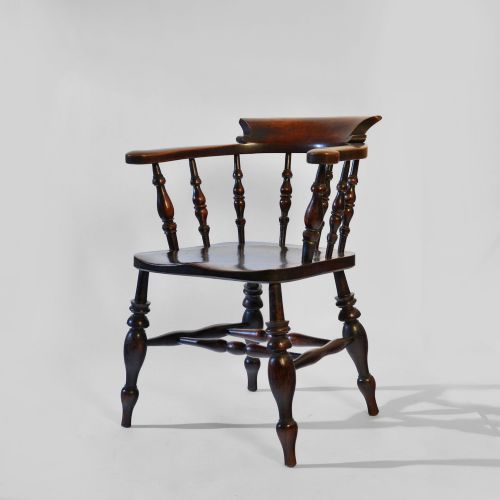
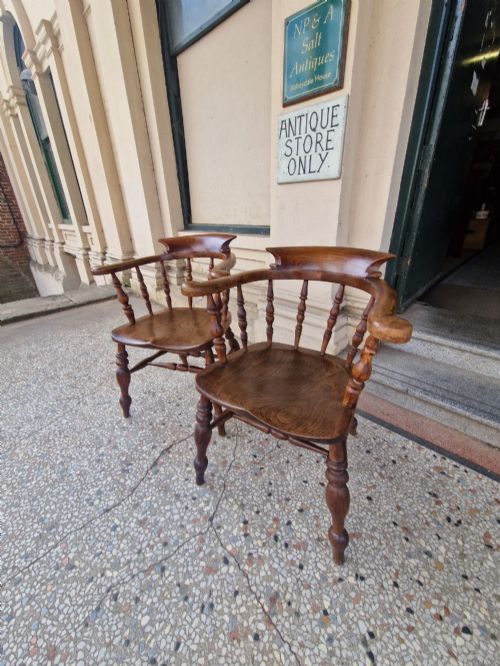


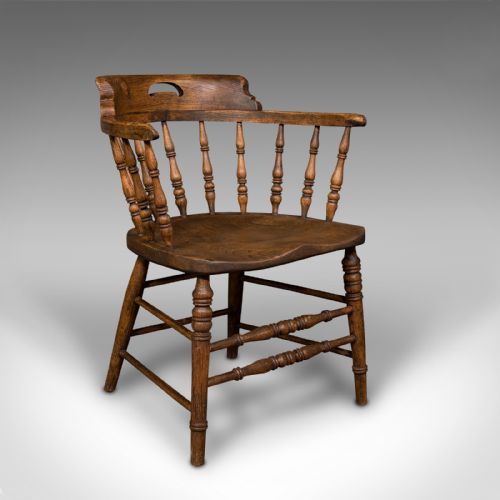


Victorian Ash Smokers Bow
These robust Victorian ash smokers bow armchairs combine country utility with sturdy nineteenth-century joinery.
Victorian Ash Smokers Bow
A victorian ash smokers bow is a distinct vernacular armchair found across nineteenth-century English interiors, merging the low-back Windsor form with a robust turned spindle gallery. These sturdy seats appear in descriptions under various regional names including captain chairs, elbow chairs, and farmhouse armchairs.
The primary examples on this page date from the Victorian period, frequently attributed to the mid nineteenth century and around eighteen eighty. They function comfortably as desk chairs or parlor seating, offering a generous rounded arm bow supported by balanced turned spindles above a saddle seat.
How they were made
Construction relies on a combination of native timbers, predominantly utilising ash for framing and spindles alongside elm for sculpted plank seats. Beech occasionally appears in the turned structural components, reflecting traditional country workshop practices of selecting specific woods for strength and flexibility.
Makers shaped solid elm boards into comfortable saddle seats using adzes and drawknives, then bored tapered holes to receive the steam-bent ash bow and undercarriage legs. Spindles and stretchers were hand-turned on pole lathes, creating tight wedged joints that held firm without modern adhesives.
Victorian Ash Smokers Bow Retail Price Guide 2026
Typical asking prices for victorian ash smokers bow among the pieces listed under this phrase on Sellingantiques today, from the lower quarter to the upper quarter. They describe what is for sale here now, not the wider market.
Country makers relied on wood so tough that shaping a saddle seat required an adze and immense patience.
What varies in quality
Quality rests principally in the figure of the timber and the depth of the sculpted elm seat, where deeply dished planks indicate greater initial labour and comfort. The thickness and continuous sweep of the ash bow also dictate structural integrity, with finer examples retaining crisp turning details on the spindles and legs.
Proportion and balance distinguish superior country pieces from heavier utility seating, particularly in the curve of the arm bow and the splay of the undercarriage. Wear patterns tell a story of longevity, but the best specimens maintain tight joints and minimal timber shrinkage around the wedged leg tops.
The Victorian Ash Smokers Bow Glossary
- Smoker's bow
- A low-backed wooden armchair with a continuous curved rail functioning as both backrest and arms, popular in nineteenth-century country settings and public houses. This form provides compact support while permitting freedom of movement.
- Windsor chair
- A wooden chair constructed with a solid sculpted seat into which the legs and back sticks are independently tenoned. Traditional English examples frequently mix timbers such as ash, elm, and beech.
- Captain's chair
- A nineteenth-century vernacular term often applied interchangeably to low-back Windsor armchairs and smokers bows used in offices or domestic studies. They provide sturdy seating suited to prolonged desk work.
- Saddle seat
- A thick wooden chair base shaped with concave depressions to mimic the contours of a saddle for enhanced sitter comfort. Elm is the preferred timber for this component due to its interlocking grain which resists splitting.
- Spindle
- A slender, turned wooden rod used vertically to fill the space between the seat and the arm bow. These components distribute weight and provide structural rigidity to the backrest.
Victorian Ash Smokers Bow: Frequently Asked Questions
What is a smokers bow chair?
A smokers bow is a nineteenth-century low-backed wooden armchair featuring a continuous curved arm rail and turned spindles.
These pieces combine the construction methods of Windsor chairs with compact dimensions suitable for domestic or commercial use.
How old are these armchairs?
The pieces listed originate in the Victorian era, spanning the nineteenth century with specific examples dated around eighteen fifty and eighteen eighty.
Age is determined through construction techniques, timber characteristics, and traditional vernacular design styles.
Why are different woods used together?
Country makers selected specific timbers for their individual mechanical properties, combining tough ash for bentwood bows with resilient elm for carved seats.
Beech frequently supported turned undercarriage components where fine lathe work was required.
Were these chairs used at desks?
Nineteenth-century examples frequently served as desk chairs or parlor seating due to their supportive low backs and sturdy arm rests.
Listings often describe them interchangeably as captain chairs or farmhouse armchairs depending on their specific proportions.
How should I care for an ash and elm chair?
Maintain antique wooden furniture by keeping it away from direct heat sources and sudden humidity changes that cause timber movement.
Applying occasional natural wax preserves the finish and nourishes the historic grain of the ash and elm.