




Veneered Console Table
These veneered console table examples bring rich timber surfaces and architectural form to hallways and drawing rooms alike.
Veneered Console Table
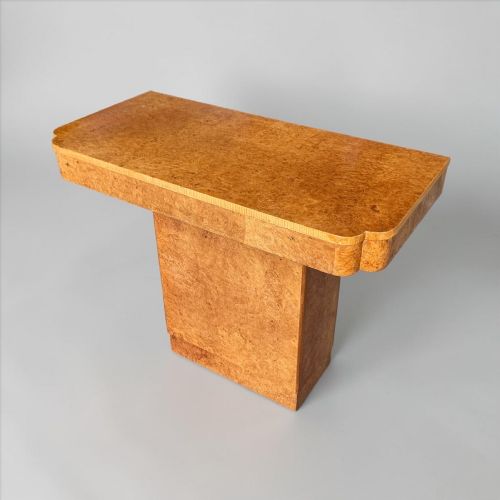
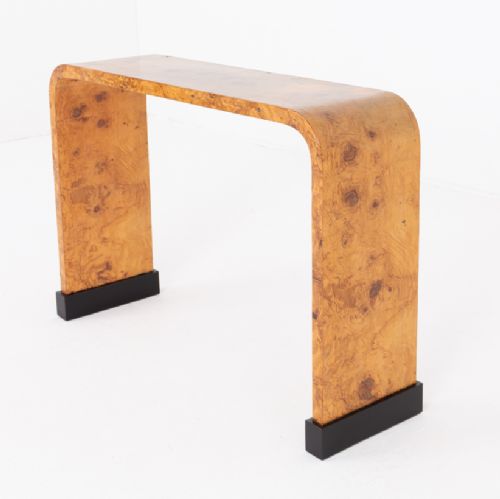
A veneered console table serves as a striking wall-mounted or freestanding surface designed to display decorative objects or anchor a hallway. When exploring this selection, buyers frequently encounter walnut and burr birch finishes from periods ranging from the seventeenth century through to Art Deco designs.
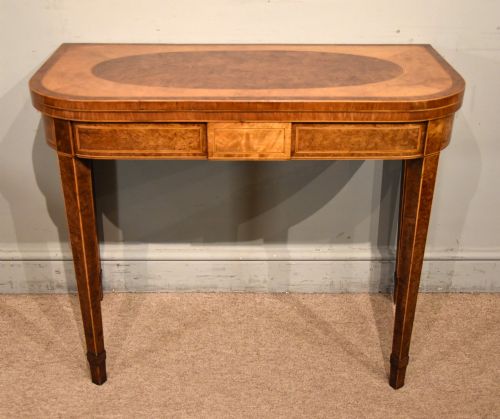
The assortment spans diverse silhouettes, including demi-lune shapes, folding card tables, and lowboys alongside traditional console tables. These pieces draw on various stylistic revivals, incorporating French, Empire, and Queen Anne influences into their structural forms.
Originating from centuries of cabinet-making traditions, these tables utilise thin decorative wood slices applied to primary timber carcases. The resulting forms balance functional surface space with elaborate grain patterns suited to formal interiors.
Materials and construction methods
Cabinet-makers applied fine decorative veneers such as burr walnut, kingwood, tulipwood, and maserbirch onto stable underlying timber carcases. This technique allowed workshops to display intricate natural grain patterns that solid timber planks could not provide uniformly.
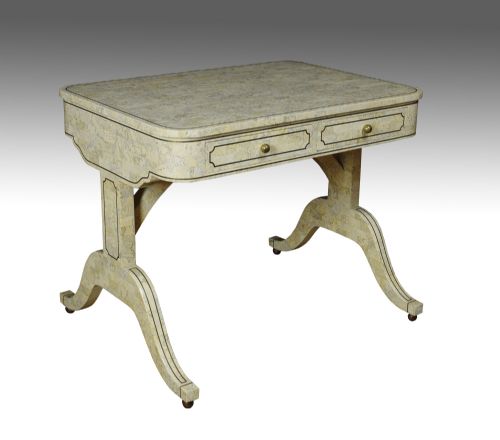
Many examples incorporate cast brass and ormolu mounts to accent structural edges, aprons, and legs. Surface decoration frequently includes featherbanding and quarter-veneered arrangements to create geometric symmetry across the tabletops.
Several tables manage to look startled by their own reflection when paired with a matching console mirror.
Assessing quality and execution
Superior execution shows in the careful book-matching or quarter-matching of timber veneers across the top surface, ensuring natural patterns mirror each other seamlessly. Lower grades often display uneven grain alignment or heavy secondary finishes that obscure the natural warmth of the wood.
The refinement of secondary details, such as precise brass mounts, hand-cut joinery, and well-preserved featherbanding, separates standard production from exceptional examples. Structural integrity in the legs and aprons remains paramount for pieces designed to support decorative items against a wall.
The Veneered Console Table Glossary
- Quarter veneered
- A layout where four matching slices of wood grain are arranged symmetrically to form a distinctive quartered pattern on the tabletop.
- Featherbanding
- A delicate inlay technique using small pieces of veneer arranged in a herringbone pattern around the perimeter of a surface.
- Demi-lune
- A half-moon shape common in console and card tables designed to sit flush against a wall.
- Ormolu
- Gilded bronze mounts used decoratively on furniture frames, particularly prominent in French revival pieces.
Veneered Console Table: Frequently Asked Questions
What is a veneered console table used for?
These tables traditionally stand against hallway or drawing room walls to display ornamental objects, mirrors, or lighting.
They also adapt well as compact serving surfaces or writing desks depending on the specific tabletop configuration.
How do I care for antique veneer?
Keep wooden surfaces away from direct sunlight and sudden temperature shifts to prevent the underlying adhesive from drying out.
Apply traditional wax sparingly and polish with a soft cloth to maintain the natural lustre of the timber.
What is the difference between a console and a side table?
Console tables historically stand against a wall, sometimes relying on wall brackets or front legs for support.
Side tables feature four independent legs and are designed to stand freely anywhere within a room.
How can I identify a Biedermeier table?
Biedermeier pieces typically showcase light-coloured domestic veneers like maserbirch with clean, unadorned architectural lines.
Decoration focuses on natural wood grain rather than heavy applied ornamentation.
Are these tables suitable for modern homes?
Their narrow profile makes them practical for contemporary hallways, entryways, and narrow living spaces.
They mix easily with modern decor by adding natural warmth and historical texture to a room.