
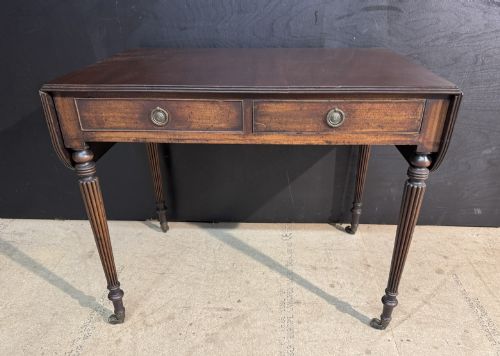


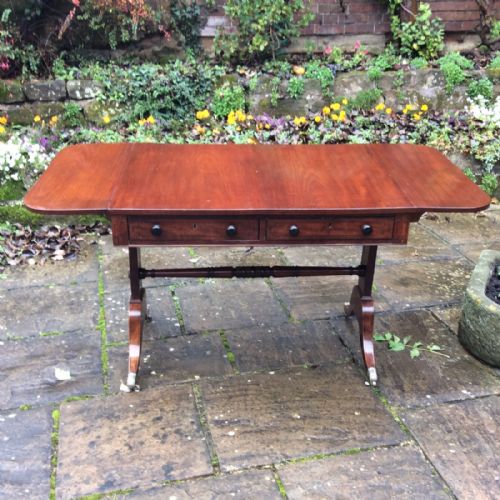

Two Drawer Pembroke Table
A two drawer pembroke table offers clever drop-leaf practicality and tidy storage, making it a versatile classic for any room.
Two Drawer Pembroke Table
A two drawer pembroke table combines hinged drop leaves with a pair of working drawers, designed for flexible placement in domestic spaces. These versatile pieces appear across multiple historical periods, including the Georgian, Regency, William IV, and Edwardian eras.
The form frequently overlaps with sofa tables and occasional tables in the historical record, featuring timber drop leaves supported by swing brackets. Most examples encountered on this page utilise rich hardwoods such as mahogany and rosewood.
Buyers often discover these tables finished with thoughtful details like boxwood inlay or brass mounts. Originating as functional household furniture, they function successfully today as writing desks or console surfaces.
How they were made
Cabinetmakers constructed these tables using dense timbers such as mahogany, Cuban mahogany, and rosewood, often selecting figured grain for visible surfaces. Structural framing frequently incorporated secondary woods to support the weight of the drawers and extending leaves.
Fine decorative elements involved contrasting stringing and boxwood inlay set directly into the primary wood. Brass fittings, including castors and inlaid details, provided both mobility and visual contrast against the dark timber.
Some nineteenth-century work tables include integrated fabric bags beneath the drawers for storing sewing wool.
What varies in quality
The sophistication of the timber selection largely determines the standing of a piece, with figured Cuban mahogany and rosewood sitting at the upper end. Finer examples display meticulous attention to the continuity of the wood grain across the drawer fronts and drop leaves.
Construction methods also separate standard production from superior cabinet work, particularly in the precision of the drawer dovetailing and the smooth operation of the drop leaf hinges. Subtle additions such as delicate boxwood inlay or quality brass hardware indicate a higher grade of manufacture.
Andrew Thomson & Sons
The Two Drawer Pembroke Table Glossary
- Pembroke table
- A small table featuring two hinged drop leaves on opposite sides. This form typically includes one or two drawers and dates back to the eighteenth century.
- Drop leaf
- A hinged flap of wood attached to the main top of a table. It can be raised and supported by a swinging bracket or lowered to save space.
- Cuban mahogany
- A dense, highly figured timber sourced from Cuba and widely used in fine eighteenth and nineteenth-century cabinetmaking. Its rich colour and grain make it particularly sought after by collectors.
- Boxwood inlay
- A decorative technique where thin strips of pale boxwood are embedded into darker wood surfaces. This creates sharp geometric patterns or contrasting borders.
- Sofa table
- A rectangular drop-leaf table designed during the late eighteenth and early nineteenth centuries to stand in front of a sofa. It usually incorporates two drawers and twin pillar supports.
Two Drawer Pembroke Table: Frequently Asked Questions
What is a two drawer pembroke table?
A two drawer pembroke table is a compact item of furniture featuring hinged leaves on either side and a pair of drawers. It was designed for flexible use in domestic interiors.
The inclusion of drop leaves allows the table footprint to expand or contract depending on space requirements. The drawers provide concealed storage for small household items.
How were these tables used originally?
These tables served various domestic functions, from serving tea and writing letters to holding work baskets. Their adaptability made them suitable for multiple rooms in a home.
Because they could stand against a wall with leaves dropped and move into the centre of a room when opened, they offered exceptional versatility.
How do I tell Regency from Georgian pieces?
Georgian pieces often display simpler, straight-lined elegance with classical proportions and darker mahogany tones. They frequently date from the mid to late eighteenth century.
Regency examples, produced around the turn of the nineteenth century, tend to incorporate bolder decorative elements such as brass inlay, rosewood veneers, and pedestal bases.
Where should I place one at home?
These tables suit hallways, sitting rooms, or studies where floor space is limited. With the leaves down, they occupy a very small footprint.
Opening one or both leaves creates a functional surface for lamps, books, or a laptop while retaining the historical character of the room.