

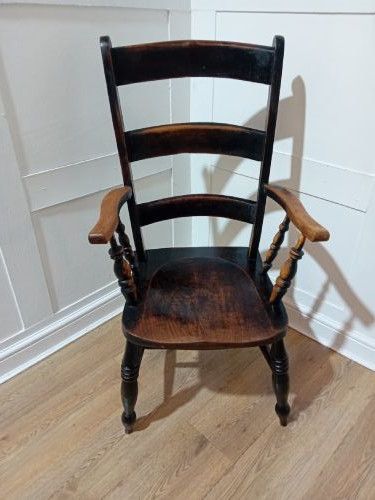


Turned Wood Ladderback Armchair
A turned wood ladderback armchair offers rustic seating shaped by regional vernacular traditions across centuries.
Turned Wood Ladderback Armchair
When you search for a turned wood ladderback armchair, you encounter robust seating forms rooted in domestic history. These chairs combine upright posts with horizontal back slats and turned components that give the frame its structure. The selection spans domestic utility from the eighteenth century through to the early twentieth century.
You meet variations ranging from simple kitchen chairs to rocking forms and regional styles such as Victorian Thames Valley designs or Anglo-Indian colonial pieces. The origins stretch from English country workshops to Shaker communities and colonial outposts, reflecting diverse local needs.
Armchairs dominate the selection, often accompanied by rocking variants designed for domestic comfort. The proportions vary from sturdy elm and beech kitchen seating to lighter ash frames built for specific regional interiors.
Materials and construction methods
Timbers like elm, ash, beech, oak, and teak form the backbone of these chairs, chosen for their local availability and strength. Cabinet makers turned spindles on lathes to create uprights and stretchers, joining them securely to heavy solid seats.
Seating areas rely on natural materials such as woven rush, sea grass, or fabric inserts to provide flexible support within the wooden frame. These traditional methods ensure the structure remains resilient through decades of daily use.
Turned Wood Ladderback Armchair Retail Price Guide 2026
Typical asking prices for turned wood ladderback armchair among the pieces listed under this phrase on Sellingantiques today, from the lower quarter to the upper quarter. They describe what is for sale here now, not the wider market.
Listings feature elm, beech, ash, and teak frameworks paired with rush and sea grass seating across multiple centuries.
Assessing quality in turned seating
Quality rests upon the integrity of the turned spindles and the tightness of the joinery connecting the ladder rails to the upright posts. Original surface finishes elevate a piece, whereas heavy modern intervention diminishes historical character.
The choice of timber grain and the skill in shaping the arms and slats dictate the visual balance of the chair. Uniformity in the turning combined with robust proportions separates utilitarian workshop output from refined vernacular furniture.
The Turned Wood Ladderback Armchair Glossary
- Ladderback
- A chair back featuring horizontal slats resembling the rungs of a ladder between two upright posts. These slats are often curved to fit the contours of the sitter.
- Rush
- Woven marsh plant stems used to create durable, flexible seat pads. This material requires skilled hand-weaving to span the wooden seat frame.
- Vernacular
- Everyday objects built by local craftspeople using regional traditions and readily available local materials rather than high-style metropolitan designs.
- Spindle
- A cylindrical turned piece of wood shaped on a lathe to form structural supports, legs, or decorative back posts.
Turned Wood Ladderback Armchair: Frequently Asked Questions
Where were these chairs used?
These armchairs served primarily in domestic kitchens, country houses, and communal spaces where durable seating was essential. Their robust construction suited daily manual labour and long hours of household use.
Over time, many migrated from utilitarian rooms to living spaces as collectors began to value regional craftsmanship and rustic aesthetics.
How do I care for rush seats?
Rush seating requires dry conditions to prevent the natural plant fibres from rotting or becoming brittle. Regular dusting with a soft brush helps maintain the material without introducing excess moisture.
Avoid placing these chairs near direct heat sources or damp areas to preserve the flexibility of the woven strands.
How do I date a ladderback chair?
Dating relies on examining tool marks, timber species, and the profile of the turned spindles. Earlier pieces often display irregular hand-turned details and deep patination on native hardwoods.
Comparing the construction joints and the style of the ladder rails against known regional periods helps narrow down the decade of production.
Are rocking chairs original?
Many rocking chairs were built as rockers from the outset, while others were adapted later in their lifespan from standard armchairs. Examining the feet and lower rockers reveals whether the curve is an integral part of the initial design.
Both forms appear across nineteenth-century country workshops and communal production centres.