
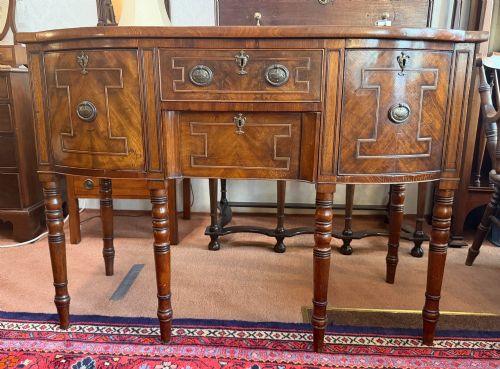
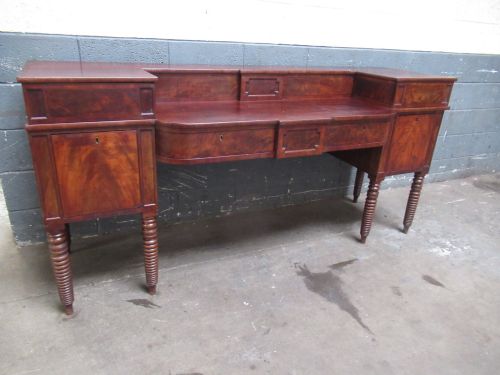
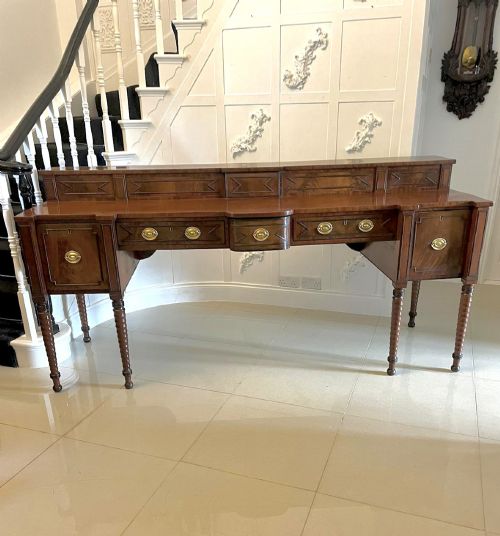
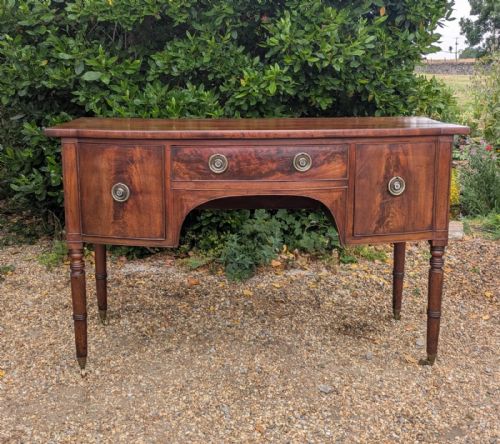
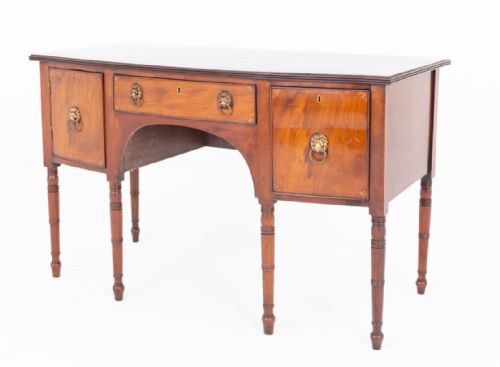
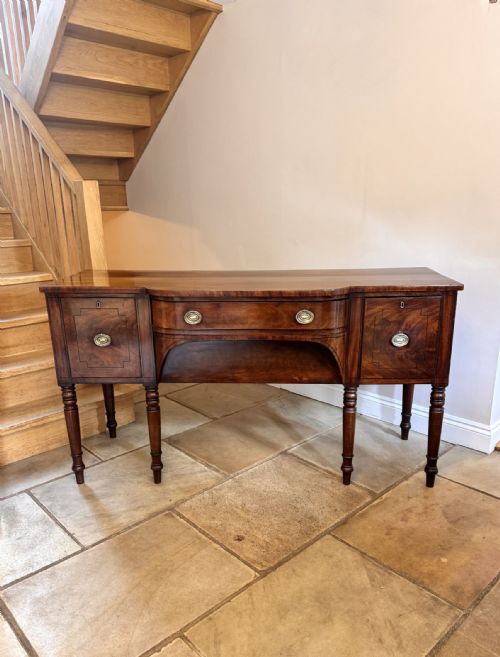


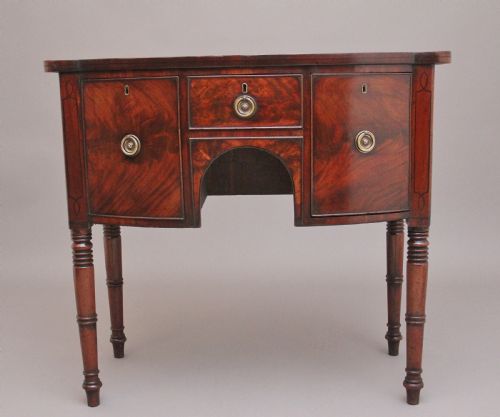


Turned Leg Mahogany Sideboard
These turned leg mahogany sideboard examples bring lasting utility and period warmth to a dining room.
What a turned leg mahogany sideboard is
A turned leg mahogany sideboard serves as a practical dining room server and a strong focal point in a traditional interior. When you search for a turned leg mahogany sideboard, you encounter formal dining furniture designed for serving food and storing linen.
Most pieces appearing here belong to the Georgian and Regency periods, with styles spanning George III through to Grand Regency. Makers utilised rich timbers to create both bowfront and breakfront silhouettes suited to formal entertaining.
How they were made
Cabinet makers constructed these sideboards using solid mahogany and flame mahogany veneers over secondary timbers. Selected pieces feature delicate boxwood inlay to accent the front fascia and drawers.
Makers shaped the supports on a lathe to produce the characteristic turned legs seen on these examples. Brass hardware, including handles and escutcheons, completes the construction of the drawer fronts.
Retail Price Guide 2026
Typical UK retail prices for turned leg mahogany sideboard, calculated from the Sellingantiques database of over a million retail prices indexed since 2003. This retail price guide relies exclusively on Sellingantiques data; no external sources or auction records are used, so the figures do not describe the wider market.
The inventory includes both straight bowfront configurations and grand breakfront designs supported on turned legs.
What varies in quality
Quality depends upon the selection of timber, with highly figured flame mahogany marking the upper end of the range. The crispness of the turned legs and the precision of any boxwood inlay further distinguish finer workshops.
Proportion and scale dictate desirability, from long bowfront formats to smaller provincial interpretations. The integration of original brass mounts and untouched timber patination elevates an example above standard utility pieces.
The Turned Leg Mahogany Sideboard Glossary
- Mahogany
- A durable tropical hardwood prized for its rich reddish-brown colour and stability in cabinet making. It takes a high polish and forms the primary material for these dining pieces.
- Bowfront
- A curved cabinet front that swells outward in the centre, softening the linear geometry of a room. This shape provides additional interior depth while maintaining a graceful exterior profile.
- Breakfront
- A cabinetry design where the central section projects forward from the flanking outer sections. This arrangement creates a sophisticated architectural facade on larger sideboards.
- Boxwood inlay
- Contrasting pale wood inserted into recesses on the mahogany surface to form decorative lines or motifs. Craftsmen employed this technique to highlight drawer borders and edges.
Frequently Asked Questions
What is a turned leg mahogany sideboard?
A turned leg mahogany sideboard is a dining room storage piece featuring cylindrical or spindle-shaped supports and dark timber construction. These items provide surface space for serving and drawers for cutlery and linen.
Craftsmen built them during the Georgian and Regency eras to furnish formal dining rooms. They remain practical additions to period and contemporary homes alike.
How do I style a mahogany sideboard?
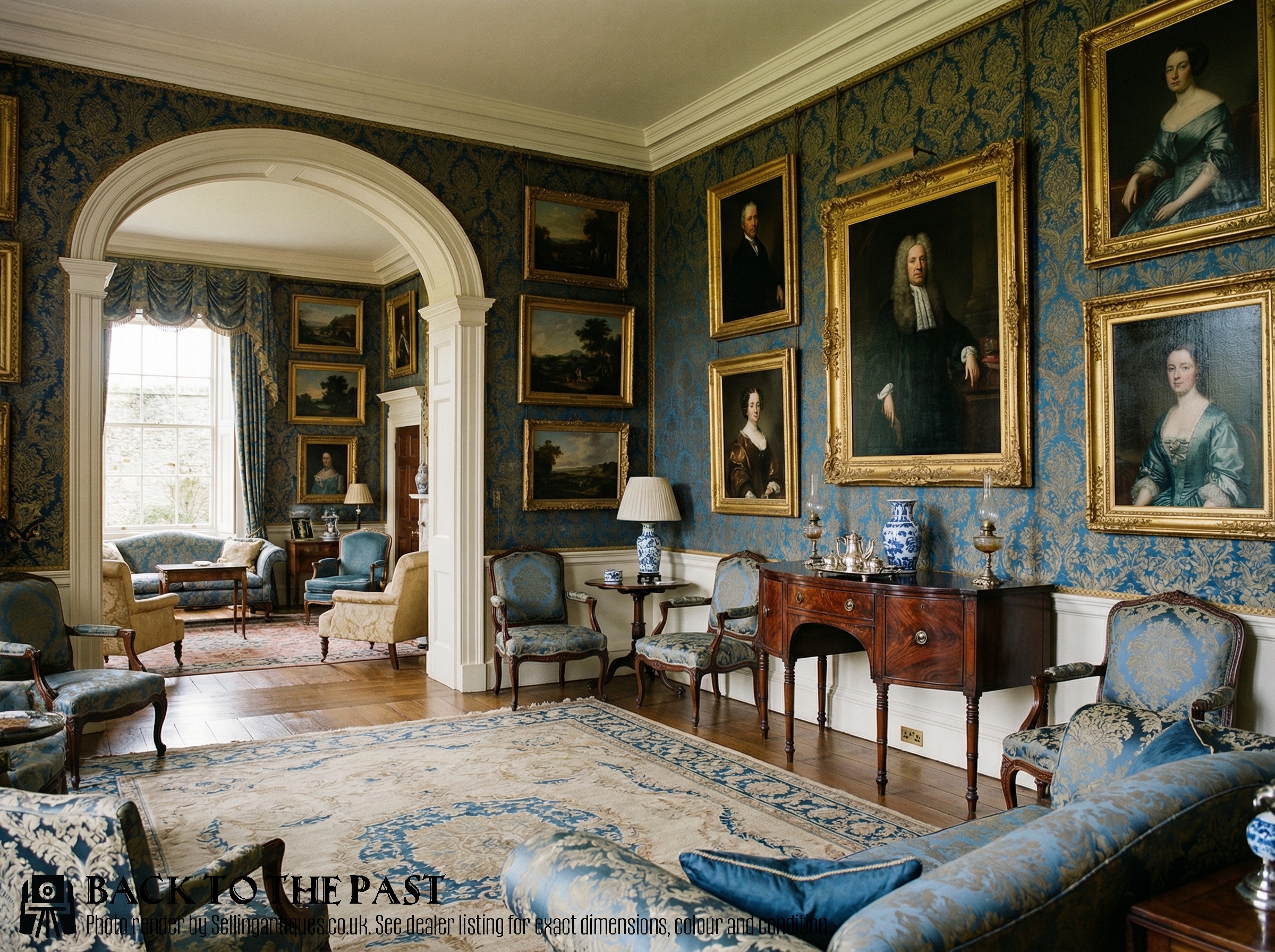
Place the sideboard against a principal dining room wall where it can anchor the room visually. Pair it with traditional silver accessories, ceramic lamps, or framed artwork hung directly above.
The rich tone of the timber works well against neutral wall colours or bolder heritage shades. Ensure adequate clearance around the turned legs to let the furniture stand free.
How do I tell Georgian from Regency sideboards?
Georgian pieces often display restrained classical proportions with straight or bow fronts and understated bracket feet. They date from the eighteenth and early nineteenth centuries.
Regency examples frequently incorporate bolder architectural elements, brass inlay, and Grand Regency styling. The turned legs become more pronounced and decorative during this later phase.
What rooms suit a bowfront sideboard?
Bowfront sideboards fit comfortably into dining rooms, large hallways, or spacious living areas. Their curved profile softens sharp room corners and eases circulation flow in narrow spaces.
The internal configuration provides generous storage without dominating the floor plan. They serve equally well as display surfaces in entrance halls.