

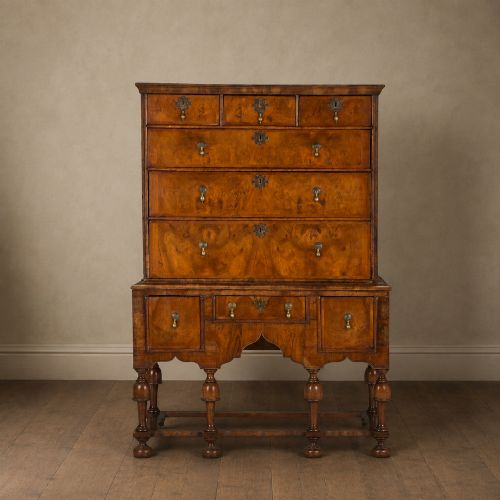
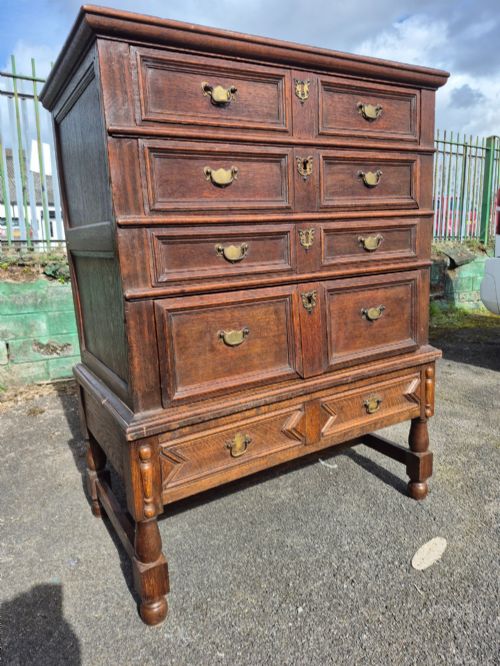
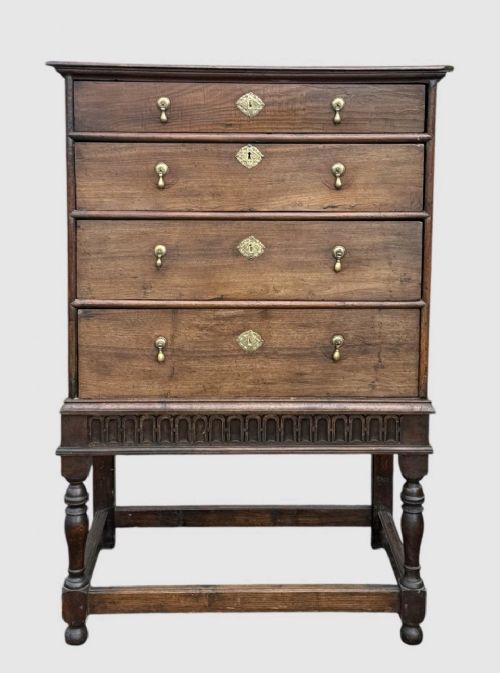


Turned Leg Highboy Chest
A turned leg highboy chest is a substantial upper drawer section raised on a slender-legged stand, offering tall vertical storage with distinct period character.
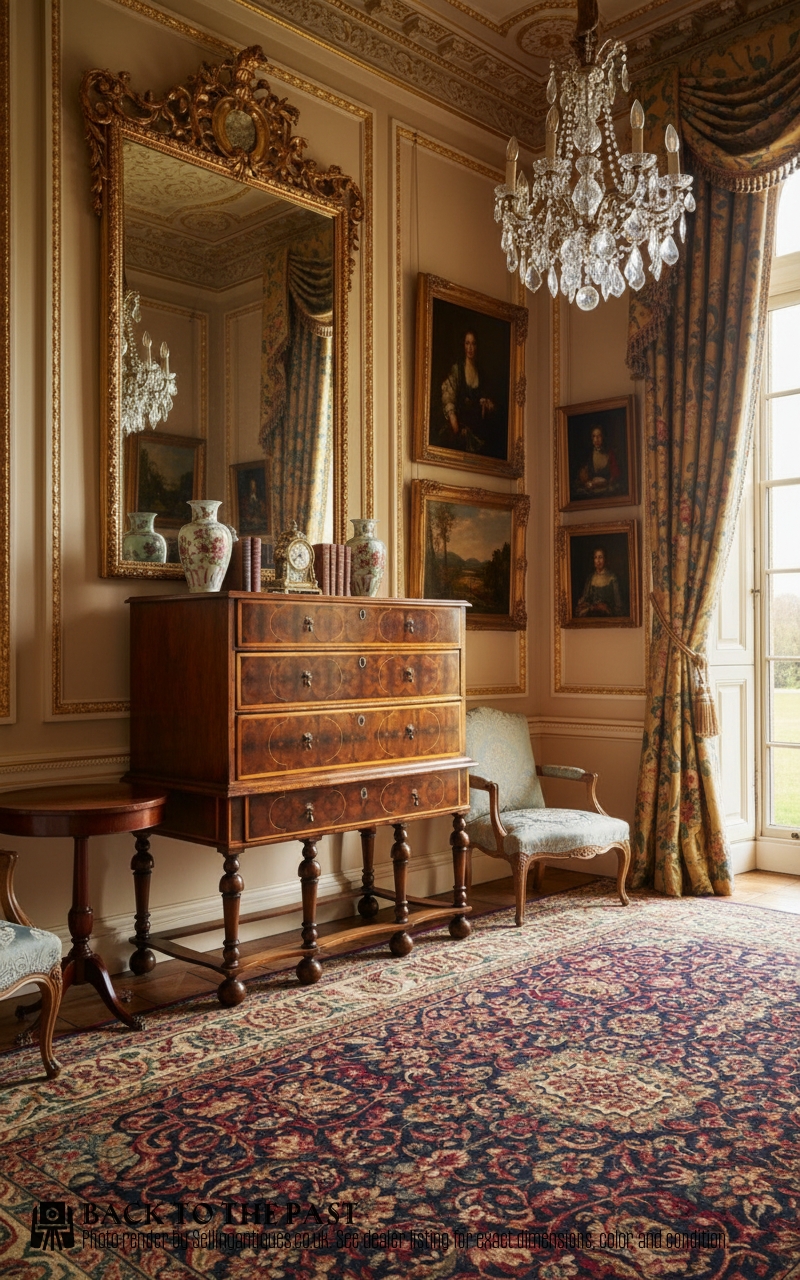
Turned Leg Highboy Chest
A turned leg highboy chest combines a multi-drawer upper cabinet with a supporting stand raised on prominent legs, appearing across various seventeenth and eighteenth century styles. These pieces provide compact vertical storage through stacked drawers while maintaining a lighter footprint on the floor than a standard floor-standing chest.
The versions most commonly met on this page date from the seventeenth and eighteenth centuries, reflecting periods such as William and Mary, Queen Anne, and George I. They frequently manifest as oak or walnut structures, sometimes arranged as a chest on stand or occasionally a chest on chest configuration.
Buyers seeking a turned leg highboy chest encounter forms finished in regional woods or decorative veneers, spanning Jacobean through Georgian aesthetic traditions. Each example demonstrates the evolution of elevated storage furniture designed for domestic chambers.
How they were made
Cabinet makers constructed these pieces using solid timbers like oak and walnut, occasionally employing specialised decorative treatments such as oyster veneer on the primary surfaces. Brass hardware, including handles and escutcheons, was fitted to the drawer fronts to complement the rich timber tones.
The structural joinery relies on traditional framing techniques to support the upper drawer section securely upon the distinct stand. Turned legs define the lower portion, connecting via stretcher rails in earlier examples to ensure stability beneath the heavy upper cabinet.
Current listings span the 17th and 18th centuries, featuring oak, walnut, and olivewood materials across Queen Anne, William and Mary, and Georgian styles.
What varies in quality
The distinction between tiers of quality rests heavily on the choice of timber figure, particularly the depth and grain pattern visible in walnut and oak surfaces. Pieces utilising elaborate oyster veneering or finely figured primary woods demonstrate a higher level of initial craftsmanship.
Proportion and the sophistication of the turned leg supports also dictate the visual success of the piece. Crisp execution in the joinery and the retention of original brass fittings elevate an example above simpler vernacular equivalents.
The Turned Leg Highboy Chest Glossary
- Highboy chest
- A tall chest of drawers consisting of an upper section mounted on a separate low stand with legs. This configuration maximises vertical storage capacity while keeping the overall mass visually lighter.
- Oyster veneer
- Circular or oval cross-sections of branch wood laid in intricate patterns across the surface. This technique creates a distinctive repeating eye-like motif across the drawer fronts.
- Chest on stand
- A cabinet of drawers elevated upon a distinct supporting frame fitted with legs. It represents the primary structural format for these tall storage pieces.
- Stretcher
- A horizontal wooden brace connecting the legs of a stand beneath the main body. They provide structural rigidity and frequently feature shaped profiles characteristic of specific periods.
Turned Leg Highboy Chest: Frequently Asked Questions
What is a turned leg highboy chest?
A turned leg highboy chest is an elevated storage cabinet featuring an upper section of drawers mounted onto a distinct legged stand. These pieces provide substantial vertical storage capacity within a compact floor footprint.
They appear across seventeenth and eighteenth-century styles, utilising materials such as oak, walnut, and decorative veneers.
How were these chests used?
These chests served primarily as domestic storage for garments, linens, and personal valuables within private chambers. Their elevated design kept contents away from cold, damp floors.
The upper section held the main drawer compartments, while the stand raised the entire piece to a convenient height for daily access.
How do I identify the period?
Period identification relies on observing the combination of primary timbers, hardware styles, and leg turnings. Earlier seventeenth-century examples typically feature solid oak construction with robust framing.
Later eighteenth-century pieces often display walnut veneers, refined Queen Anne or Georgian lines, and sophisticated turned leg supports.
How do I live with a highboy?
Living with a highboy involves positioning the tall piece against a stable wall where its vertical proportions can be appreciated without obstruction. Because of the elevated design, ensuring the stand rests level on the floor is essential for structural stability.
Regular polishing with appropriate wax maintains the condition of historic oak and walnut surfaces over time.