



Tunbridge Ware Jewellery Box
A tunbridge ware jewellery box brings intricate mosaic wood pictures to your dressing table, offering a glimpse into nineteenth-century craft.
Tunbridge Ware Jewellery Box
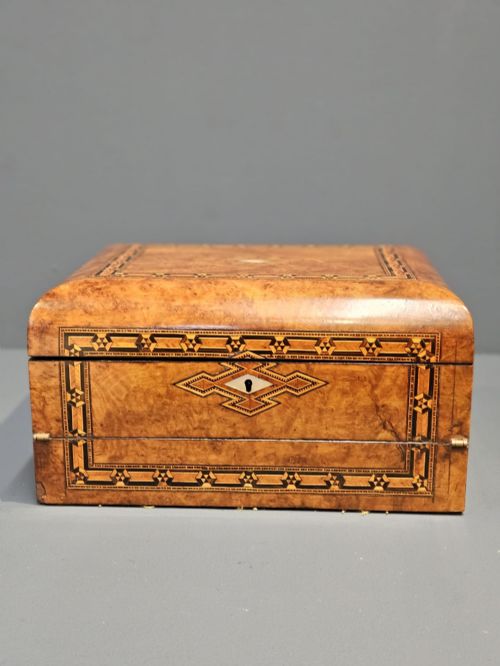
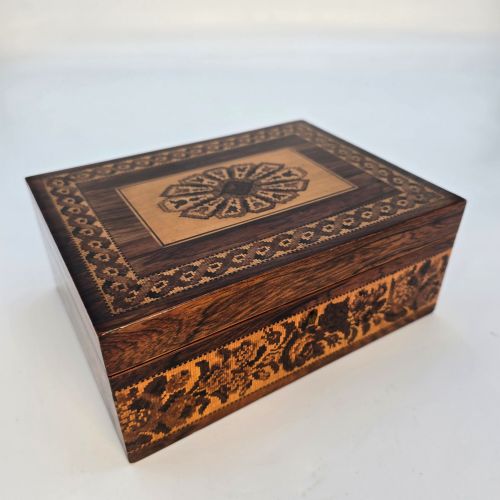
A tunbridge ware jewellery box is a small lidded casket decorated with tiny wood mosaic designs depicting flowers, butterflies, or geometric patterns. These boxes date mainly from the Victorian period, emerging during the nineteenth century in various sizes for holding trinkets, needlework tools, or personal valuables.
The pieces listed on this page encompass items from the eighteen-forties through to nineteen hundred, showing forms such as tea caddies, work boxes, and table boxes. Walnut, rosewood, and sycamore serve as the primary woods for these vessels, often paired with parquetry borders and lined interiors.
Materials and Construction
Maker workshops utilised solid timbers like walnut, rosewood, and sycamore as the foundational body for each box, applying wood veneer to exterior surfaces. Brass fixtures often provided structural hinges and locks.
The distinct mosaic patterns rely on wood inlay techniques, where thousands of tiny slivers of variously coloured woods are glued together in cross-section bundles and sliced thinly to form repeatable pictorial tiles.
Tunbridge Ware Jewellery Box Retail Price Guide 2026
Typical asking prices for tunbridge ware jewellery box among the pieces listed under this phrase on Sellingantiques today, from the lower quarter to the upper quarter. They describe what is for sale here now, not the wider market.
Every listed box incorporates nineteenth-century construction methods, ranging from simple parquetry tea caddies to detailed mosaic jewellery caskets.
Judging Quality
The complexity of the mosaic imagery dictates the refinement of the piece, with pictorial scenes demanding greater skill than simple geometric parquetry. The choice of base timber also influences the character, as burr walnut and figured rosewood provide richer grain patterns than plain sycamore.
The precision of the wood inlay work and the tightness of the mitre joints reveal the standard of workshop execution. Original interior linings and functional brass hardware preserve the integrity of the surviving box.
Edmund Nye
The Tunbridge Ware Jewellery Box Glossary
- Tunbridge Ware
- Wooden objects decorated with mosaic wood tiling produced in Kent. The technique creates detailed pictorial representations using natural coloured woods without paint.
- Marquetry
- Decorative veneer applied to a wooden structure to form pictures or ornamental designs. Craftsmen cut contrasting wood veneers and fit them together precisely.
- Parquetry
- Geometric mosaic woodwork used for repeating patterns on floors and box surfaces. It relies on regular shapes like squares, triangles, and diamonds.
- Veneer
- A thin layer of superior wood glued to a secondary timber base. This method allows makers to display decorative grain figures efficiently.
- Work Box
- A container fitted for sewing implements, threads, and small needles. Victorian examples often feature internal compartments and trays.
Tunbridge Ware Jewellery Box: Frequently Asked Questions
What is tunbridge ware?
Tunbridge ware is a distinct form of nineteenth-century woodwork originating from Kent, featuring tiny mosaic tiles made from different coloured woods. These tiles form detailed pictures of flora and fauna.
The craft reached its peak during the Victorian era, adorning small household containers such as work boxes, tea caddies, and jewellery caskets.
How do I date a box?
Dating relies on timber choices, construction styles, and the complexity of the mosaic decoration. Victorian pieces often combine burr walnut or rosewood with specific parquetry borders.
Makers active in the mid to late nineteenth century left distinct stylistic markers in their floral panels and geometric banding.
Were these boxes used for jewellery?
While many served to store precious rings and necklaces, makers also designed them as work boxes, trinket boxes, or tea caddies. Internal partitions often accommodated sewing accessories or loose letters.
Owners kept them on dressing tables or writing desks as both decorative and functional personal objects.
How should I care for my box?
Keep wooden boxes away from direct sunlight and sudden temperature changes to protect the delicate veneer and mosaic tiles. Gentle dusting with a dry cloth preserves the polished surface.
Avoid applying liquid polishes or moisture, as dampness can weaken the historical glue beneath the tiny wood tesserae.