


Tufted Velvet Chaise
These tufted velvet chaise listings bring together nineteenth-century day beds and buttoned couches designed for formal London reception rooms.
Tufted Velvet Chaise
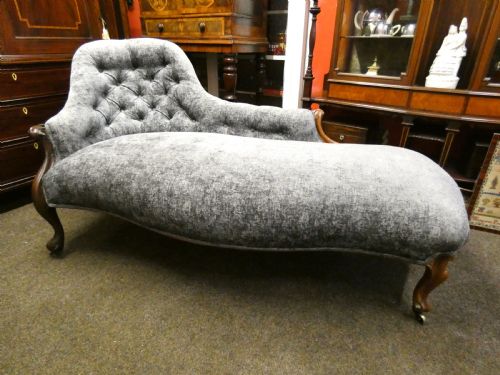
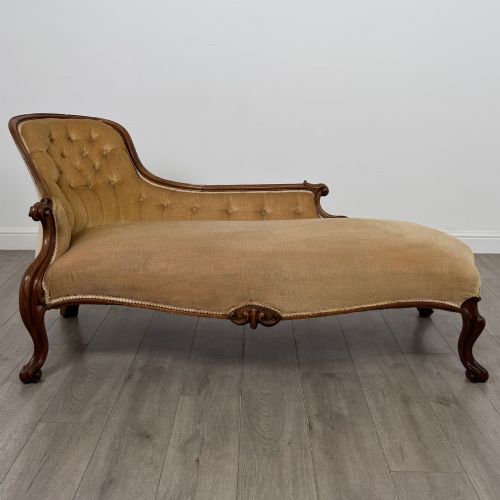
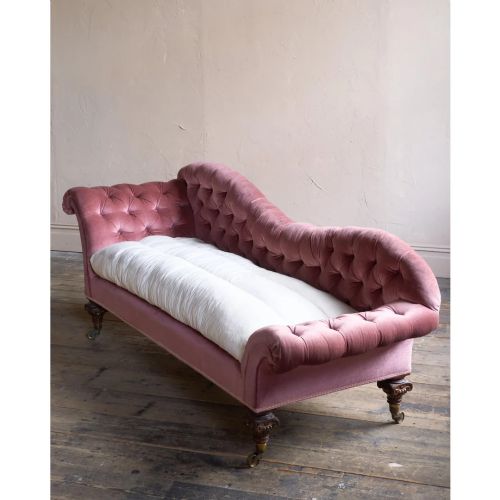
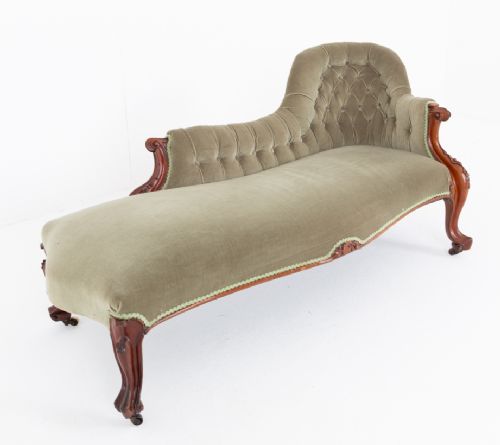
A tufted velvet chaise provides a single-ended reclining seat intended for semi-recumbent repose rather than formal upright sitting. The form spans nineteenth-century day beds, kidney sofas, and conversational furniture designed to furnish nineteenth-century interiors.
Most examples found here date from the Victorian era and the preceding Regency period, constructed as substantial salon seating. These pieces often feature scrolling headrests and generous proportions meant to accommodate long skirts and lounging postures.
Makers utilised rich timbers and deep upholstery to create striking silhouettes for parlours and boudoirs. Buyers will encounter both single chaise longue forms and multi-part salon suites sharing identical carved woodwork and textile finishes.
How they were made
Makers built the primary frames from solid hardwoods including mahogany, rosewood, and walnut, often shaping the timber into curvaceous rails and scroll ends. Skilled carvers applied floral motifs and applied columns directly to the exposed wooden framework.
Deep buttoning secured the velvet upholstery firmly to the interior padding, creating the characteristic tufted surface pattern. Metal castors and brass fittings frequently supported the heavy wooden legs, allowing easier movement across carpeted floors.
Listings span the Regency era through to the late Victorian period, featuring rosewood, mahogany, and walnut frameworks.
What varies in quality
The sophistication of the timber carving dictates much of the visual distinction between standard production and exceptional examples. Crisp hand-chiselled details on rosewood or mahogany frames surpass simpler moulded decoration in sculptural depth.
The precision of the buttoning and the resilience of the sprung foundation determine how cleanly the velvet holds its geometric tension over time. Superior proportions in the scroll end and the balance of the single armrest create a more harmonious silhouette.
Howard and Sons
The Tufted Velvet Chaise Glossary
- Chaise longue
- A long upholstered chair allowing the sitter to recline with legs fully supported. The term translates from French as long chair.
- Buttoning
- An upholstery technique where twine pulls the fabric deep into the padding to form a grid of diamond shapes. This secures the filling and creates a tufted texture.
- Rosewood
- A dense, dark timber featuring pronounced figuring utilised extensively in high-status nineteenth-century cabinet work. It accepts a high polish.
- Scroll end
- The sweeping, curved wooden terminal that forms the backrest or headrest of a day bed. It echoes classical furniture forms.
- Barley twist
- A carved wooden furniture leg resembling a spiralling rope or column. This decorative turning appears frequently on nineteenth-century supports.
Tufted Velvet Chaise: Frequently Asked Questions
Where did people use a chaise longue?
Nineteenth-century households placed these reclining seats in private boudoirs, withdrawing rooms, and grand libraries. They served as comfortable resting places for reading or receiving close visitors.
In larger reception spaces, they complemented matching conversation seats and settees to complete a coordinated scheme of upholstery.
How do I care for velvet upholstery?
Velvet requires gentle brushing with the grain to maintain the pile and prevent dust accumulation over time. Direct sunlight should be avoided to prevent the textile from fading.
Professional textile cleaners should handle deeper restoration to protect the underlying buttoning and historical padding.
How do I distinguish Regency from Victorian pieces?
Regency seating tends to show sharper classical restraint, drawing direct inspiration from ancient Greek and Roman furniture archetypes. Mahogany timbers and clean architectural lines often characterise this earlier phase.
Victorian pieces introduce heavier carved ornamentation, scrollwork, and rich rosewood or walnut frames with deep buttoned padding. The proportions become more exuberant as the nineteenth century progresses.
Can I use a day bed for sleeping?
These historical day beds and chaises served primarily for daytime resting, reading, and lounging rather than overnight sleeping. Their narrow widths and high scroll ends suit semi-recumbent posture best.
Their interior webbing and padding are constructed to support sitting and reclining bodies rather than full mattress loads.