

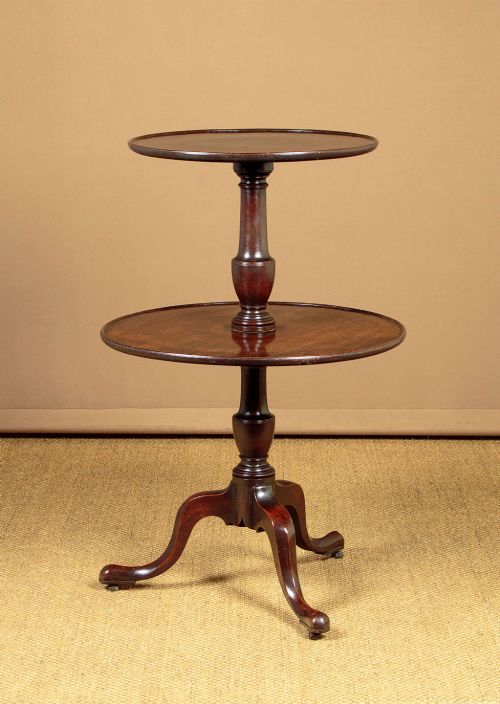


Tripod Base Serving Table
These tripod base serving table examples, better known as dumb waiters, offer tiered mahogany construction designed for dining room service.
Tripod Base Serving Table
When you search for a tripod base serving table, you are looking at practical dining furniture designed to hold dishes and bottles without requiring a servant to stand at the elbow. The versions you are most likely to meet on this page date from the Georgian and Regency periods, spanning the eighteenth and early nineteenth centuries.
These pieces typically take the form of tiered tables or serving stands with two or three graduated circular trays mounted on a central pillar. The central column rests upon a tripod base, often featuring downswept legs terminating in brass castors for ease of movement around the dining room.
Many examples incorporate folding mechanisms or revolving tops, allowing diners to access food and wine easily during a meal. The dominant timber seen across these pieces is mahogany, shaped in styles ranging from plain George III designs to more elaborate Regency forms.
How they were made
Cabinet makers constructed these serving tables using solid and veneered mahogany, selected for its rich grain and durability under heavy dining use. The central pillars were turned on lathes, while the tripod legs were joined to the column with sturdy wooden joints to support the weight of multiple tiers.
Metal components played a crucial role in the construction, with brass fixings used for pivoting mechanisms and castors on the feet. Revolving tiers required precise internal wooden or brass pivots to ensure smooth rotation without wobbling.
Tripod Base Serving Table Retail Price Guide 2026
Typical asking prices for tripod base serving table among the pieces listed under this phrase on Sellingantiques today, from the lower quarter to the upper quarter. They describe what is for sale here now, not the wider market.
Listings feature mahogany and brass materials across eighteenth and nineteenth-century periods, including George III and Regency styles.
What varies in quality
The distinction between standard and superior examples lies in the figure and selection of the mahogany timber, particularly on the top surfaces where the grain is most prominent. Finer pieces display carefully matched veneers and subtle turned details on the central column rather than plain, heavy turnings.
Construction methods also separate the grades, with better pieces featuring sophisticated folding mechanisms and robust tripod joints that maintain stability across multiple tiers. The inclusion of original brass castors and smooth revolving movement indicates a higher standard of original workshop production.
The Tripod Base Serving Table Glossary
- Dumb waiter
- A tiered serving table designed to hold food, plates, and bottles beside a dining table. These pieces usually feature two or three graduating circular trays on a central column.
- Tripod base
- A three-legged support structure radiating from a central pillar. This design provides stability on uneven dining room floors and allows the piece to stand firmly.
- Revolving top
- A tray mechanism that rotates around the central axis. This allows diners to access items easily without standing up or reaching across the table.
- Tiered table
- Furniture built with multiple stacked surfaces rising one above another. In serving stands, these trays graduate in size with the largest at the bottom.
- Castor
- A small wheel attached to the base of each leg to aid movement. On these tables, brass castors often finish the tripod feet.
Tripod Base Serving Table: Frequently Asked Questions
What was a tripod base serving table used for?
These pieces served as auxiliary tables in the dining room during the eighteenth and nineteenth centuries. They held extra plates, glasses, and wine bottles during meals.
By keeping bottles and dishes close to the diners, the table reduced the need for servants to remain in the room throughout the entire dinner.
How do I tell George III from Regency pieces?
George III pieces typically show simpler lines, heavier proportions, and restraint in ornament. The timber is often dark mahogany with straightforward turned columns.
Regency examples often incorporate more refined details, slender tripod legs, and sophisticated revolving or folding mechanisms developed in the early nineteenth century.
Do all these tables have revolving tiers?
Not all pieces feature revolving trays, though many do. Some examples have fixed tiers while others incorporate folding mechanisms designed to save space when not in use.
Checking the central pivot reveals whether the trays were built to turn or remain stationary.
How do I live with a dumb waiter today?
These versatile stands work well in modern dining rooms or living spaces as side tables for drinks, books, or display. Their tiered structure offers substantial surface area while taking up minimal floor space.
Placing them away from direct heat sources helps protect the mahogany timber and prevents the timber from drying out.