




Trio of Mahogany Tables
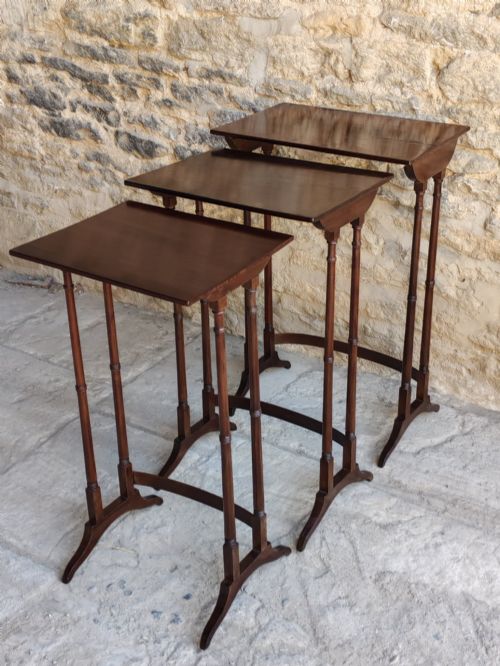
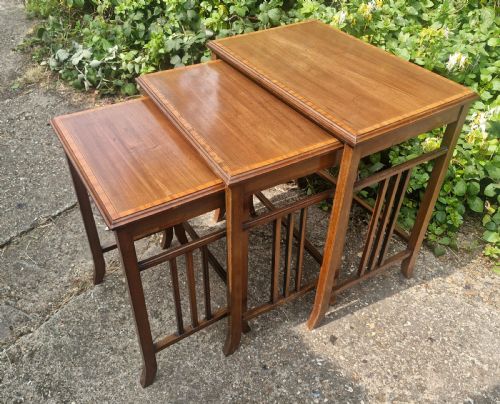
These trio of mahogany tables offer clever surface space that stacks away neatly, uniting Georgian grace with Edwardian practicality.
Trio of Mahogany Tables
When searching for a trio of mahogany tables, you are looking at nests of stacking side tables designed to sit together until needed separately around a room. The pieces found here span from Georgian origins through to the Edwardian period and the early twentieth century.
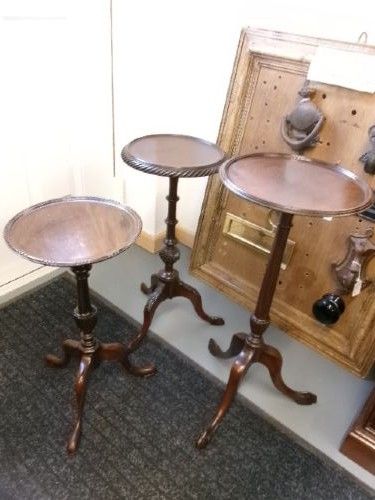
The most common form on this page is the Edwardian nest of three tables, alongside occasional wine tables and nesting sets. They appear in rectangular, oval, and shaped top formats, serving as versatile lamp or side tables in sitting rooms.
How they were made
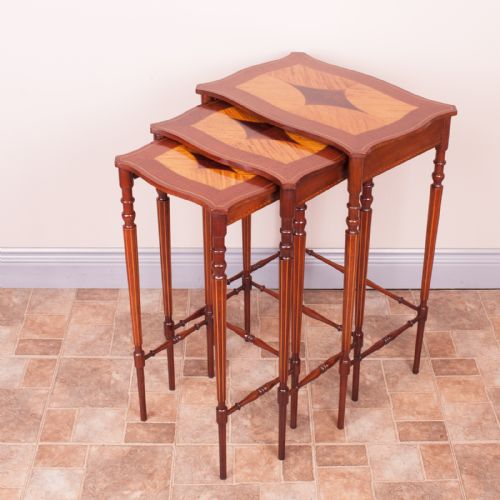
Cabinet makers utilised solid mahogany and mahogany veneers, often incorporating contrasting timbers such as satinwood, boxwood, and amboyna for decorative effect. Wood inlay and marquetry inlay ornament the surfaces of many examples.
Some specialised variations include embossed leather inserts set into the top surface. Construction relies on traditional joinery methods suited to lightweight stacking frames.
Materials across these tables extend beyond plain mahogany to include satinwood, amboyna, and embossed leather.
What varies in quality
The distinction between ordinary and superior pieces rests on the choice of timber and the precision of the inlay work. Finer examples display carefully selected grain patterns and crisp boxwood or satinwood stringing.
Structural integrity also separates the range, as tables that slide smoothly and retain sturdy legs without wobble demonstrate better original craftsmanship.
The Trio of Mahogany Tables Glossary
- Nest of tables
- A set of graduated tables designed to fit one beneath another to save floor space. They became particularly popular during the Edwardian era for entertaining.
- Marquetry inlay
- Decorative patterns formed by fitting small pieces of various coloured woods into a veneer. This technique adds pictorial or geometric detail to the table tops.
- Satinwood
- A pale, lustrous timber imported from tropical regions, frequently used for contrasting stringing and banding on mahogany furniture. It provides a bright visual accent.
- Boxwood
- A dense, pale yellow wood employed for fine stringing lines in inlaid furniture. Its neutral tone contrasts sharply with darker mahogany.
- Amboyna
- An exotic burl wood with a rich, mottled grain used sparingly for luxury panels. It appears on select decorative tables.
Trio of Mahogany Tables: Frequently Asked Questions
What is a trio of mahogany tables?
A trio of mahogany tables is a set of three graduated tables designed to stack inside one another. They provide multiple surfaces for drinks or lamps while occupying the floor space of just one small table.
Such sets became a staple of British drawing rooms, particularly during the Edwardian period when flexibility in furnishing was desired.
How do I date a nest of tables?
Dating relies on timber selection, leg style, and inlay techniques. Georgian examples often show simpler, heavier proportions, whereas Edwardian pieces frequently feature delicate satinwood stringing and slender legs.
Construction details and secondary woods underneath also offer clues to the specific decade of manufacture.
Were these always used as nesting tables?
While primarily designed to stack together, individual tables from the set were constantly pulled out for tea or holding books. They functioned as portable occasional furniture rather than fixed fixtures.
This mobility made them practical for receiving guests in smaller sitting rooms.
How do I care for a leather top table?
Leather surfaces benefit from occasional dusting with a dry cloth and sparing treatment with specialised leather balms to prevent drying. Avoid placing hot mugs directly onto the embossed leather.
Keeping the tables away from direct sunlight preserves both the leather colour and the surrounding mahogany polish.