
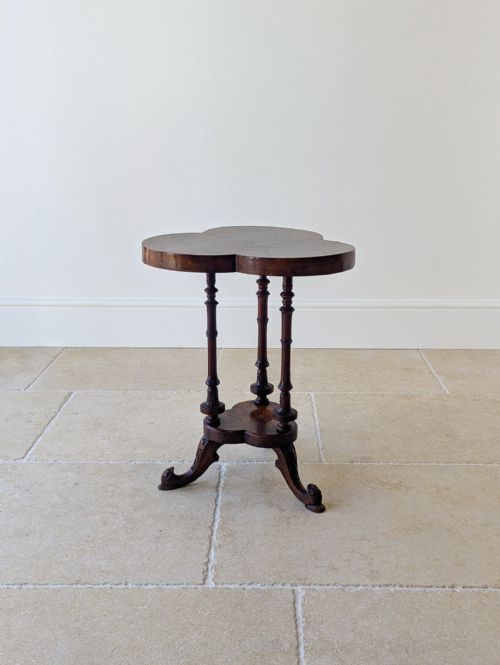
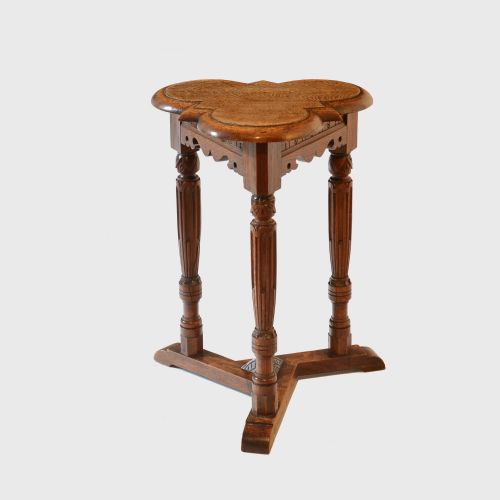


Trefoil Carved Table
A trefoil carved table brings distinct three-lobed surfaces and Gothic character into a room, offering compact surface space with architectural presence.
Trefoil Carved Table
A trefoil carved table takes its defining form from the clover leaf or three-lobed outline, often appearing as an occasional table, side table, or centre table. These pieces emerge across the nineteenth and early twentieth centuries, spanning Victorian, Edwardian, and Arts and Crafts periods.
The version most commonly met on this page is the occasional or centre table in oak or mahogany, frequently bearing Gothic Revival details. Such pieces range from compact occasional forms to substantial tables suited to period interiors.
What varies in quality
Quality rests upon the crispness of the timber carving and the selection of materials, where richly figured burr walnut or substantial quarter-sawn oak elevates a piece above standard utility furniture. The harmony between the three-lobed top and the supporting legs dictates the overall structural success.
The depth of historical detail, from precise Gothic tracery to integrated wood inlay, separates standard production from finer cabinet work. Proportion and the integrity of the timber grain determine whether a piece holds lasting presence.
Trefoil tables bring clover leaf geometry indoors, ensuring your morning coffee rests upon botanical symmetry.
The Trefoil Carved Table Glossary
- Trefoil
- A three-lobed shape resembling a clover leaf, forming the characteristic top or decorative motif of these tables. This geometric arrangement derives from Gothic architecture and window tracery.
- Gothic Revival
- A nineteenth-century design movement drawing inspiration from medieval architecture. It brings pointed arches, heavy mouldings, and deep carving to domestic furniture.
- Burr walnut
- A highly figured wood veneer taken from the wart-like growths on walnut trees. It provides swirling grain patterns prized by nineteenth-century cabinet makers.
- Occasional table
- A small, movable table designed for specific, intermittent use within a room. These forms include lamp tables, side tables, and clover leaf variants.
- Arts and Crafts
- A design movement valuing traditional craftsmanship and honest construction using natural materials. It produced simpler oak furniture with subtle hand-carved details.
Trefoil Carved Table: Frequently Asked Questions
What is a trefoil carved table?
A trefoil carved table is a small or medium-sized table featuring a three-lobed top resembling a clover leaf. These pieces frequently incorporate carved Gothic or Celtic motifs.
Cabinet makers produced them across the Victorian, Edwardian, and Arts and Crafts periods primarily in oak and mahogany.
How do I date a Gothic oak table?
Dating relies on examining the timber preparation, construction joints, and stylistic details associated with periods like the mid-nineteenth century or the Edwardian era. Gothic Revival pieces from eighteen sixty often display heavier proportions than later Arts and Crafts examples.
Archival records show similar pieces spanning from the mid-nineteenth century through nineteen ten.
Where should I place an occasional table?
An occasional table suits small spaces, corners, or beside seating where a compact surface is useful. The three-lobed top allows the table to fit neatly into restricted areas while offering visual interest.
These pieces function effectively as lamp tables or independent display surfaces in period rooms.
What woods were used for these tables?
Makers utilised hard timbers such as oak, mahogany, and walnut, alongside pitch pine for specific regional or utilitarian pieces. Burr walnut appears on finer Victorian examples to provide decorative grain.
Wood inlay and iron components sometimes supplement the primary timber structure.