
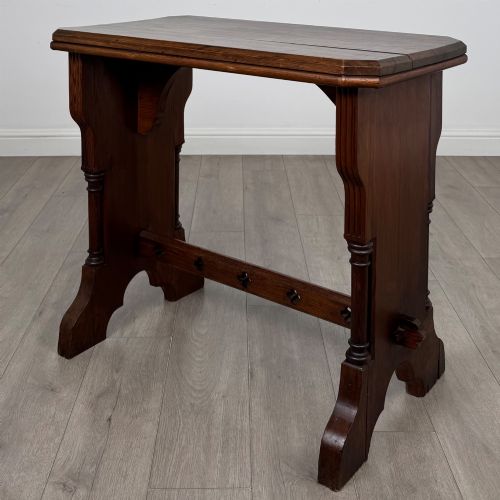
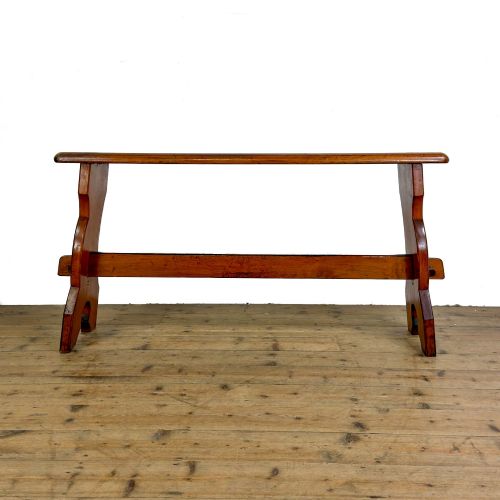


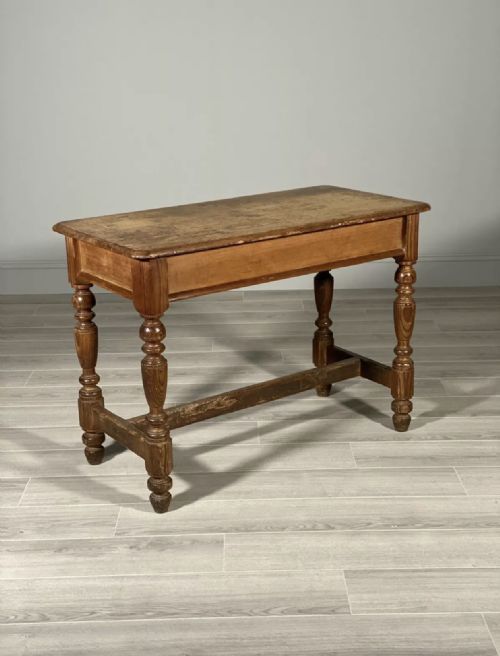

Church Side Table
These church side table pieces combine ecclesiastical craftsmanship with domestic utility, offering sturdy timber construction and distinct Gothic character for modern interiors.
Church Side Table
A church side table typically emerges from nineteenth-century ecclesiastical contexts, drawing upon Gothic Revival aesthetics to serve practical roles in vestries, halls, or chapels. The examples appearing here span the Victorian period up to nineteen ten, encompassing forms such as altar tables, writing desks, and adapted organ benches.
Buyers seeking a church side table will most frequently encounter pieces fashioned from pitch pine or yellow pine, often bearing the chamfered edges and arched braces characteristic of Victorian Gothic design. These functional items transitioned from religious settings into domestic hallways and kitchens, where their narrow proportions and robust frames continue to prove useful.
How they were made
Carpenters constructed these tables predominantly using dense pitch pine and sturdy oak, selecting timbers capable of withstanding heavy daily use in institutional and ecclesiastical environments. Joinery methods relied on solid plank construction, pegged joints, and occasionally exposed framing such as X-frame supports.
Surface treatments remained straightforward, prioritising durable finishes over elaborate decoration, which allowed the natural grain of the pine or oak to dominate. Iron bracing and hardware sometimes reinforced structural stability, reflecting the utilitarian demands placed upon church furnishings.
Pitch pine and standard pine dominate the materials seen here, alongside occasional oak and iron components.
What varies in quality
Quality in these pieces rests upon the integrity of the timber selection and the restraint shown in any subsequent adaptation from larger ecclesiastical furniture. Tables retaining their original unpainted surfaces and structural framing command greater attention than those altered heavily during domestic conversion.
The refinement of the Gothic detailing, such as carved quatrefoils or chamfered stretchers, distinguishes standard utilitarian workshop production from pieces executed in the manner of notable designers.
AW Pugin·Toplis St Pauls Churchyard
The Church Side Table Glossary
- Pitch pine
- A resinous softwood valued for its durability and strong grain pattern, widely utilised in nineteenth-century ecclesiastical joinery. It darkens richly over time when exposed to light.
- Gothic Revival
- An architectural and decorative style popular during the Victorian era that revived medieval forms including pointed arches and heavy buttresses. This aesthetic heavily influences the framing of these tables.
- Ecclesiastical
- Relating to the Christian Church or its clergy, describing items originally commissioned for use in places of worship. Such provenance often ensures heavier timber construction.
- X-frame
- A structural support consisting of two crossed members forming an X shape, providing stability without bulky side rails. This configuration appears on specific stools and tables in the archive.
Church Side Table: Frequently Asked Questions
What is a church side table?
A church side table is a piece of nineteenth-century utilitarian furniture originating from ecclesiastical spaces like vestries or chapels. They were built to serve practical functions using sturdy domestic woods.
Most examples seen today date from the Victorian era to nineteen ten and display distinct Gothic Revival characteristics such as pointed arches and chamfered supports.
How were they used originally?
These tables served various practical purposes within religious buildings, functioning as auxiliary surfaces for communion vessels, writing desks for parish records, or foundational supports in vestries. Some examples began life as organ benches or chapel tables before finding alternative roles.
Their robust construction allowed them to endure frequent handling by clergy and parishioners alike, making them naturally suited for heavy domestic tasks later in their lifespans.
Where do they fit in a home?
Their narrow proportions and restrained ornamentation make these tables particularly suitable for hallways, landings, or kitchens where space is limited yet sturdy surface area is required. They pair well with diverse interior schemes, adding architectural presence without dominating a room.
The warm tones of aged pitch pine and oak complement both traditional country houses and more contemporary neutral spaces.
How do I date a church side table?
Dating relies heavily on identifying the primary wood species, construction techniques, and stylistic markers such as Victorian Gothic mouldings or simpler Edwardian utility framing. The dominance of pitch pine typically points towards the later nineteenth century.
Examining the underside and drawer construction, where present, reveals tool marks and fixing methods that assist in narrowing down the period of manufacture.