



Traditional Weather Station
A traditional weather station brings together precise scientific instruments and robust cabinetry to track atmospheric pressure and temperature with enduring mechanical grace.
Traditional Weather Station
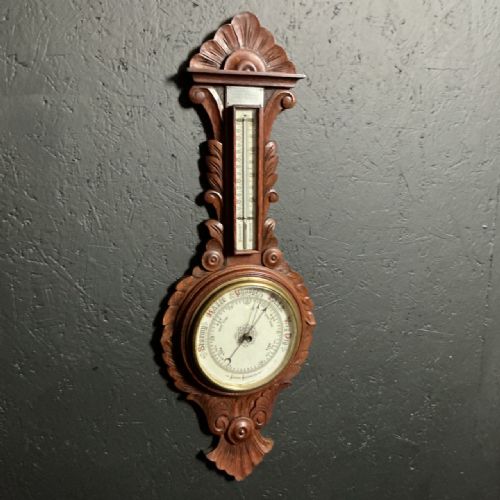
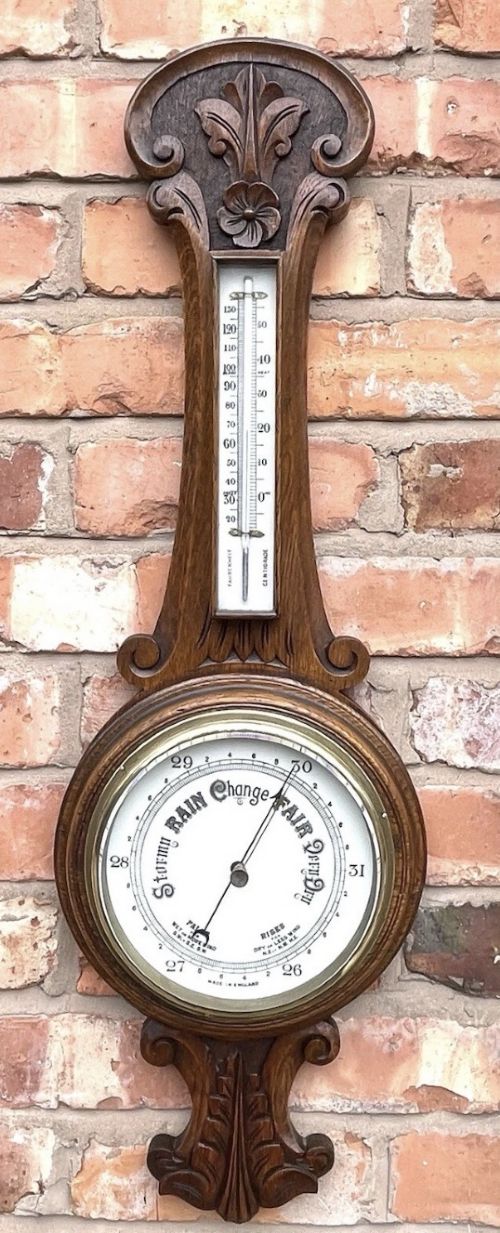
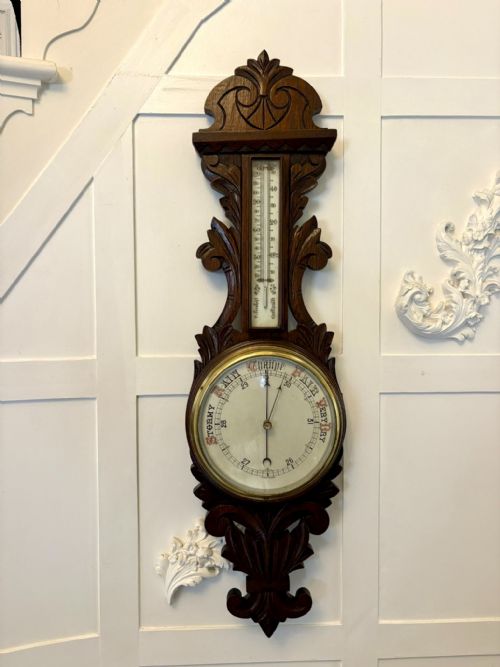
When you search for a traditional weather station, you are looking at domestic scientific instruments housed in handsome timber cases designed to hang upon a wall or sit on a desk. The examples you are most likely to meet on this page span the Victorian and Edwardian periods, frequently taking the form of banjo barometers or combination units incorporating thermometers and clocks.
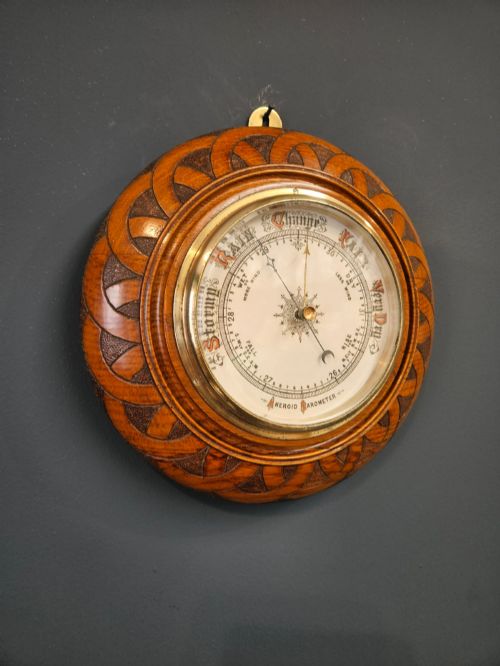
Makers fashioned these functional objects primarily from turned and carved oak, rich mahogany, and figured walnut. Many incorporate silvered metal dials behind bevelled glass, protected by heavy brass bezels that catch the light in a hallway or study.
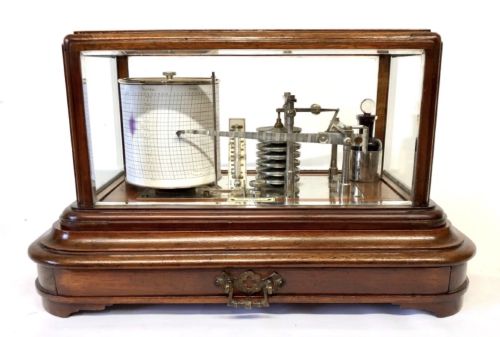
Beyond standard domestic wall pieces, rarer iterations include mahogany barographs recording continuous pressure onto paper charts, and carved Black Forest specimens displaying intricate woodland motifs. These pieces served a vital daily purpose in the nineteenth-century household before electronic forecasts existed.
Materials and construction
Cabinetmakers utilised dense hardwoods such as oak, mahogany, and walnut, selecting them for stability and grain pattern before carving them with foliage or turning them on a lathe. These wooden housings protect the delicate internal linkages, whether operating on mercury columns or aneroid metal chambers.
The dials and indicators rely on precision metalwork, combining silvered brass plates with dark engraved lettering and steel indicator hands behind protective glass. Heavy cast brass bezels secure the glass faces while adding structural weight and a polished metallic accent to the dark timber backgrounds.
Listings feature multiple Victorian carved oak banjo barometers alongside Edwardian oak models and George III mahogany stick variants.
Judging quality
Quality rests in the crispness of the timber carving and the architectural proportions of the case, where deeper relief work and superior grain selection distinguish a bespoke parlour piece from a standard hallway barometer. Finer instruments often bear the engraved signature of established retailers or scientific makers upon the silvered dial.
The sophistication of the mechanism further elevates a piece, shifting simple pressure tracking toward comprehensive stations that integrate functioning thermometers, hygrometers, or clock movements within a unified walnut or oak chassis.
GAUPP & CO HONGKONG & SINGAPORE·Jenkins Of Old Swindon·Maple & Co·Negretti & Zambra·Vecchio & Co of Shaftsbury
The Traditional Weather Station Glossary
- Aneroid barometer
- An instrument that measures atmospheric pressure through the expansion and contraction of a sealed corrugated metal box rather than liquid mercury. This mechanical design allowed makers to create compact wall-hanging instruments without fluid spill risks.
- Barograph
- A recording meteorological instrument that draws a continuous line of barometric pressure onto a rotating drum holding a paper chart. These heavier apparatuses typically sit within glazed mahogany or oak desk boxes.
- Banjo barometer
- A domestic weather instrument shaped broadly like the musical stringed instrument, featuring a circular dial at the base and a long vertical thermometer stem above. They dominated Victorian hallway decoration.
- Mercury barometer
- A traditional device utilising a column of liquid mercury in a glass tube to indicate atmospheric changes. Examples range from simple stick forms to grand mercurial instruments housed in figured mahogany.
- Bezel
- The grooved metal ring that holds the protective glass face in position over the barometer dial. On better pieces, this ring is cast in solid brass and hinged for easy access to the pointer.
Traditional Weather Station: Frequently Asked Questions
How do I read a traditional barometer?
You observe the position of the pointer relative to engraved weather descriptions like fair or rain, then gently tap the glass to settle the mechanical linkage.
By turning the auxiliary brass indicator needle to sit directly over the main hand, you track whether pressure rises or falls over the subsequent hours.
Where should I hang a barometer?
Choose an interior wall free from direct sunlight and away from radiators or draughty doorways to ensure the internal mechanism reacts purely to ambient atmospheric pressure.
Solid masonry or well-anchored stud walls provide the necessary support for heavier oak and mahogany cased instruments.
What is a Black Forest barometer?
These decorative German instruments feature deeply carved wooden cases depicting natural foliage, birds, or hunting motifs executed in rich dark oak.
They represent a distinct nineteenth-century aesthetic that prioritised elaborate rustic sculpture alongside reliable aneroid mechanisms.
Do antique barometers still work?
Many retain their functional mechanical sensitivity, though older mercury columns and aneroid springs occasionally require professional adjustment or calibration.
They continue to track genuine barometric shifts faithfully when placed in stable household environments.