


Traditional Turkish Prayer Rug
A traditional turkish prayer rug brings centuries of Anatolian weaving tradition into a room through distinct architectural motifs and rich regional palettes.
Traditional Turkish Prayer Rug
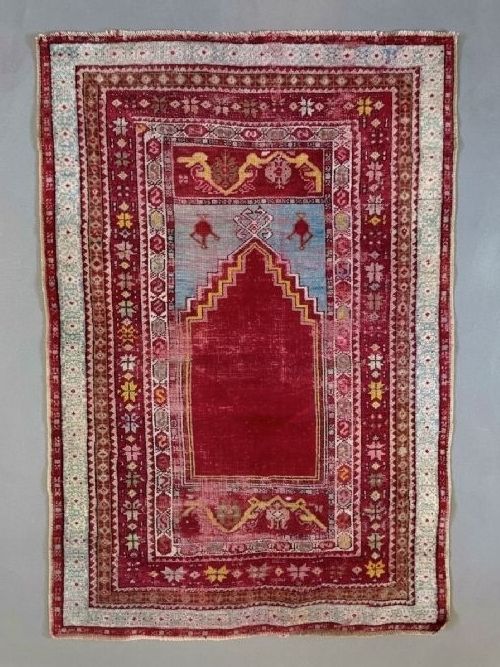
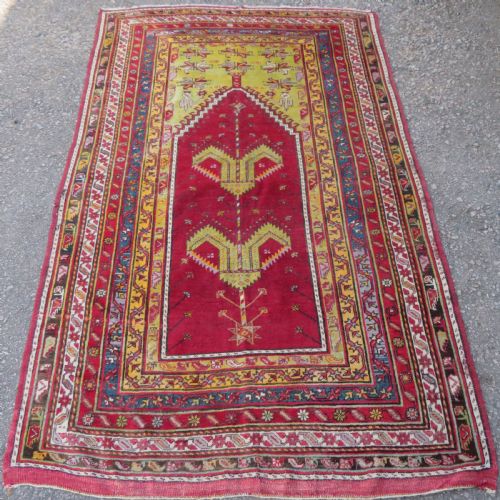
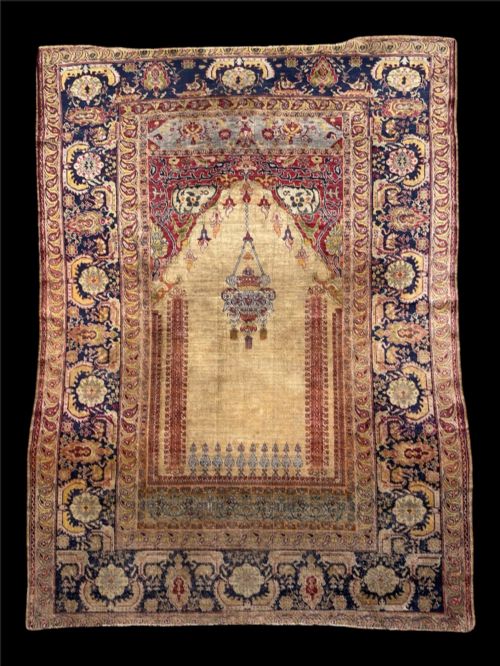
When you search for a traditional turkish prayer rug, you encounter floor coverings defined by a single arched niche, known as the mihrab, which directs the placement of the hands and head during daily devotions. These pieces hail from various Anatolian weaving centres and village cooperatives, each incorporating regional borders and medallion layouts passed down through generations.
The examples on this page predominantly display formats originating from towns such as Ghiordes, Ladik, Milas, Kirsehir, and Konya. Most specimens date from the nineteenth and early twentieth centuries, reflecting the classical Ottoman aesthetic of balanced symmetry and symbolic floral or geometric fillers.
Village and regional rugs form the majority of what you meet here, showing looser tribal interpretations alongside finer city workshop output. Buyers select them for domestic warmth, wall display, or floor placement where the characteristic pointed arch creates an immediate visual focal point.
Materials and Construction
Weavers utilised natural sheep wool, hand-spun wool, cotton for foundation warps and wefts, and occasionally silk or angora wool for pile and detail. These fibres were dyed using natural vegetable and insect extracts, producing the deep reds, indigos, yellows, and pistachios recorded across the inventory.
The hand-knotting technique anchors the pile firmly to the cotton or wool foundation, ensuring structural integrity over centuries of use. Village pieces often retain thicker, more robust wool handles, whilst town workshops in Kayseri or Ghiordes employed tighter knot densities and finer silk or wool threads for intricate floral panels.
Listings span periods from the eighteenth century through to the early twentieth century, incorporating wool, cotton, and silk materials.
Judging Quality and Execution
Quality rests upon the crispness of the drawing within the mihrab arch and the proportion of the main borders to the central field. Superior specimens demonstrate confident, balanced geometry or precise botanical rendering without distortion in the main architectural lines.
The depth, saturation, and harmony of the natural dye palette distinguish finer examples from standard production. Even wear across the pile and intact original side cordings and kilim ends indicate careful preservation by previous owners.
Ghiordes·Ladik·Milas·Kirsehir·Konya·Kayseri·Bergama·Kula·Panderma·Sivas
The Traditional Turkish Prayer Rug Glossary
- Mihrab
- The arched niche at one end of a prayer rug that mimics the direction of Mecca. It serves as the primary architectural focal point of the design.
- Warp
- The vertical threads stretched tightly on the loom before knotting begins. Cotton and wool are the predominant materials found in these foundations.
- Weft
- The horizontal threads passed through the warp threads after each row of knots to secure the structure. They maintain the rigidity and shape of the rug.
- Saf
- A multi-niche prayer rug containing several arches in a row, designed to accommodate multiple worshippers simultaneously. These formats are less common than single-niche examples.
- Kilim
- A flat-woven textile produced without a pile, sometimes utilised for prayer formats in regional Anatolian traditions. They offer a lighter structure than knotted pile rugs.
Traditional Turkish Prayer Rug: Frequently Asked Questions
What is the purpose of the arch shape?
The pointed arch, or mihrab, represents the prayer niche found in mosques. It directed the worshipper towards Mecca during daily devotions.
In domestic settings, this architectural feature provides a strong geometric centrepiece that draws the eye and structures the entire composition of the field.
How do I identify a village rug from a town rug?
Village pieces from regions like Milas or Bergama typically display bolder, more abstract geometric motifs and thicker, hand-spun wool handles. They reflect local tribal traditions and independent domestic production.
Town workshop pieces from centres like Kayseri or Ghiordes tend to feature finer materials, tighter knot densities, and more refined floral or silk compositions.
Can I use these rugs on the floor?
Many buyers place these textiles directly onto floors in low-traffic areas, studies, or bedrooms where the pile experiences minimal abrasion. Placing a suitable underlay beneath the rug prevents slipping and reduces wear.
Alternatively, many collectors mount them on walls as textile art to protect the foundation and showcase the mihrab design without foot traffic.