


Traditional Travel Clock
These traditional travel clock pieces offer portable timekeeping, bringing mechanical precision and brass elegance to any desktop.
Traditional Travel Clock
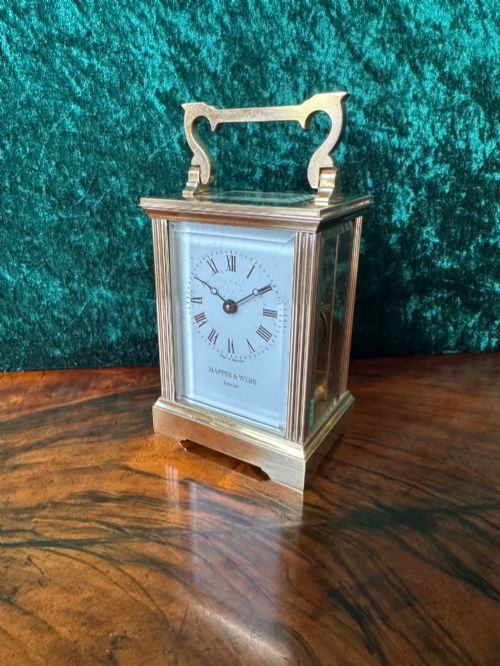
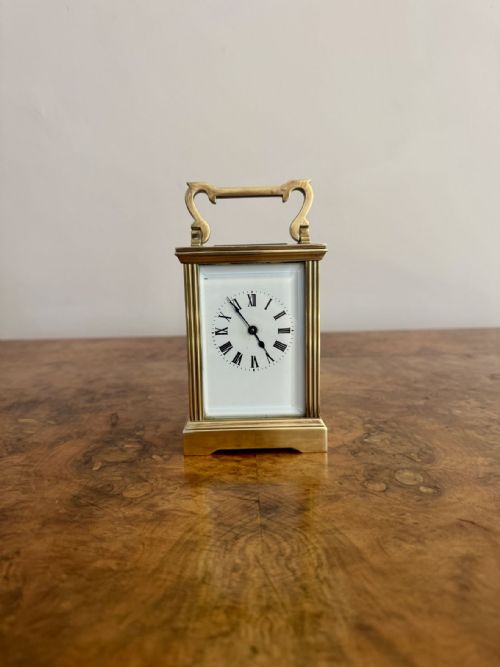
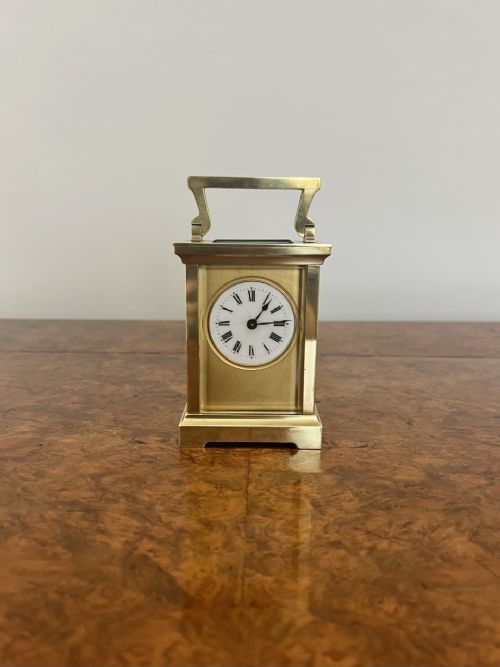
A traditional travel clock typically takes the form of a carriage clock, designed for portability during journeys in the nineteenth and twentieth centuries. These pieces appear in styles such as Victorian, Edwardian, and French, reflecting the aesthetic preferences of their respective eras.
The most common examples on this page are brass carriage clocks housing eight-day movements, often enclosed in glass panels that reveal the inner workings. Formats range from standard rectangular brass cases to oval, serpentine, and gorge case designs.
Origins span English and French workshops, encompassing periods from the mid nineteenth century through to the mid twentieth century. Buyers encounter both simple timepieces and more complex striking or repeating mechanisms.
Materials and construction
Brass and gilt brass form the structural foundation of these timepieces, providing durable housings that protect the delicate internal gear trains. Glass panels fitted into the top and sides allow light to enter and display the escapement.
Movements incorporate steel and brass components, engineered to maintain accurate time while withstanding the movement of travel. Leather cases frequently accompany these clocks to safeguard the exterior during transit.
Several clocks possess repeating mechanisms, allowing owners to summon the chime of the hour in total darkness by pressing a button.
Distinctions in quality
The sophistication of the internal movement dictates much of the standard, distinguishing a simple time-only mechanism from a striking or repeating movement that sounds the hours and quarters. Heavier gilt brass cases and complex escapements indicate higher workshop input.
The crispness of the casting on the brass frame and the clarity of the bevelled glass panes separate standard production pieces from finer examples. Maker signatures on the dial or movement backplate provide further indication of the standard of production.
Mappin and Web·Henry Jacob·James Grohé·Garrard and Co·Penlington and Batty
The Traditional Travel Clock Glossary
- Carriage clock
- A small, spring-driven clock designed for travel, featuring a carrying handle on top and glazed panels. Originating in the nineteenth century, these clocks were built to keep time on the move.
- Gorge case
- A distinct style of carriage clock case featuring stepped mouldings to the top and bottom. This architectural frame is characteristic of better quality French examples.
- Escapement
- The mechanical linkage that controls the release of power in the clock movement, maintaining the beat. Visible escapements through the top glass are a sought-after feature.
- Repeating movement
- A mechanism that chimes the last hour or quarter-hour on demand when a button is pressed. This complication requires extra gear trains within the brass case.
Traditional Travel Clock: Frequently Asked Questions
How do I wind a traditional travel clock?
Most of these clocks utilise a key inserted into the winding square on the backplate to tension the mainspring.
Care must be taken not to over-wind the mechanism, stopping as soon as resistance is felt.
Were these clocks actually used for travel?
Yes, they were originally built for officers and gentlemen on the move during the nineteenth century, enclosed in leather cases.
They eventually transitioned into decorative desk and mantel clocks as modern travel methods evolved.
What is the difference between a French and English travel clock?
French examples from the nineteenth century frequently feature gilt brass framing and complex repeating or striking movements.
English pieces often display robust traditional brass construction with straightforward timekeeping gear trains.
How do I set the time on a carriage clock?
Time is adjusted using a separate square on the backplate, turning the hands gently in the correct direction.
One should avoid moving the hands backward on striking models to prevent jamming the chime sequence.