

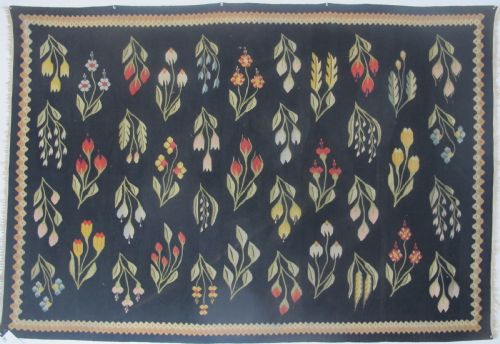
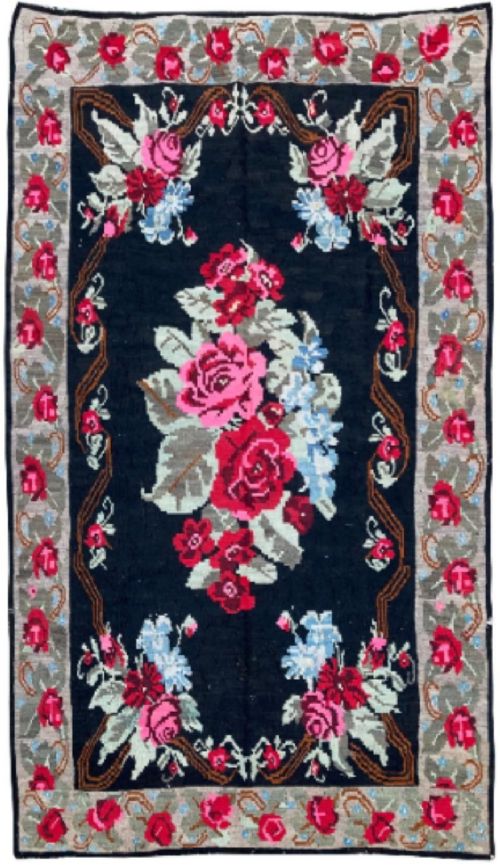
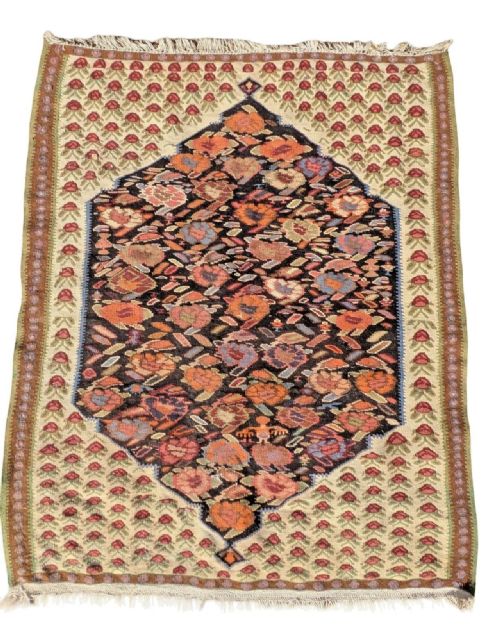


Traditional Floral Kilim Rug
These flatweave floor coverings bring warmth and rich botanical patterns into a room, offering durability alongside hand-woven historical charm.
Traditional Floral Kilim Rug
When you search for a traditional floral kilim rug, you encounter flatweave textiles that combine botanical motifs with regional weaving traditions. These pieces originate from locations including Romania, the Caucasus, Persia, and the Balkans, spanning the late nineteenth century to the early twentieth century.
The most common versions met on this page are antique Bessarabian kilims featuring distinct floral arrangements. Other notable forms include Ukrainian, Moldovan, Caucasian Karabagh, and Persian Bidjar or Senneh kilims, often categorized broadly as rugs, carpets, or tapestries.
Buyers select these items to introduce earthy textures and vivid floral compositions onto wooden floors or as wall hangings. Their flat-woven structure lacks a traditional pile, making them versatile for various spaces within a home.
Materials and construction methods
The materials recorded in these listings rely principally on natural wool and cotton fibres. Wool provides the primary foundation and surface for the coloured motifs, imparting resilience and a distinct tactile quality to each flatweave.
Weavers employ slit-weave and related flat-weaving techniques to build crisp colour transitions without a raised pile. This construction method allows intricate floral sprays and naturalistic garlands to emerge sharply against darker backgrounds.
Traditional Floral Kilim Rug Retail Price Guide 2026
Typical asking prices for traditional floral kilim rug among the pieces listed under this phrase on Sellingantiques today, from the lower quarter to the upper quarter. They describe what is for sale here now, not the wider market.
Listings span production dates from 1890 through 1930, utilising natural wool and cotton materials across Eastern European and Persian styles.
Distinctions in quality and execution
Quality separates through the precision of the botanical drawing and the complexity of the colour palette. Finer examples display highly detailed floral arrangements with subtle shading, whereas simpler pieces rely on bolder, more repetitive geometric floral interpretations.
The handling of the wool and the tightness of the weave further define the standard of a piece. Tighter flatweaving produces a firmer, more resilient textile that maintains structural integrity over decades of use.
The Traditional Floral Kilim Rug Glossary
- Kilim
- A flat-woven carpet or rug produced without a pile. This technique creates a lightweight textile suitable for both floor placement and wall display.
- Bessarabian
- A regional style originating from an area historically spanning parts of Eastern Europe. These pieces frequently showcase realistic floral bouquets set against dark, muted fields.
- Bidjar
- A Persian weaving origin known for dense construction and enduring durability. Rugs from this tradition often incorporate floral patterns alongside robust structural foundations.
- Slit-weave
- A flat-weaving technique where the weft threads loop back at the boundary of each colour block. This method creates small vertical slits between distinct colour areas.
- Flatweave
- A textile produced by interlacing warp and weft threads without knotting pile tufts. This results in a smooth, reversible surface.
Traditional Floral Kilim Rug: Frequently Asked Questions
How do I clean a kilim rug?
Gentle surface cleaning and regular light vacuuming without a rotating brush help maintain wool fibres.
Professional specialist cleaning is recommended for deeper maintenance to protect the natural dyes.
Can I place these rugs in high traffic areas?
The flat-woven wool construction offers durability suitable for general domestic use.
Placing them in moderate traffic zones helps preserve the flat textile structure over time.
How do I date an antique kilim?
Dating relies on assessing the natural dye palette, wool characteristics, and regional weaving structures.
Comparative analysis with documented pieces from periods like the late nineteenth or early twentieth century aids identification.
Are these rugs reversible?
Many flatweave textiles present a similar design on both sides due to the weaving process.
Checking the reverse reveals the underlying construction and colour saturation.