
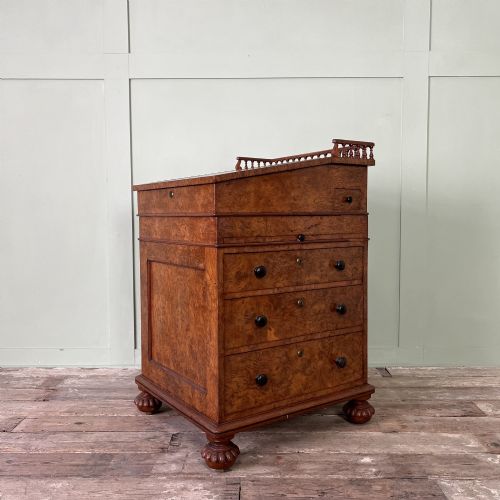


Traditional Davenport Desk
A traditional davenport desk packs a sloping writing surface and useful drawers into a remarkably compact piece of nineteenth-century furniture.

Traditional Davenport Desk
The traditional davenport desk is a compact form of writing furniture that emerged with popularity during the nineteenth century, including Victorian, Regency, William IV, and Edwardian examples. These pieces combine a slanted writing slope with a set of drawers built into the side, offering a practical writing station that occupies minimal floor space.
Buyers encounter variations ranging from freestanding walnut models with drawers on both sides to slide-top writing desks and marquetry inlaid versions. These desks served primarily as ladies writing desks or private correspondence tables in the principal rooms of the house.
Materials and Construction
Cabinet makers built these desks using solid structural timbers faced with carefully selected veneers such as burr walnut, rosewood, and figured mahogany. These decorative veneers are laid over sturdy bases to display rich figuring on the main writing surfaces and drawer fronts.
Functional details include inset leather writing panels, brass hardware, and sliding mechanisms that adjust the upper desk section. Drawers are fitted into the pedestals, sometimes arranged to pull out from both sides in freestanding examples.
Traditional Davenport Desk Retail Price Guide 2026
Typical asking prices for traditional davenport desk among the pieces listed under this phrase on Sellingantiques today, from the lower quarter to the upper quarter. They describe what is for sale here now, not the wider market.
Some desks hide secret compartments for private letters behind dummy drawer fronts.
Judging Quality and Execution
Quality in a traditional davenport desk rests upon the choice of timber and the precision of the cabinet work. Pieces featuring figured burr walnut, rosewood, or pollard oak with well-matched veneers demonstrate a higher grade of manufacture than plain timber versions.
The sophistication of the internal fittings, such as secret drawers, marquetry inlay, and carved wooden details, separates standard production items from workshop pieces bearing attribution to makers like Gillow and Co.
Gillow and Co
The Traditional Davenport Desk Glossary
- Davenport desk
- A compact writing desk featuring a sloping, hinged desktop above a pedestal of side drawers. The form became a staple of nineteenth-century domestic interior decoration.
- Burr walnut
- A highly prized wood taken from the burl growth of the walnut tree, showing swirling knot patterns. Cabinet makers used its decorative grain for the exterior surfaces of finer desks.
- Marquetry
- The art of applying pieces of veneer to a structure to form decorative patterns and pictures. Floral and geometric marquetry frequently adorns Victorian walnut writing surfaces.
- Pedestal
- The structural support beneath the desk top containing the bank of side drawers. In freestanding versions, these pedestals are finished on all sides.
- Pollard oak
- Oak timber taken from trees that have been pollarded, producing dense clusters of growth rings and a mottled grain. This material appears on selected nineteenth-century desk examples.
Traditional Davenport Desk: Frequently Asked Questions
What is a traditional davenport desk?
A traditional davenport desk is a small nineteenth-century writing cabinet featuring a sloping top and a pedestal of side drawers.
These pieces were designed to provide a dedicated writing surface without dominating the floor space of a room.
How were these desks used originally?
They served as private writing stations for correspondence, record keeping, and storing stationery inside the fitted compartments.
Owners kept their writing paper and ink within the interior wells beneath the sliding or hinged slope.
How do I identify a Victorian davenport?
Victorian examples typically display rich walnut or mahogany timbers, often incorporating marquetry inlay, carved details, or brass galleries.
The side drawers and internal stationery compartments follow the established nineteenth-century proportions for compact writing furniture.
Where should I place a davenport desk?
Their compact footprint allows them to sit comfortably in studies, bedrooms, or living rooms as accent furniture.
Freestanding models with drawers on both sides can stand away from walls in the centre of a room.