


Traditional Carriage Timepiece
These traditional carriage timepiece examples in brass and glass combine utility with the refined portability prized in the nineteenth and twentieth centuries.
Traditional Carriage Timepiece
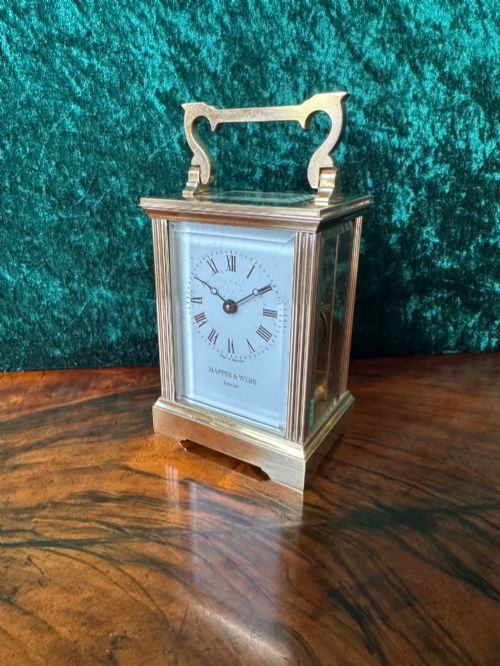
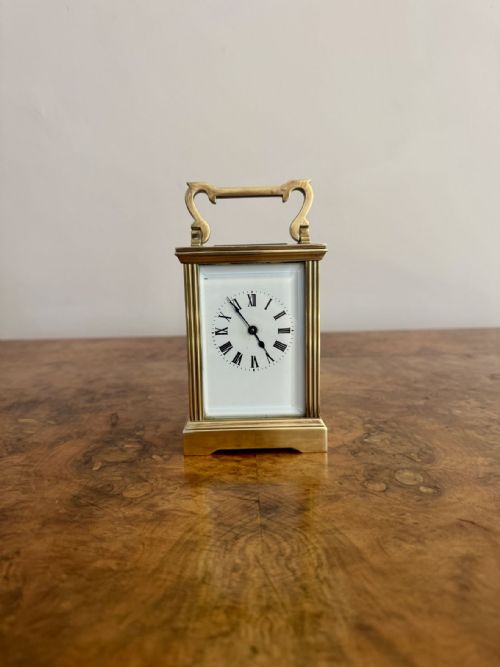
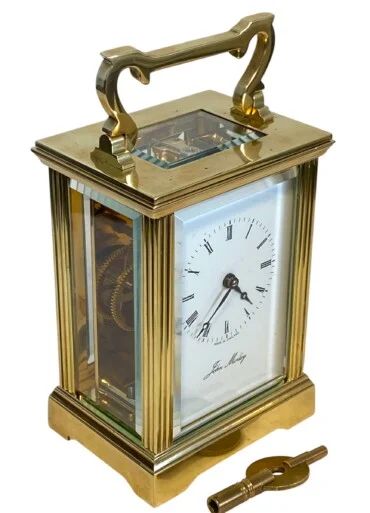
A traditional carriage timepiece is a portable clock designed for travel, housed in a brass and glass case that allows the movement to be seen from multiple angles. Most pieces on this page originate from the Victorian and Edwardian periods, alongside French workshops of the late nineteenth century.
The form ranges from simple brass cases with white enamel dials to elaborate gorge and serpentine models with repeaters or moon phase complications. Buyers encounter English and French examples dating from eighteen seventy through to nineteen sixty.
These clocks serve equally well on a mantelpiece, a desk or inside a travelling case. Their sturdy metal frames and bevelled glass panels define the classic aesthetic of the category.
How they were made
Maker workshops utilised heavy brass, often fire-gilt, to construct robust frames capable of housing intricate eight-day movements without distortion. Bevelled glass panels fitted snugly into the metal housing to protect the dial while maintaining visibility from every side.
Dials were typically formed from white enamel with painted Roman numerals, sometimes accompanied by subsidiary dials for alarm or date functions. Leather outer cases were occasionally provided for protection during journeys.
Listings span from eighteen sixty to nineteen sixty, utilising materials such as gilt brass, mahogany, leather, marquetry inlay and bevelled glass.
What varies in quality
Quality in a traditional carriage timepiece rests upon the weight of the brass casting and the finish of the gilding. Heavier cases with crisp mouldings and thick bevelled glass indicate superior manufacture.
The complexity of the movement also dictates the standing of the piece, with repeater mechanisms, striking trains and moon phase complications marking out the finer examples from simple timepieces.
Mappin and Web·John Morley·Tiffany·L Epee·Malecot of Paris·Penlington and Batty
The Traditional Carriage Timepiece Glossary
- Gorge case
- A distinctively shaped brass carriage case featuring stepped mouldings to the top and bottom. This form was widely utilised by French and English makers.
- Repeater
- A mechanism that chimes the hours and quarters on demand when a plunger on the top is pressed. It allowed owners to check the time in the dark.
- Eight-day movement
- A clock mechanism that requires winding only once every eight days. It represents a practical improvement over standard daily-wound movements.
- Enamel dial
- A metal dial fused with powdered glass powder fired at high heat to create a smooth, glossy white surface. Roman numerals are typically painted onto this ground.
- Four glass clock
- A mantel clock design enclosed by glass on the front, back and both sides, revealing the inner escapement and gear trains.
Traditional Carriage Timepiece: Frequently Asked Questions
How do I wind a carriage clock?
Most pieces require a key inserted into the winding arbor on the back plate, turned gently until resistance is felt.
Care must be taken not to overwind the mainspring, as this can damage the internal mechanism.
Where should I place a carriage clock?
These clocks sit securely on level surfaces such as mantelpieces, desks or occasional tables where the movement can be admired.
Avoid areas subject to direct sunlight or damp conditions to preserve the brass and enamel dial.
How do I know if a clock is French or English?
French examples often feature numbered stampings on the movement back plate and distinctive escapement platforms visible through the top glass.
English pieces by makers like John Morley or Mappin and Web usually bear signature engravings on the dial or movement.
What is the difference between a timepiece and a striking clock?
A timepiece simply tells the time without any striking or chiming mechanism attached to the gear train.
A striking clock includes additional trains and hammers to sound the hours or quarters automatically.