
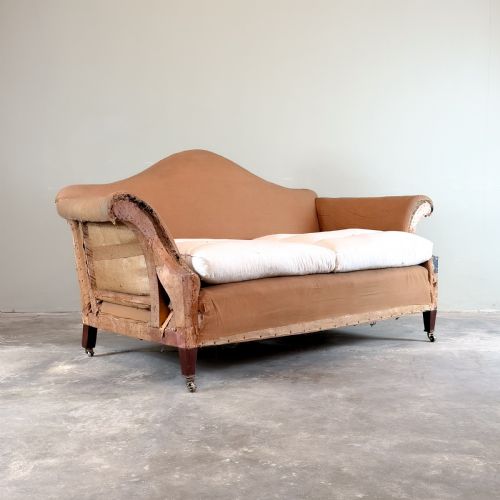


Traditional Camel Back Settee
A traditional camel back settee brings sweeping Georgian proportions and timeless elegance to any room.
Traditional Camel Back Settee
A traditional camel back settee is an upholstered sofa defined by the distinctive undulating arched profile of its backrest, reminiscent of a camel's hump. These seating pieces span several centuries and design revivals, drawing heavily on eighteenth-century aesthetics.
The selections available here range from eighteenth-century originals to nineteenth-century interpretations, Edwardian examples, and mid-twentieth-century pieces created in historical styles. Common variations include serpentine fronts and differing leg configurations influenced by Chippendale, Hepplewhite, and Queen Anne traditions.
Buyers will encounter substantial three-seat sofas alongside smaller settees, all sharing the characteristic fluid silhouette of the camel back form. Makers across the nineteenth and twentieth centuries continually returned to these classical proportions, producing both refined revival pieces and period examples.
How they were made
The internal frames are constructed from solid woods such as mahogany, supported by traditional upholstery materials including jute, cotton, and webbing to build the resilient arched contours. Upholstery techniques rely on dense stuffing and careful stitching to maintain the taut, sweeping lines of the backrest.
What varies in quality
Quality in a traditional camel back settee rests primarily on the grace and fluidity of the arched back profile and the harmony of its proportions. Superior pieces display a confident sweep to the camel hump that transitions smoothly into the arms, whereas lesser examples can appear stiff or mistimed in their curves.
The integrity of the internal wooden frame and the precision of the joinery distinguish fine period or revival pieces from more utilitarian seating. Furthermore, the crispness of any woodwork detailing, such as carved mahogany legs in the manner of Hepplewhite or Chippendale, elevates the overall execution.
The Traditional Camel Back Settee Glossary
- Camel back
- A sofa or settee back featuring a continuous undulating curve that rises into one or more humps, central to traditional camel back settee designs. This silhouette gained prominence during the Georgian era.
- Serpentine front
- A furniture front that curves outward in the centre and inward toward the ends, frequently paired with the arched backrest. This shaping adds considerable visual movement to the piece.
- Hepplewhite style
- A light, elegant neoclassical furniture style named after the eighteenth-century cabinetmaker George Hepplewhite, often characterised by tapered legs and shield or camel backs. Revival pieces frequently adopt these refined characteristics.
- Damask
- A reversible figured fabric traditionally woven on a jacquard loom, frequently utilised for formal upholstery on historical seating. Its pattern plays with light through matte and glossy yarns.
Traditional Camel Back Settee: Frequently Asked Questions
What is a camel back settee?
A camel back settee is an upholstered seating form characterised by a distinctive undulating arched backrest that mimics a camel hump. These pieces date from the eighteenth century onward and include various revival styles.
They are valued for their graceful proportions and ability to integrate into both traditional and contemporary interiors as statement seating.
How do I identify a Georgian style sofa?
Georgian style sofas are identified by their classical proportions, refined wooden legs, and restrained ornamentation. They often incorporate mahogany frames and traditional upholstery fabrics like damask or velvet.
Looking closely at the frame construction and leg style helps distinguish eighteenth-century originals from later nineteenth-century revivals.
Are these settees comfortable for daily use?
Traditional camel back settees were designed for formal sitting, offering firm support through dense internal stuffing and tight upholstery. Their upright posture makes them well-suited for living rooms, hallways, and studies.
While construction methods vary between eighteenth-century pieces and mid-twentieth-century interpretations, most provide sturdy and dependable seating.