


Traditional Brass Twin Beds
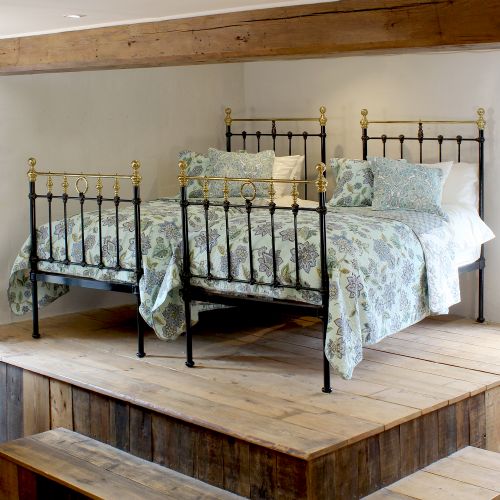
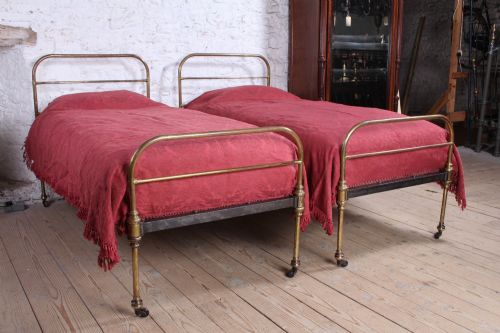
Traditional brass twin beds bring warmth and steady symmetry to a bedroom, offering sturdy metal frames designed to join together or stand apart.
Traditional Brass Twin Beds
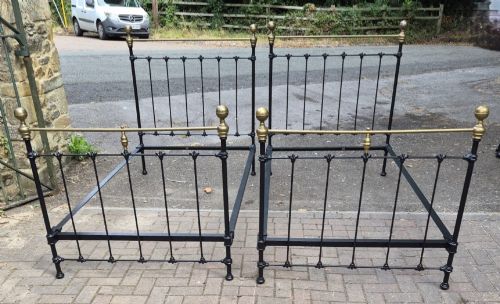
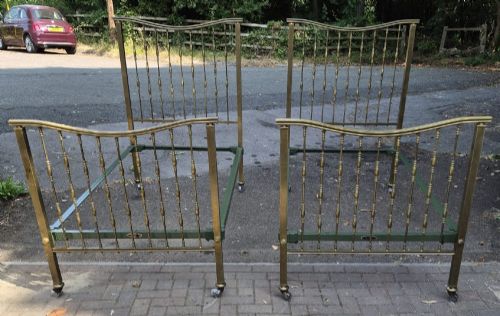
Traditional brass twin beds comprise single-sized sleeping frames from the Victorian, Edwardian, and late nineteenth-century eras, often appearing as matched pairs that can join together to form a larger sleeping area. The forms span simple all-brass constructions and combinations of brass and painted cast iron.
Most examples found here date from the 1870s to 1900, reflecting the manufacturing output of factories and workshops operating during the reign of Queen Victoria and the subsequent Edwardian period. Buyers encounter both single items and pairs finished in black, white, or bare metal.
The style ranges from plain utilitarian designs to pieces featuring decorative rings, cast iron components, and polished brass ornamentation. Portuguese traditional single beds also appear alongside British Victorian varieties, maintaining the same functional twin scale.
How traditional brass twin beds were made
Construction relies on a combination of brass tubing and heavy cast or wrought iron frames, providing structural rigidity while allowing the components to be dismantled. Brass elements provide the prominent visual finish, often polished or lacquered, while iron forms the chassis and support.
Many frames incorporate ceramic elements or painted surfaces in black and white alongside the metalwork, showing how makers combined different materials for durability and decoration. Brass decoration and rings are secured directly to the iron and brass framework.
The listings span four distinct decades from 1870 to 1900, alongside Edwardian examples, incorporating brass, iron, ceramic, and paint.
What varies in quality in traditional brass twin beds
Quality rests upon the proportion of solid brass versus plated metal, the crispness of the cast iron detailing, and the integrity of the joining mechanisms that allow pairs to connect. Finer pieces display substantial brass tubing and robust corner brackets rather than thin or hollowed fittings.
The finish also dictates distinction, as original painted surfaces and well-preserved brass retain more character than over-restored examples. Matching pairs that retain their original sizing and complementary components represent the higher end of the range.
Hoskins and Sewell·R W Winfield
The Traditional Brass Twin Beds Glossary
- Bedstead
- The complete framework of a bed, including headboard, footboard, and side rails. This structural assembly supports the mattress base.
- Cast iron
- An iron-carbon alloy poured into moulds to create decorative or structural components. It forms the heavy, durable base frames of mixed-metal beds.
- Wrought iron
- Iron beaten into shape while hot by a smith, valued for its tensile strength. It appears in the structural parts of older bed frames.
- Twin
- Two corresponding beds designed to be used in the same room. Many antique examples are built to join together.
- Edwardian
- The period of British history spanning the reign of King Edward VII from 1901 to 1910. Beds from this era often feature lighter proportions than their Victorian predecessors.
Traditional Brass Twin Beds: Frequently Asked Questions
Can these twin beds actually be joined together?
Many examples are specifically noted as capable of being joined to form a larger bed arrangement. They retain original linking fixings designed for this dual purpose.
Buyers should inspect the specific side rails and brackets to understand how the two individual bedsteads lock into alignment.
How do I fit a modern mattress on these beds?
Antique single and twin beds often feature internal dimensions that differ slightly from modern standard mattress sizes. Custom or bespoke mattresses are frequently required for a precise fit.
Measuring the internal width and length between the side rails before sourcing a base is essential for stability.
What is the difference between Victorian and Edwardian beds?
Victorian beds, spanning the mid to late nineteenth century, tend to feature heavier iron components and robust, ornate brass castings. They often display darker finishes or substantial metalwork.
Edwardian beds generally present lighter proportions and simpler silhouettes reflecting changing aesthetic tastes at the start of the twentieth century.
How do I care for antique brass and iron frames?
Regular dusting with a dry microfibre cloth prevents the accumulation of grime on both painted iron and polished brass surfaces. Harsh chemical cleaners should be avoided to protect original lacquers and finishes.
Keeping the metal away from damp environments preserves the structural integrity of the iron and prevents tarnishing of the brass.