


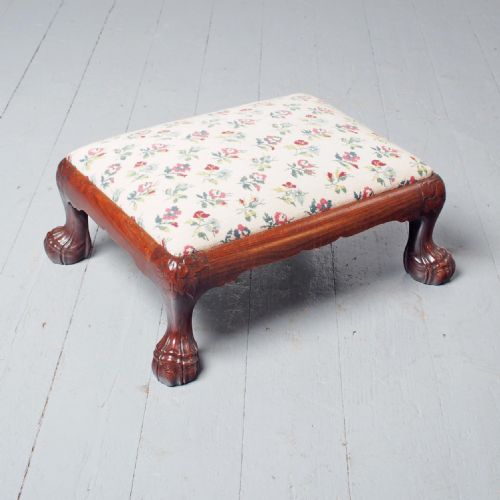


Traditional Bedroom Footstool
These traditional bedroom footstool pieces bring period character and practical comfort to the room, offering sturdy timber frames and classic upholstery.
Traditional Bedroom Footstool
A traditional bedroom footstool takes many forms across this selection, from compact dressing stools to long ottomans designed for the end of the bed. You will frequently meet pieces from the nineteenth and early twentieth centuries, spanning revival styles like Queen Anne and Chippendale alongside simpler Victorian designs.
The assortment includes solid mahogany and walnut frames paired with woven and buttoned fabric upholstery. These items served practical seating and resting purposes in period bedrooms, often featuring carved wooden details or ball and claw feet.
How they were made
Cabinetmakers constructed these frames using durable hardwoods such as mahogany and walnut, frequently employing traditional joinery methods. Selected pieces display detailed hand carving on the wooden legs and rails.
Upholstery techniques involved deep buttoning and tight fabric covers fitted over padded foundations. Brass details occasionally appeared as decorative accents on specific styles.
The listed pieces span the nineteenth and early twentieth centuries, featuring walnut, mahogany, and brass components.
What varies in quality
The distinction between standard and superior pieces rests largely on the depth of hand carving and the selection of cabinet timbers. Solid mahogany or walnut frames with crisp, well-defined details sit comfortably above simpler hardwood constructions.
The execution of the upholstery work also dictates the overall standard, particularly where complex deep buttoning or precise fabric fitting is involved. Refined details like ball and claw feet elevate the visual presence of a piece.
Whytock and Reid
The Traditional Bedroom Footstool Glossary
- Mahogany
- A dense, durable tropical hardwood prized for its rich colour and smooth finish. It was widely utilised in fine cabinetmaking throughout the eighteenth and nineteenth centuries.
- Deep Buttoned
- An upholstery technique where buttons are pulled tight through the padding to create a diamond pattern of soft indentations. This method provides both structural tension and a decorative finish.
- Ball and Claw
- A furniture foot design depicting a bird's talon grasping a ball, heavily favoured in revival pieces. It originated in Chinese art before becoming a staple of European cabinet design.
- Dressing Stool
- A low seat designed specifically for use at a dressing table or vanity. These pieces often feature upholstered tops and polished wooden frames matching period bedroom suites.
- Queen Anne Style
- A design movement characterised by cabriole legs, curved outlines, and restrained ornamentation. It experienced revivals during the late nineteenth and early twentieth centuries.
Traditional Bedroom Footstool: Frequently Asked Questions
What is a traditional bedroom footstool used for?
These pieces served multiple functions in historical bedrooms, acting as seats at dressing tables or as rests for the feet at the end of a bed. Longer ottoman variants also provided surface space or convenient resting places.
Their compact dimensions meant they could easily tuck beneath furniture or sit neatly against a wall when not in active use.
How do I identify a Victorian footstool?
Victorian examples often display darker hardwoods like walnut or mahogany, frequently accompanied by heavy upholstery and substantial proportions. Look for period construction methods and characteristic nineteenth-century silhouette designs.
Revival pieces from later decades sometimes emulate these older forms, making timber analysis and joinery inspection essential for accurate dating.
Are these footstools suitable for modern bedrooms?
Their classic timber frames and neutral or patterned upholstery allow them to integrate smoothly into contemporary bedroom schemes. They offer practical seating without dominating the floor space.
Mixing a period stool with modern furniture adds textural contrast and practical utility to the room.
What does deep buttoned upholstery mean?
Deep buttoning involves securing tufting buttons through the thick padding of the seat at regular intervals to form geometric folds. This traditional technique kept internal stuffing firmly distributed.
Beyond its structural purpose, the method creates a distinctive tactile surface associated with comfortable historical seating.