
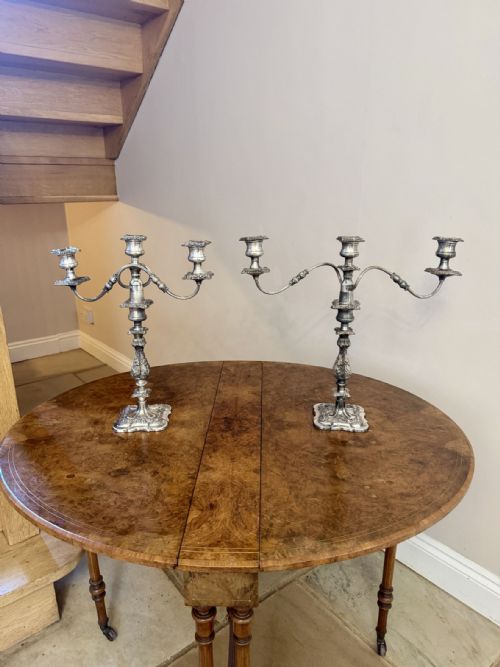
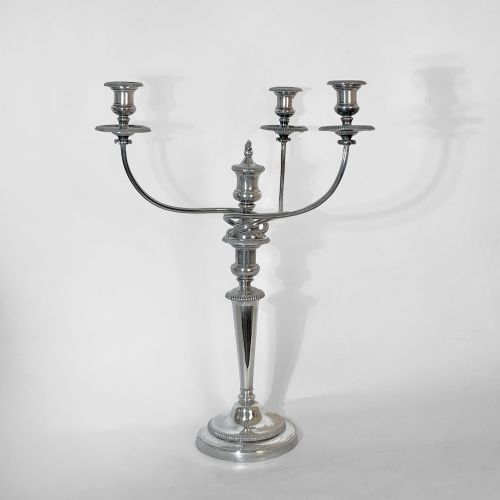
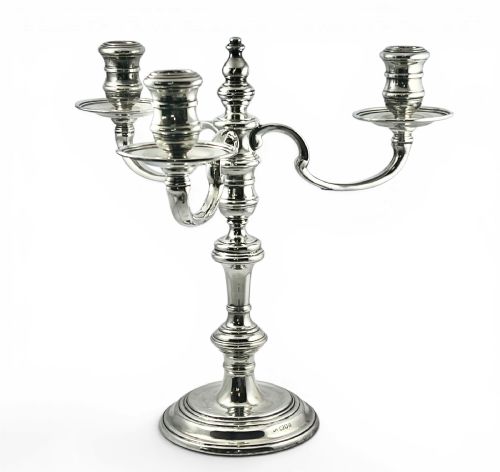
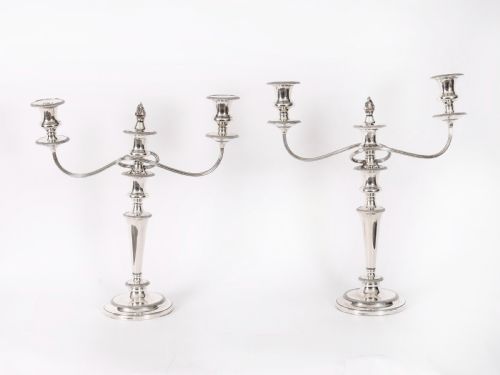
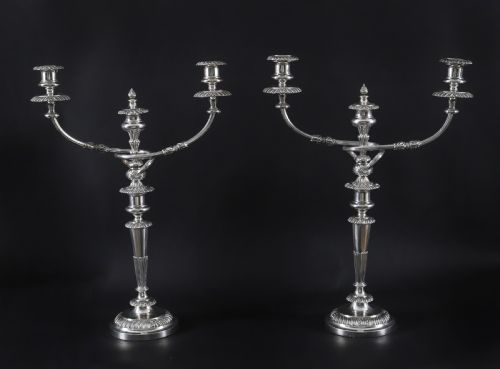
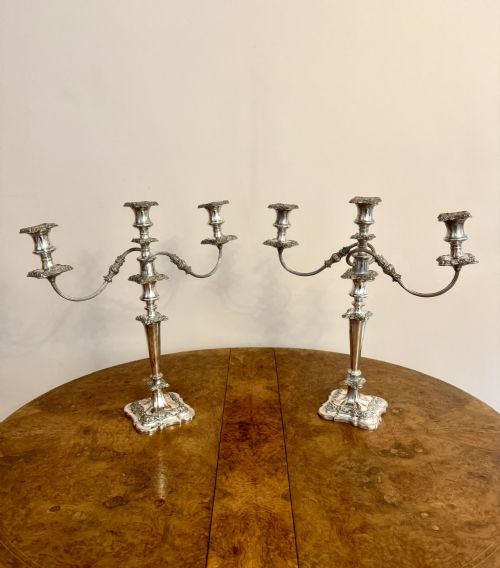
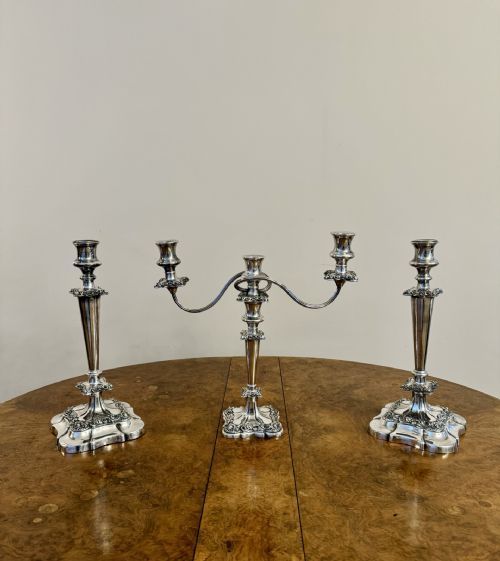


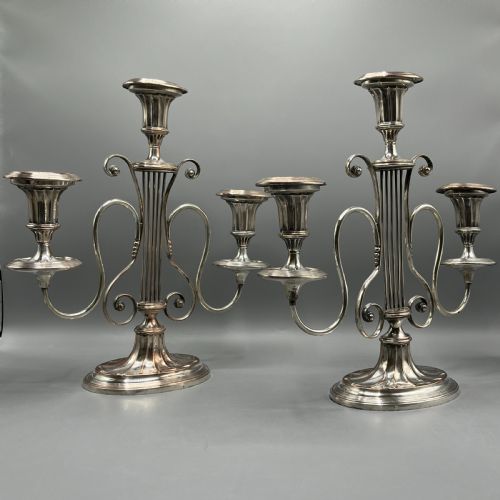


Three Light Candlestick Holder
A three light candlestick holder brings multiple candle branches to a table, combining practical illumination with formal period style.
Three Light Candlestick Holder
A three light candlestick holder takes the form of a branched candelabrum or a convertible candlestick base, designed to support multiple candles simultaneously. These pieces range from compact tableaus to large centrepieces, originating across several centuries of European and British design.
Victorian and Regency examples appear frequently on this page, alongside Georgian, Edwardian, and mid-century items. Makers construct these branch holders to sit centrally on dining tables, sideboards, or mantelpieces, often functioning as matched pairs.
The configurations include detachable branches that transform a candelabrum back into a standard single candlestick. Buyers encounter both strict three-branch designs and adjustable arm variants made across British and Continental workshops.
Materials and construction methods
Silversmiths and metalworkers utilise silver plate, Old Sheffield plate, sterling silver, brass, copper, bronze, and ormolu. Silver plating techniques applied to copper bases or Britannia metal define many Victorian and Georgian items, while cast bronze and gilt metal appear in French and Regency works.
Foundries employ casting, chasing, and electroplating methods to create ornate scrolling branches, fluted stems, and heavy circular or tripartite bases. Ormolu components involve mercury gilding on bronze, whereas Sheffield plate fuses a thin sheet of silver to a thicker copper ingot before shaping.
Listings feature items spanning the 18th century, Regency, Victorian, Edwardian, and 1960s periods in silver plate, brass, ormolu, and sterling silver.
Assessing quality in multi-light holders
Quality separates pieces by the crispness of chased detail in the foliage, cast ornament, and scrollwork. Heavier gauge metals provide structural stability to branching arms, preventing the drooping seen in lighter, more economical press-formed items.
The integrity of the plating or patination on the metal surface indicates how well a piece survives decades of cleaning and use. Maker marks stamped into the base or drip pans often signify superior workshop standards from silversmiths like Matthew Boulton or Garrard and Co.
Garrard and Co·Matthew Boulton·Wm Tonks and Sons·Blagden Hodgson and Co·Barker Ellis
The Three Light Candlestick Holder Glossary
- Candelabrum
- A large branched candlestick designed to hold multiple candles at once. The plural form is candelabra.
- Old Sheffield Plate
- An early composite material made by fusing a layer of silver to a copper base. This technique predates modern electroplating.
- Ormolu
- Gilded bronze, where a layer of gold amalgam is applied to cast bronze through heat treatment. It produces a rich golden finish on Regency and French pieces.
- Drip pan
- A small circular plate fitted below the candle nozzle to catch melting wax. These components detach on many period designs.
- Electroplated Nickel Silver
- A base metal alloy of copper, nickel, and zinc coated with a layer of pure silver using an electrical current. It replaced older fusion plating methods in the nineteenth century.
Three Light Candlestick Holder: Frequently Asked Questions
Are all three light candlestick holders convertible?
Many Victorian and Georgian candelabra feature a central finial and removable branch section that allows the main shaft to function as a standalone candlestick.
Fixed-branch models integrate the arms permanently into the socket construction during casting.
What is the difference between Old Sheffield Plate and silver plate?
Old Sheffield Plate fuses a visible sheet of sterling silver to a copper core by heat, resulting in a durable sandwich of metals with a distinctive copper edge.
Later silver plate applies a thin chemical coat of pure silver over a nickel-brass base via electrical current.
How do I date a brass three light candlestick holder?
Examine the construction marks, base weight, and casting seams, as nineteenth-century pieces often feature hand-finished components and heavy sand-cast parts.
Stylistic cues such as neoclassical urn motifs or Regency reeding help narrow the decade of manufacture.