


Terrestrial Desk Globe
A terrestrial desk globe brings the geography of empires and changing borders directly onto a writing table.
Terrestrial Desk Globe
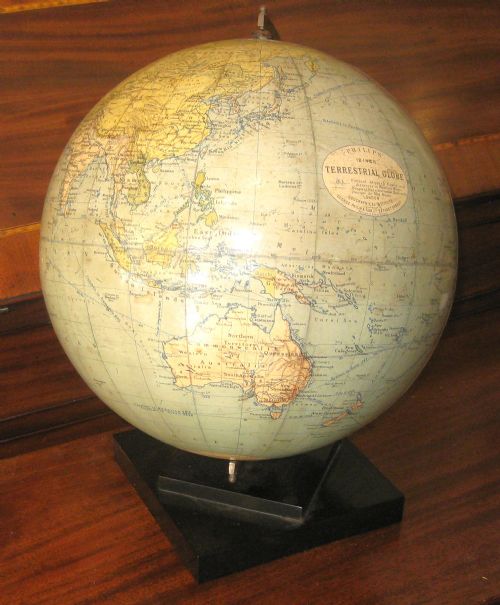
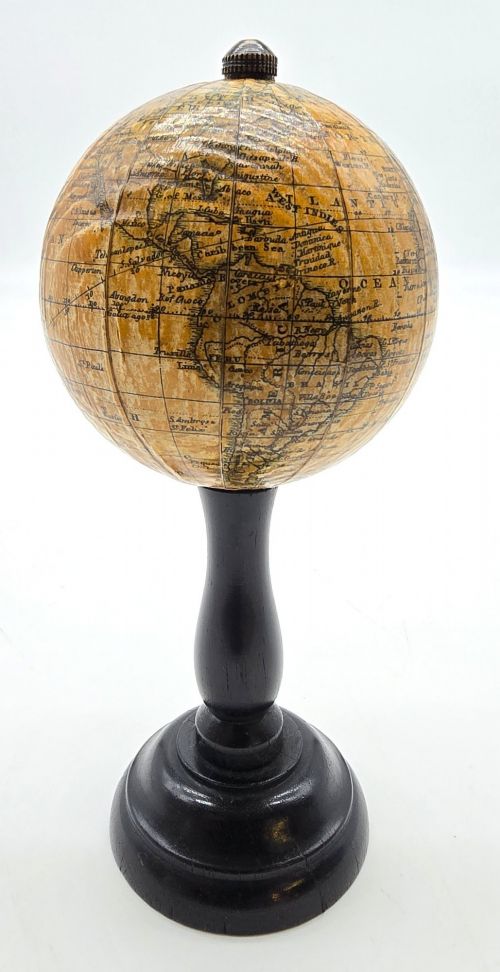
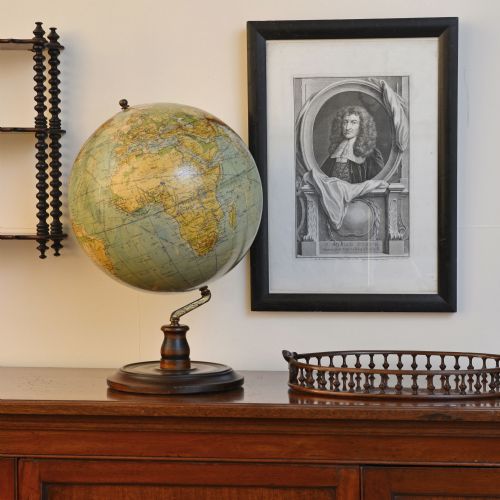
A terrestrial desk globe is a scaled-down representation of the earth designed for close study on a table or desk surface. When you search for this phrase, you encounter miniature pocket globes, twelve-inch library pieces, and four-inch educational models spanning from the Victorian era through the interwar years.
How they were made
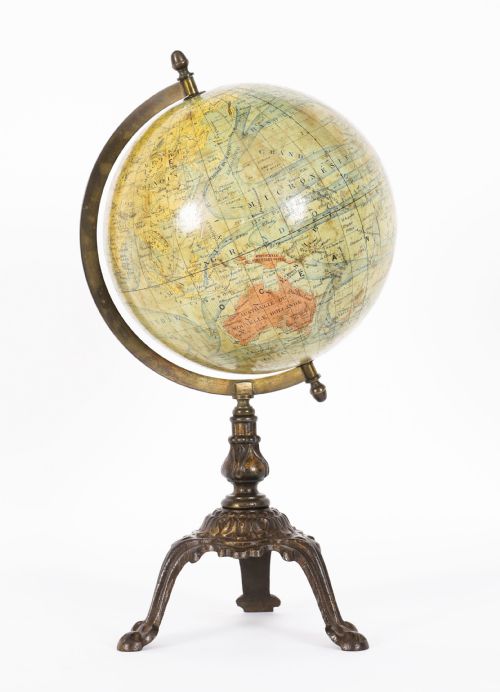
Manufacturers built the spheres by applying paper gores - printed segments of the world map - over a plaster or papier-mâché core. Lithographed or copperplate-printed cartography was hand-applied section by section to fit the spherical surface smoothly.
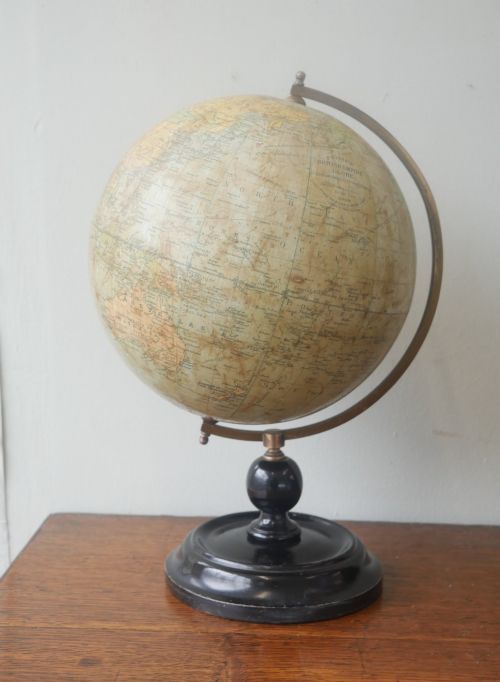
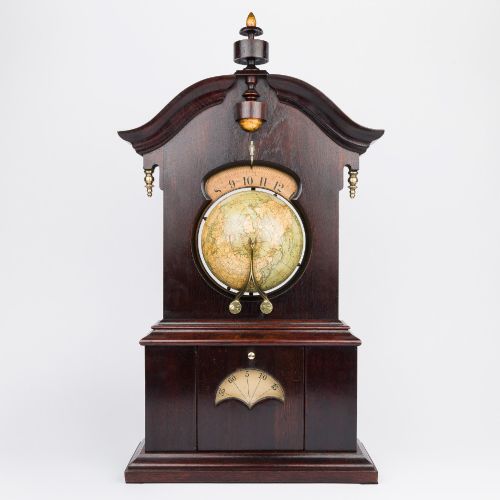
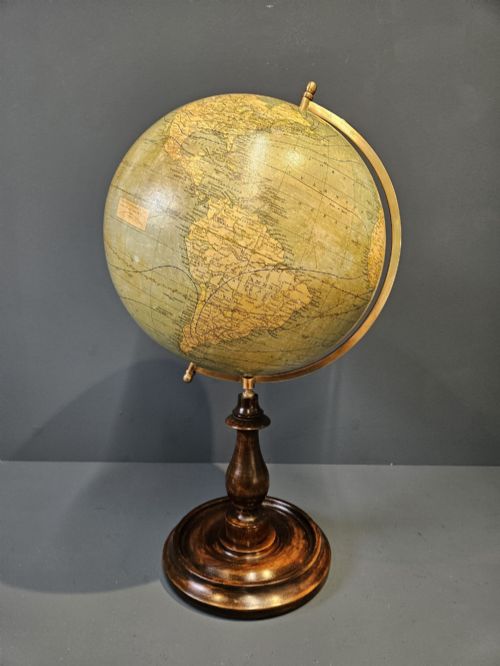
The mounted balls sat upon turned wooden stands of mahogany, walnut, and ebonised wood, or rested in heavy cast iron and brass meridian rings. Many stands incorporate secondary functions, such as compass bases or clockwork mechanisms.
Periods represented in the inventory span the Victorian era, Edwardian period, and interwar years through to the mid-twentieth century.
What varies in quality
Quality rests primarily in the precision of the cartographic engraving and the clarity of the geopolitical boundaries printed upon the paper gores. Finer spheres display crisp typography and detailed political colouring that remains legible across the entire surface.
The integrity of the physical materials distinguishes finer pieces, particularly the weight of the timber foot and the smooth operation of the brass meridian ring. Original stands retaining their intended finish and untouched varnish surfaces elevate the piece significantly.
George Philips and Son Ltd·Malby·Geographia·Bacon·J Forest·Lebegue and Cie·Crunchley·Raths
The Terrestrial Desk Globe Glossary
- Gores
- Printed paper segments shaped like lunes that are pasted onto a sphere to form a complete world map. These individual strips require precise alignment to ensure geographical names match across the seams.
- Meridian ring
- The graduated brass or metal semi-circle surrounding the globe that holds the sphere at an angle. It allows the globe to be rotated on its axis to demonstrate the earth's tilt.
- Papier-mâché
- A composite material made from paper pulp and adhesive binder, moulded to create a lightweight and stable spherical core. It provided a durable alternative to solid plaster.
- Pocket globe
- A miniature terrestrial sphere housed inside a protective hollow case, often lined with celestial maps. These small items were carried by travellers and gentlemen in the eighteenth and nineteenth centuries.
Terrestrial Desk Globe: Frequently Asked Questions
How do you read dates on a globe?
Cartographers often printed the publication year directly onto the cartouche near the equator or within the Atlantic Ocean. Changes in national borders and colonial territories provide additional clues to the era of manufacture.
Examining the spelling of place names and the titles of overseas possessions helps narrow down the decade when the paper gores were printed.
Were these globes used in schools?
Many smaller four-inch and eight-inch models served as educational tools in classrooms and private studies. Their compact size allowed students to examine physical geography and trade routes at close range.
Larger twelve-inch and eighteen-inch library editions were intended for offices, studies, and drawing rooms rather than daily school use.
How should I clean the paper surface?
Dusting the globe requires only a very soft, dry brush or microfibre cloth used with extreme gentleness. Moisture damages the aged paper gores and dissolves the historic adhesives beneath.
Keeping the piece away from direct sunlight prevents the coloured inks from fading and stops the paper from becoming brittle over time.
What is the difference between terrestrial and celestial?
Terrestrial globes map the surface of the earth, including continents, oceans, shipping routes, and political boundaries. Celestial globes map the night sky, displaying constellations, stars, and astronomical coordinates.
Poviders occasionally produced matching pairs of desk globes so owners could study both the earth and the heavens simultaneously.