




Terracotta Still Life Art
Terracotta still life art brings together earthy pots, flowers and fruit captured across Victorian and mid-century movements.
Terracotta Still Life Art
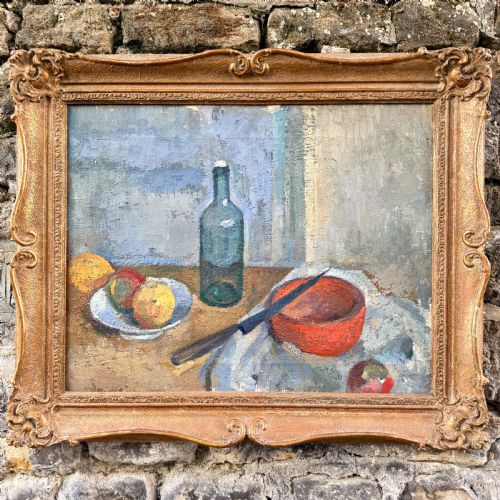
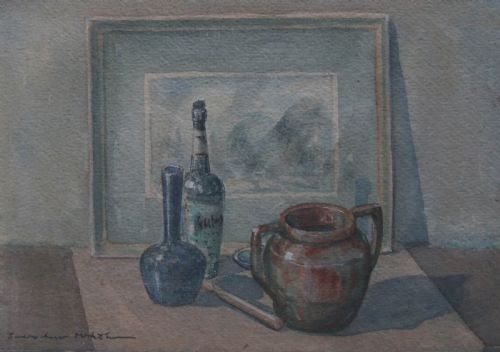
When you search for terracotta still life art, you encounter oil paintings, watercolours and encaustic works spanning from the Victorian era to the mid-twentieth century. The subjects frequently centre on pottery vessels, flowers, fruit and botanical studies rendered in distinct regional styles.
You are most likely to meet mid-century modernist French canvases alongside 19th-century watercolours depicting plants in terracotta pots. These works demonstrate how artists across different decades engaged with simple domestic arrangements and earthenware containers.
The periods represented stretch from the Victorian era through the 1890s, 1900, 1910, 1920, 1950 and up to 1960. Styles range from academic realism and Victorian botanical illustration to post-impressionism, fauvism and mid-century European modernism.
Quality and execution
Quality rests upon the sureness of the handling and the confidence of the composition. Works by recognised masters or avant-garde figures display a rigour in form and colour relationship that elevates simple subjects like lemons, jugs and pottery.
The distinction between standard decorative pieces and finer works lies in the subtlety of the paint application and the harmony of the palette. Strong modernist abstracts and detailed period watercolours show a precision in execution that defines the upper tier of the range.
Listings feature works created across eight distinct decades, spanning from Victorian botanical studies to mid-century modernist European compositions.
Grace Hastie·Annie Mary Youngman·James Kerr McArthur
The Terracotta Still Life Art Glossary
- Encaustic paint
- A medium consisting of heated beeswax mixed with coloured pigments. This technique produces a durable surface with distinct texture and luminosity.
- Post-Impressionism
- An art movement developing roughly from the 1880s that rejected impressionist naturalism in favour of bolder colours and symbolic forms.
- Fauvism
- An early twentieth-century style led by painters who favored painterly qualities and strong colour over the representational values of traditional painting.
- Academic realism
- A style of painting produced under the influence of European academies of art, emphasising precise rendering and traditional subjects.
- Watercolour paint
- A water-based medium where the colour pigments are suspended in a water-soluble vehicle, traditionally applied to paper.
Terracotta Still Life Art: Frequently Asked Questions
What periods do these pieces cover?
The available works span from the Victorian period and the late nineteenth century through the early decades of the twentieth century, including the 1920s and mid-century 1950s and 1960s.
This broad chronological spread allows collectors to choose between traditional botanical watercolours and bold modernist oil paintings.
How should I display a framed watercolour?
Watercolours on paper require protection from direct sunlight to prevent the pigments and washes from fading over time. Hanging them in rooms with controlled, indirect light preserves the delicate colours of subjects like pelargoniums and pansies.
Ensure the framing uses acid-free mounts to protect the paper from yellowing or deterioration in domestic environments.
What is the difference between oil and encaustic?
Oil paint uses drying oils to bind pigments, allowing for smooth blending and deep, layered applications on canvas. Encaustic paint uses molten beeswax, creating a matte, textured surface with unique depth.
Both techniques were utilised by artists depicting still life arrangements, offering contrasting visual textures.
How do I recognise modernist still life?
Modernist still life pieces often feature abstracted forms, flattened perspectives and non-naturalistic colour palettes applied to everyday objects like jugs and fruit. These works break away from academic realism to emphasise form and brushwork.
They frequently date from the mid-twentieth century and reflect European and American avant-garde movements.