

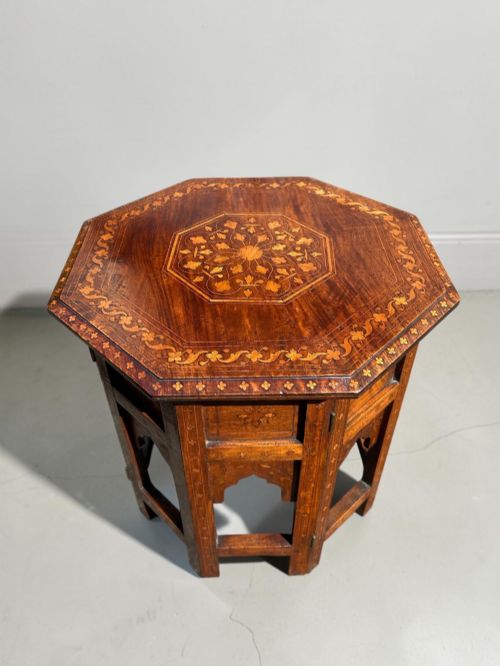
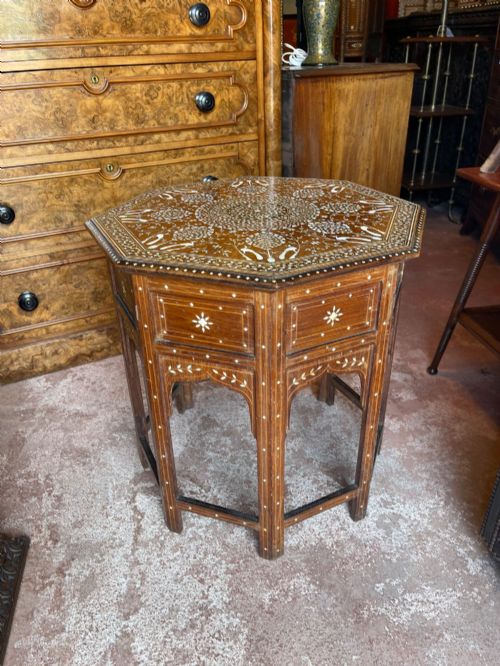
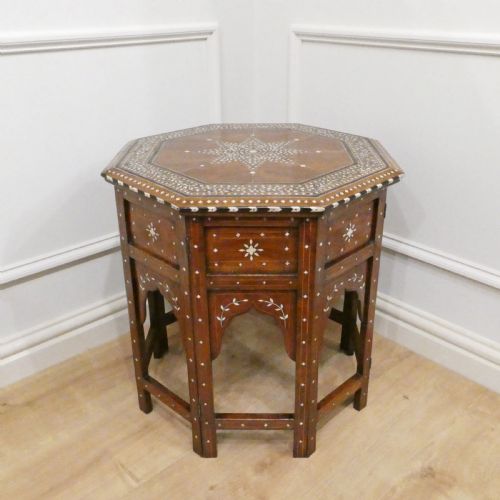


Teak Inlay Occasional Table
These teak inlay occasional table pieces bring intricate hand-carved craftsmanship and contrasting metalwork straight into a room.
Teak Inlay Occasional Table
A teak inlay occasional table is typically an Anglo-Indian occasional or side table originating across the nineteenth and early twentieth centuries, spanning periods from eighteen ninety up to nineteen thirty. The selection centres heavily on octagonal forms alongside circular, oval, shield-shaped, and tripod coffee tables.
Most examples hail from Hoshiarpur, showcasing dense regional carving and geometric woodwork. Buyers encounter both rigid structures and clever fold-up formats designed for versatile placement.
How they were made
The primary carcass relies on teak and dense hardwoods, shaped through meticulous hand carving and fretted joinery. Artisans then embellish the wooden surfaces using contrasting inlay work.
Brass wire, sheet metal, bone, ebony, and rosewood are meticulously fitted into carved channels to create elaborate botanical and geometric patterns across the table tops.
Teak Inlay Occasional Table Retail Price Guide 2026
Typical asking prices for teak inlay occasional table among the pieces listed under this phrase on Sellingantiques today, from the lower quarter to the upper quarter. They describe what is for sale here now, not the wider market.
Some tables feature elephant motifs and Taj Mahal scenes, proving that nineteenth-century artisans understood the ultimate power of novelty.
What varies in quality
Quality rests entirely in the density and precision of the hand carving, alongside the complexity of the metal and bone inlay. Sharp, deep relief work distinguishes finer pieces from simpler, flatter surfaces.
The integrity of the timber and the tightness of the fitted brass or bone geometric motifs determine the overall refinement of each individual table.
The Teak Inlay Occasional Table Glossary
- Anglo-Indian
- Furniture made in India during the British colonial period, combining traditional local craftsmanship with European furniture forms. These pieces often feature dense surface carving and exotic timbers.
- Hoshiarpur
- A renowned centre for woodcarving in Punjab, famous for producing intricately patterned furniture embellished with bone and brass inlay. Pieces from this region frequently utilise folding or octagonal designs.
- Occasional table
- A small, lightweight table designed for flexible placement around a living space to serve momentary needs. They appear in diverse shapes including circular, oval, and shield formats.
- Inlay
- A decorative technique where contrasting materials such as brass, bone, or ebony are embedded flush into the wood surface. This creates intricate geometric or floral patterns.
Teak Inlay Occasional Table: Frequently Asked Questions
How do I style an octagonal table?
An octagonal table works well as a central focal point or beside a sofa where its detailed top can be fully appreciated. Its geometric form contrasts nicely with upholstered seating.
Many versions also feature folding bases, making them easy to reposition or store when floor space is needed.
What woods are typically used?
The primary structural timber is teak, valued for its durability and rich grain. Other dense hardwoods also appear across the various nineteenth and early twentieth-century examples.
Accents of rosewood and ebony frequently complement the lighter teak bases and metallic inlays.
How are brass and bone inlay secured?
Artisans carve precise channels into the wooden tabletop and carefully hammer or press the brass wire, sheet pieces, or carved bone directly into place. The surrounding wood holds the contrasting materials snug.
This painstaking method creates a smooth, decorative surface that catches the light.