
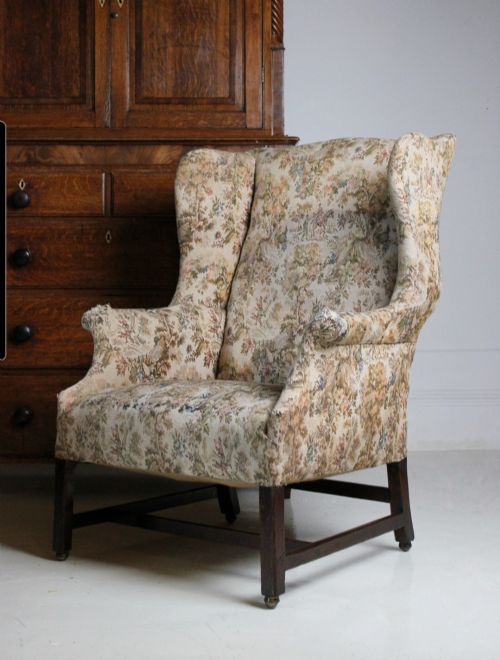
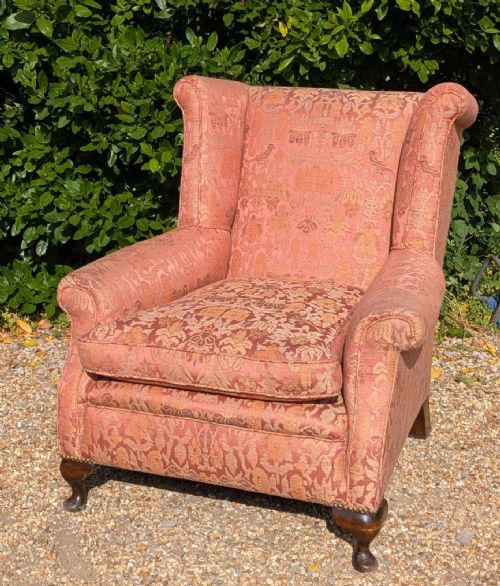
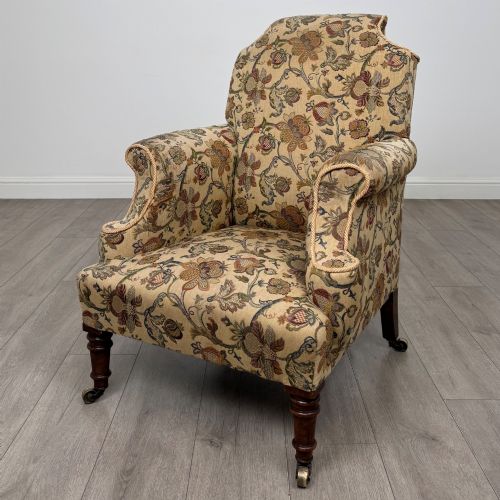

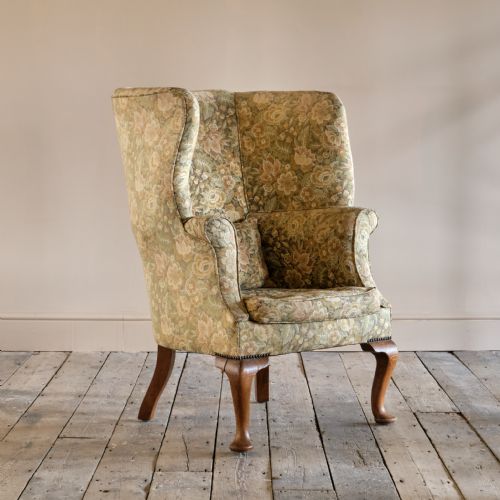


Tapestry Wing Armchair
These tapestry wing armchair selections offer deep-seated comfort and historic character, bringing traditional upholstery and sheltering wings into a living space.
Tapestry Wing Armchair
When you search for a tapestry wing armchair, you are looking at substantial seating designed to protect against draughts while adding texture to a room. These pieces combine deep seats with high backs and characteristic side panels known as wings.
The versions you are most likely to meet on this page span from the Victorian and Edwardian eras into the early twentieth century. Listings include barrel-backed forms, high-back library chairs, and examples executed in Queen Anne, Georgian, and Jacobean revival styles.
Originating across British and French traditions, these armchairs frequently feature robust frames paired with woven textile coverings. Pieces range from fireside models ready for re-upholstery to matched pairs with historic upholstery intact.
How they were made
The foundational frames of these chairs rely on sturdy hardwoods such as mahogany and walnut, providing the structural integrity required for high-backed seating. Timber components are often shaped into cabriole or claw and ball legs depending on the prevailing historical revival style.
Upholstery techniques bring together traditional stuffing and heavy woven tapestry fabric or tapestry upholstery. Feather filling appears in specific pieces to provide soft seat cushioning beneath the outer textile layers.
Forest claw and ball feet give these heavy Victorian chairs an unexpectedly fierce grip on the drawing room floor.
What varies in quality
Quality in these armchairs rests upon the integrity of the wooden framework and the fidelity of the revival style employed. Finer examples display crisply carved walnut or mahogany details, balanced proportions, and substantial construction that supports the high back and wings.
The execution of the textile covering dictates much of the character, distinguishing standard production from exceptional work. Woven tapestry fabrics with dense pictorial designs or historic motifs elevate the overall presence of the armchair.
William Morris
The Tapestry Wing Armchair Glossary
- Wingback
- A chair design featuring projecting side panels attached to the arms or back, originally intended to shield the sitter from draughts. These panels define the silhouette of the armchair.
- Tapestry upholstery
- A heavy, decorative woven fabric featuring pictorial or repeating patterns used to cover furniture. This textile provides a textured surface characteristic of traditional fireside seating.
- Cabriole leg
- A furniture leg that curves outward in a convex arc and tapers inward in a concave arc, frequently ending in a claw and ball foot. It is a defining feature of Queen Anne and Georgian style pieces.
- Barrel back
- A seating form where the upholstered back curves continuously around to form the arms in a circular enclosure. This style offers a particularly enclosed and supportive seat.
Tapestry Wing Armchair: Frequently Asked Questions
What is a tapestry wing armchair?
It is a high-backed seat featuring protective side wings and heavy woven textile upholstery. These chairs were designed to provide warmth and comfortable support by the fireside.
Surviving examples range from the Victorian and Edwardian eras into the early twentieth century, often following earlier Queen Anne or Georgian design traditions.
Are these chairs comfortable for daily use?
Yes, many of these armchairs provide deep seating and supportive high backs intended for regular relaxation. Feather-filled cushions and sturdy hardwood frames contribute to their enduring usability.
Some pieces require re-upholstery before daily use, allowing you to restore the internal padding while preserving the historic frame.
What styles are common in these armchairs?
Common styles include Queen Anne revival, Georgian, Jacobean revival, and Victorian interpretations. Each style brings distinct leg shapes, such as cabriole or claw and ball supports, to the basic wingback form.
Art Nouveau touches and French carved details also appear among the listings, reflecting the diverse design influences of the nineteenth and early twentieth centuries.