
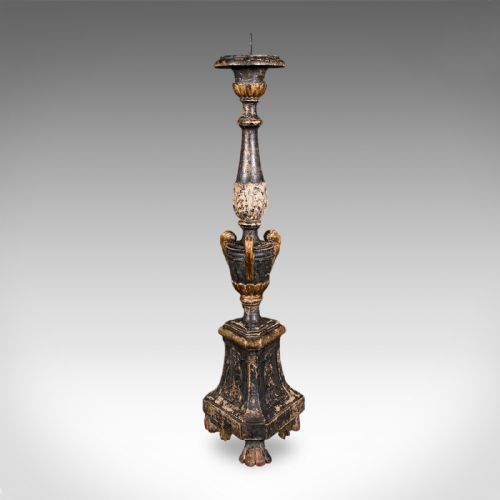


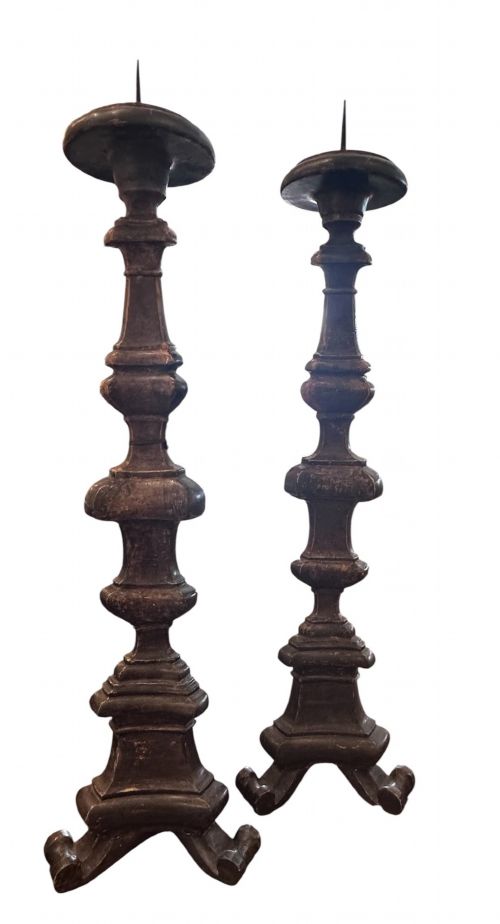


Tall Wooden Pricket Holder
These tall wooden pricket holder pieces are altar-style candlesticks designed with an upright spike to secure large candles.
Tall Wooden Pricket Holder
A tall wooden pricket holder is typically encountered as an altar-type candle holder or torchere originating from Italian and French workshops, spanning the eighteenth and nineteenth centuries. These pieces function primarily as commanding candlesticks or centrepieces, occasionally adapted later into table lamps.
The forms range from baroque style giltwood altar sticks to ebonised Georgian candlesticks and French silver leaf designs. Buyers frequently encounter nineteenth-century Italian carved pinewood and giltwood interpretations alongside larger eighteenth-century examples.
Materials and construction methods
Makers utilised carved wood and pinewood as the primary structural body, often applying gesso layers to prepare the surface for subsequent ornamentation. Giltwood, silver leaf, and paint finishes were then applied to achieve rich, decorative ecclesiastical surfaces.
Metal components such as iron and brass occasionally appear on these prickets, particularly on the central spike or structural fittings that hold the candle in place. The construction relies heavily on traditional artisan joinery suited to large decorative chapel and altar furnishings.
Listings for tall wooden pricket holder examples span the eighteenth and nineteenth centuries, featuring Italian and French origins.
Distinctions in quality and execution
The finesse of the hand-carving defines the upper tier of these pieces, distinguishing fluid, deeply carved acanthus and baroque motifs from rigid or shallow execution. Original surface treatments, such as genuine period giltwood or silver leaf over gesso, carry greater visual depth than later repainting.
Proportion and scale dictate the presence of the object, with larger altar-type torchere pieces commanding attention through substantial timber framing. The integrity of the original pricket spike relative to the wooden socket also separates utilitarian survivals from heavily altered conversions.
The Tall Wooden Pricket Holder Glossary
- Pricket
- A sharp metal spike on a candlestick designed to impale the base of a large candle and hold it upright. This form is common in ecclesiastical settings.
- Torchere
- A tall stand or ornamental candlestick originally intended to carry a torch or heavy candle. These pieces often feature prominent turned or carved wooden shafts.
- Giltwood
- Timber that has been coated with a thin layer of gold leaf or gold paint over gesso. It provides a luminous surface finish on baroque and neoclassical furnishings.
- Gesso
- A plaster-like mixture applied to wood to create a smooth surface for gilding or painting. It allows intricate relief details to be modelled before leaf application.
Tall Wooden Pricket Holder: Frequently Asked Questions
What is a pricket holder?
A pricket holder is a type of candle holder that uses an upright metal spike rather than a socket to secure the candle.
Historically utilised on altars, these pieces supported large wax tapers used in ecclesiastical ceremonies and large domestic spaces.
How were tall wooden pricket holders used?
These items served as prominent altar sticks, torchere stands, or large decorative centrepieces in chapels and grand rooms.
Their substantial height ensured that candlelight illuminated large spaces effectively during services or evening gatherings.
How do I style a tall wooden pricket holder?
These pieces function well as freestanding floor torchere displays or as striking focal points on large tables and sideboards.
Due to their height and decorated giltwood or painted finishes, they require minimal additional ornamentation around them.
How can I tell the period of a wooden pricket?
Dating relies on examining the carving style, such as baroque scrolls or neoclassical symmetry, alongside the underlying timber and gesso.
Eighteenth-century examples often exhibit heavier proportions and deeper hand-carved relief work compared to later nineteenth-century interpretations.