
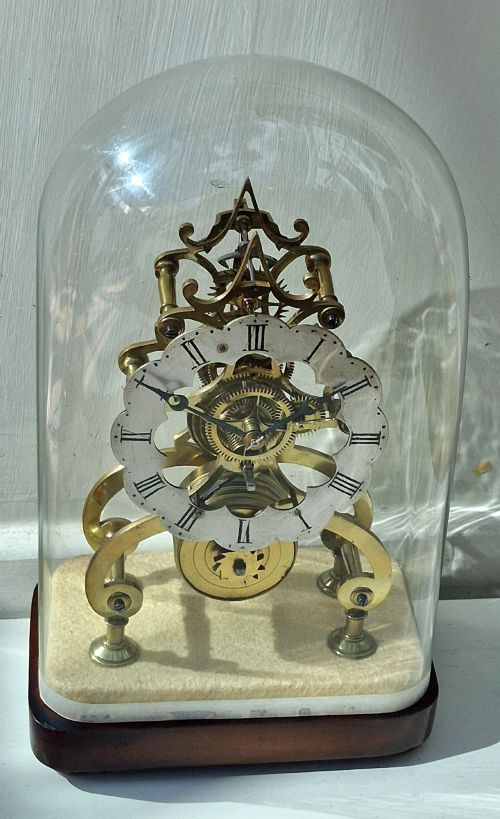
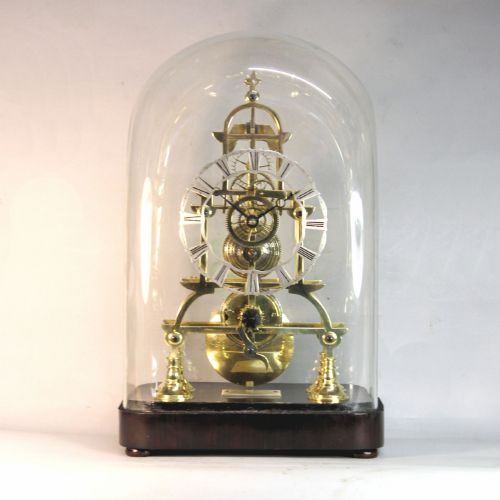


Table Skeleton Clock
A table skeleton clock strips away the traditional wooden case to expose the intricate brass gear train within.
Table Skeleton Clock
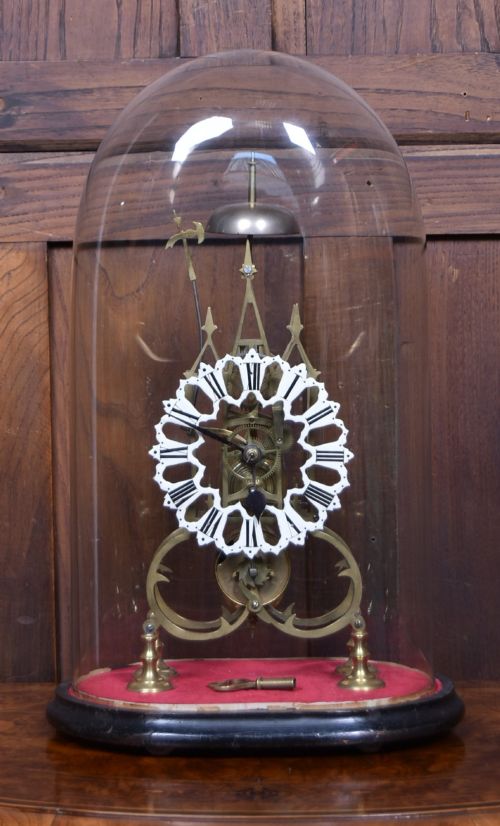
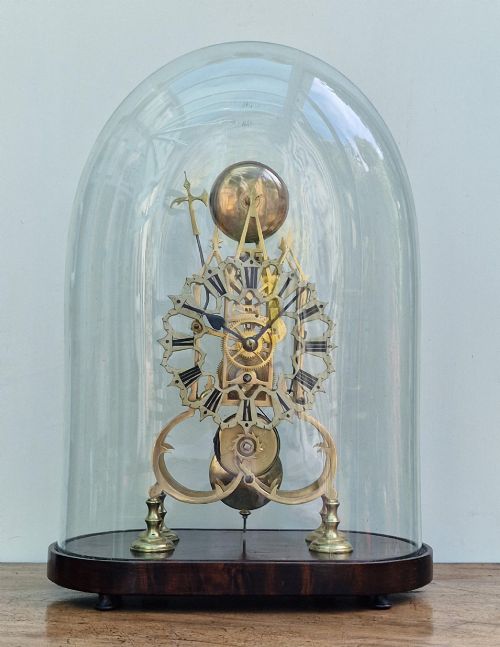
A table skeleton clock exposes its brass movement to view, often protected beneath a glass dome. These pieces emerge primarily from the Victorian period, alongside French nineteenth-century examples and twentieth-century electric iterations.
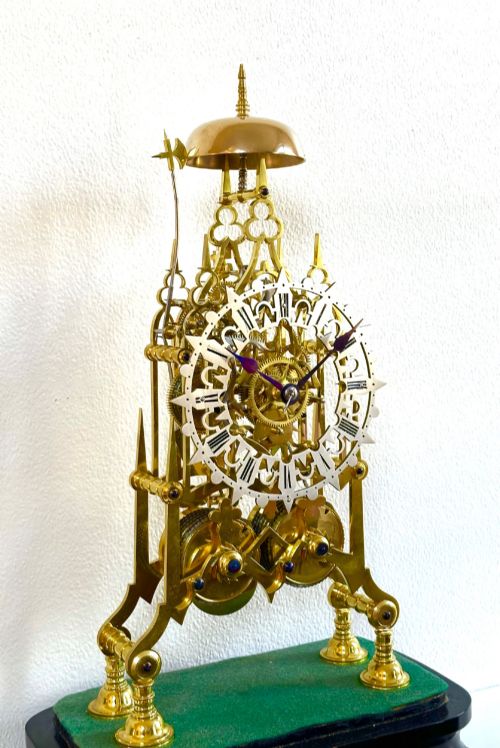
The form ranges from traditional English fusee movements to miniature Gothic designs and later Swiss inline timepieces. Most sit upon a wooden or marble plinth, displaying the mechanics of time to the room.
Materials and construction
Makers constructed the open frameworks and gear trains predominantly from brass and steel, housing delicate enamel chapter rings for the dial. Bases utilise mahogany, ebonised wood, or marble to anchor the heavy movement.
Protection came from blown glass domes or four-glass brass cases that shielded the exposed mechanisms from dust while offering an all-round view of the passing strike or fusee movement.
The inventory records mechanical fusee movements alongside twentieth-century electric calibres and precision perpetual motion desk pieces.
Distinctions in quality
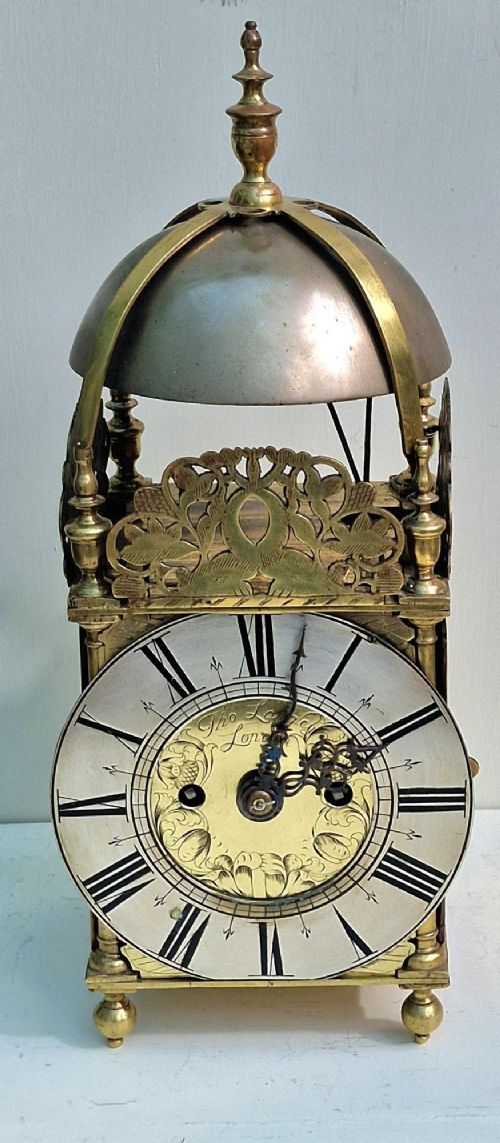
Quality rests in the precision of the brass cutting and the complexity of the escapement, such as double fusee or coup perdu detent systems. Finer examples feature hand-engraved dial plates and superior finishing on every exposed wheel and pinion.
The integrity of the original glass dome and the matching quality of the wooden or marble base distinguish well-preserved specimens from those assembled with later replacements.
Thomas Langley·Richard Winter·Maurice & Marcel Moulin Favre-Bulle·Thwaites of London·William Evans·Jaeger-LeCoultre·Thwaites & Reed·E White Of Manchester
The Table Skeleton Clock Glossary
- Fusee
- A conical pulley used in clockwork to maintain equal force on the gear train as the mainspring unwinds. This mechanism ensures more accurate timekeeping throughout the power reserve.
- Skeleton clock
- A clock designed with an open metal framework that reveals the entire gear train and movement. The dial is often reduced to a narrow chapter ring.
- Four glass clock
- A mantel clock housed in a brass-framed case with glass panels on all four sides and the top. This style provides unobstructed visibility of the movement.
- Chapter ring
- The circular band on a clock face that bears the numerals for the hours. On these pieces, they are frequently enamelled white.
- Escapement
- The mechanical linkage that controls the release of power to the gear train and gives the clock its tick. Finer models incorporate specialised escapements like the coup perdu.
Table Skeleton Clock: Frequently Asked Questions
How do I wind a fusee skeleton clock?
Use the appropriate winding key on the arbour found on the dial or movement plate. Turn it gently until resistance indicates the mainspring is fully tensioned.
Take care not to overwind, and ensure the gut line or chain on the fusee drum remains properly seated during the process.
Why does the glass dome matter?
The glass dome protects the delicate, exposed brass mechanism from airborne dust and accidental knocks. Many original domes survive and add significantly to the integrity of the piece.
Lifting the dome requires caution, using both hands and holding it by the base rather than any top knob unless securely fixed.
How do I tell English and French clocks apart?
English examples often feature robust fusee movements designed for heavy duty and long power reserves. Their architecture tends toward architectural symmetry and substantial wooden bases.
French models frequently employ spring-driven platforms or four-glass cases with distinct striking trains. They lean towards decorative elegance and delicate proportions.