




Swedish Painted Footstools
These Swedish painted footstools bring understated Nordic elegance to a room, offering practical seating with timeless painted wooden frames.
Swedish Painted Footstools
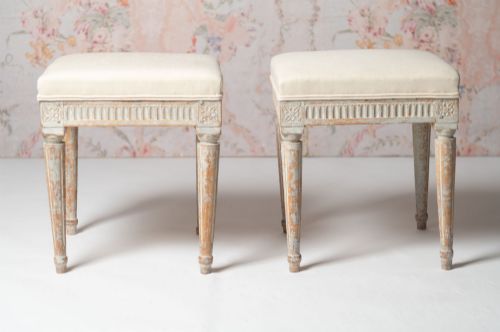
Swedish painted footstools are low seating forms originating from the eighteenth and nineteenth centuries, often appearing in pairs across the listings. You are most likely to encounter nineteenth century examples alongside eighteenth century pieces built in the Gustavian style.
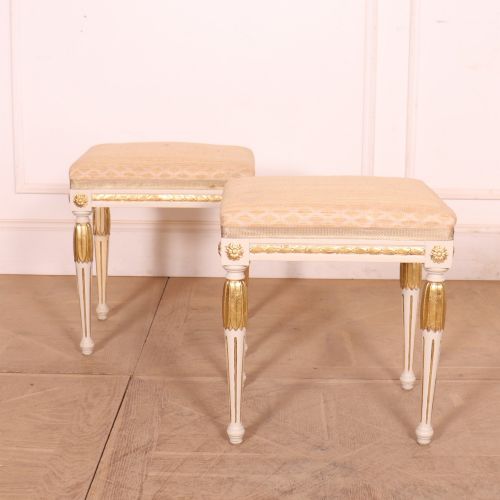
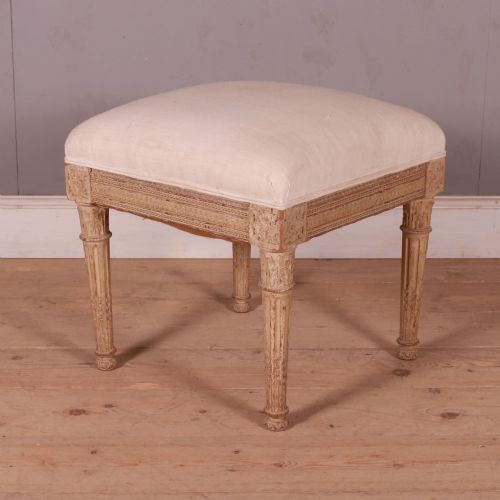
These stools and ottomans typically feature painted wood constructions, sometimes enhanced with parcel gilt or gold leaf detailing. The forms range from simple low stools to carved wooden variants upholstered in fabric or linen.
How they were made
Craftsmen built these pieces from wood, shaping the frames through traditional carving techniques before applying layers of paint. Many examples incorporate parcel gilt highlights or gold leaf accents directly onto the painted wooden surfaces.
Upholstery completed the pieces, utilising durable materials like fabric and linen to pad the low seats for domestic use.
Several listings arrive in matched pairs, perfect for symmetrical positioning in a tidy hallway.
What varies in quality
Quality rests upon the crispness of the carved wooden detailing and the preservation of the original painted surface. Finer examples show careful hand-carving and sophisticated application of parcel gilt or gold leaf.
The integrity of the wooden frame and the choice of textile upholstery also distinguish standard production from superior pieces.
The Swedish Painted Footstools Glossary
- Gustavian
- The Swedish neoclassical style spanning the late eighteenth century, characterised by restrained carving and light painted finishes. This aesthetic defines many of the stools found in Scandinavian interiors.
- Parcel Gilt
- A decorative technique where specific raised portions of a wooden surface are highlighted with gold leaf. It creates a subtle contrast against the main painted finish.
- Gilt Wood
- Wood that has been thinly coated with gold leaf or gold paint for decorative effect. This finish adds brightness to the carved details of antique seating.
- Ottoman
- A low upholstered seat or footstool without a back or arms. These pieces provide versatile resting places in traditional rooms.
Swedish Painted Footstools: Frequently Asked Questions
How do I date these stools?
Dating relies on stylistic markers such as neoclassical Gustavian proportions and the character of the painted wood finish.
Eighteenth century examples generally display finer hand-carving compared to later nineteenth century pieces.
Are pairs common?
Many listings feature matching pairs of stools rather than isolated single pieces.
Pairs often originate from nineteenth century workshops and share identical painted finishes and carved details.
What is parcel gilt?
Parcel gilt involves applying gold leaf selectively to specific raised carved elements on the painted wooden frame.
This technique accentuates the craftsmanship without overwhelming the restrained Nordic aesthetic.
Where should I place a low stool?
These compact pieces function well as footstools before armchairs or as occasional low seating in living spaces.
Their restrained painted frames integrate easily into both traditional and modern interiors.